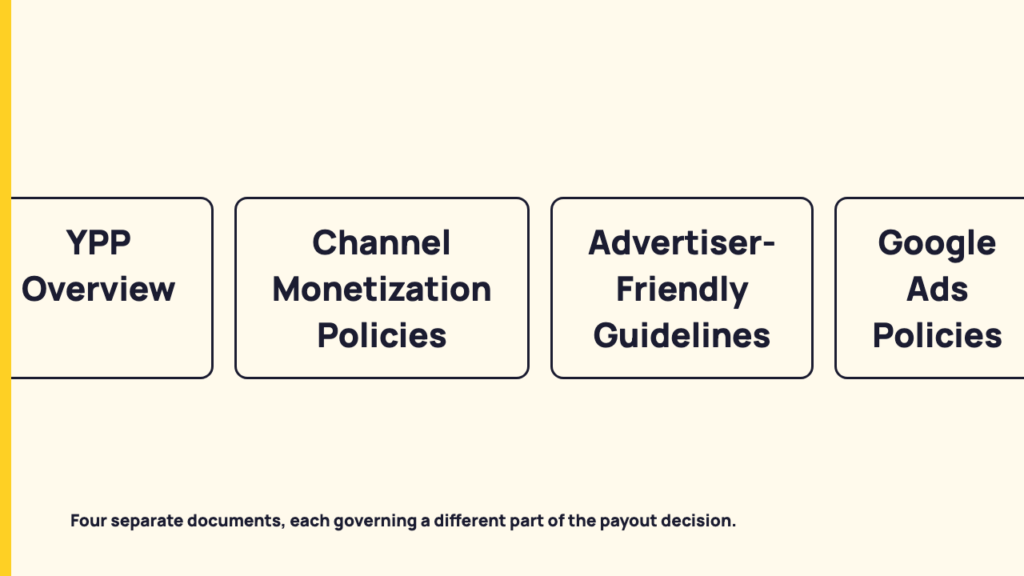
You hit the subscriber count. You hit the watch hours. You applied to the YouTube Partner Program and you were still turned down, or you were admitted and then a stack of your videos stopped earning. The forums fill up with guesses. The actual answer is almost always written down, just not on the page you signed up from. YouTube governs a single payout decision with several separate published documents, and the sign-up page quietly hands off to the ones that do the disqualifying. This is a map of which document decides what, so you can point at the exact rule behind a rejection instead of arguing with a forum.
What the sign-up page actually promises, and what it stops short of
The YouTube Partner Program overview page states the entry thresholds in plain language. Fetched on 2026-09-14, it lists two paths to eligibility: “Get 1,000 subscribers with 4,000 qualified watch hours in the last 12 months,” or “Get 1,000 subscribers with 10 million qualified Shorts views in the last 90 days.” That is the number every applicant knows. It is also the last number the page fully owns.
The same page does not restate what would disqualify you. Under “What you need to join” it says: “Follow the YouTube channel monetization policies. These are a collection of policies and guidelines that allow you to monetize on YouTube.” It then links out to that separate document rather than reproducing it. The how-to-earn page carries the same handoff, stated even more flatly: “Only channels that follow our YouTube channel monetization policies may be able to monetize.”
Read those two sentences carefully, because the whole confusion lives in them. Clearing the threshold is admission to apply. It is not a promise that your channel qualifies, and it is certainly not a promise that any given video earns. The number gets you to the door. Four other documents decide whether you walk through it, and they are not printed on the door.
The document most applicants never open: channel monetization policies
The rule that rejects channels which technically cleared the threshold sits on the channel monetization policies page, not the sign-up page. This is the document the overview links to and does not repeat, and it is the one most applicants never open before they apply.
On that page, fetched 2026-09-14, the reused content policy is defined verbatim: “Reused content refers to channels that repurpose content that’s already on YouTube or another online source without adding significant original commentary, substantive modifications, or educational or entertainment value.” The same page notes that this policy “reviews content like commentary, clips, compilations, and reaction videos.”
That single definition is why a channel can pass the numbers and still be turned away. A library of compilations, reaction clips laid over someone else’s footage, or lightly re-edited third-party video can accumulate 1,000 subscribers and 4,000 watch hours and still fail here, because the question the reviewer is asking is not “how big” but “how original.” The page also documents a related rule: as of an update dated July 15, 2025, the policy formerly called “repetitious content” was renamed to “inauthentic content,” and YouTube states it clarified this “includes content that is repetitive or mass-produced.” None of that language appears on the sign-up page. If you only ever read the threshold, you never read the rule that failed you.
Advertiser-friendly guidelines: the per-video layer that decides earnings
Getting the channel monetized is not the end of it. There is a third document, the advertiser-friendly content guidelines, and it operates at the level of the individual video rather than the channel. This is why a fully monetized channel can still have specific videos earn nothing. The guidelines page, fetched 2026-09-14, names the categories it treats as not suitable for the full range of advertising. Quoted from the page, “all the main topics that are not advertiser-friendly” are:
- Inappropriate language
- Violence
- Adult content
- Shocking content
- Harmful acts and unreliable content
- Hateful & derogatory content
- Recreational drugs and drug-related content
- Firearms-related content
- Controversial issues
- Sensitive events
- Enabling dishonest behavior
- Inappropriate content for kids and families
- Incendiary and demeaning
- Tobacco-related content
The important structural point is not the list itself but where it applies. Channel monetization policies, from the previous section, decide whether the channel is in the program at all. The advertiser-friendly guidelines are assessed against each video. A monetized channel that posts one video touching a category above can see that single video’s advertising restricted while the rest of the channel keeps earning. The advertiser-friendly guidelines also reserve a channel-level consequence: it states YouTube “may reserve the right to disable ads on your entire channel in situations where the majority of your content is” not suitable. So the per-video layer can escalate, but by default it is per video, which is exactly the distinction the earlier channel-level sections do not cover.
Where a threshold hides its definition
The headline threshold and the definition of what it actually counts live in two different places, and that gap is how a creator can honestly believe they qualify and be wrong. The overview page states 4,000 watch hours. The definition of which hours count is further down the same document, and it is narrow.
Quoted from the overview page, fetched 2026-09-14: “What counts as a qualified watch hour: Qualified watch hours gained from long-form videos you’ve set public.” The page then lists what does not count toward the thresholds: “Private videos, Unlisted videos, Deleted videos, Ad campaigns, YouTube Shorts, Livestreams that are unlisted, deleted, or not converted to VOD.” There is a further trap for anyone counting Shorts: the page states that “any qualified watch hours from Shorts views in the Shorts Feed won’t count towards the 4,000 qualified public watch hours threshold.” The Shorts path is its own separate threshold, 10 million qualified Shorts views in the last 90 days, and the page defines a qualified Short view as one “from Shorts you’ve set public that appear in the Shorts Feed,” excluding private, unlisted, deleted Shorts and ad campaigns.
Read that against a real dashboard and the mismatch is obvious. A creator watching total watch time climb, including private uploads, deleted experiments, and Shorts, can cross what looks like 4,000 hours in their own analytics and still be short of the qualified figure YouTube counts. The number on the marketing surface and the measurement rule that defines it are not printed together, which is precisely how the belief and the reality diverge.
Reading a rejection against the four documents
If you were rejected or demonetized, the useful move is to match the failure mode to the document that governs it, then open that document first. The table below is that map. It reads published policy only. It cannot tell you why your specific channel was actioned, because YouTube does not publish individual decisions, and no honest desk reading can reconstruct one. What it can do is tell you which page the rule you tripped is written on.
| What happened | Document that governs it | The specific rule |
|---|---|---|
| Rejected while below the numbers | YPP overview and eligibility page | 1,000 subscribers with 4,000 qualified public watch hours in 12 months, or 10 million qualified Shorts views in 90 days, counting only public long-form or public Shorts-Feed views |
| Rejected after clearing the numbers | Channel monetization policies | Reused content, and the renamed inauthentic (formerly repetitious) content policy |
| Individual video earns little or nothing while the channel stays monetized | Advertiser-friendly content guidelines | The fourteen not-advertiser-friendly categories, assessed per video |
| Ads behaving oddly at the ad-serving layer | Google Ads policies | The advertising rules that sit beneath the monetization documents and govern what may be served |
The reading order after a rejection is the same order these documents hand off to each other: the overview page for the threshold definition, the channel monetization policies for reused and inauthentic content, the advertiser-friendly guidelines for the per-video categories, and the Google Ads policies underneath. This same discipline of reading the exact published document rather than the folklore is the point of what the platforms actually document about restrictions, and it is the same reason a Content ID claim is not a strike: two separate YouTube documents govern outcomes creators routinely treat as one.
FAQ
Does hitting the subscriber and watch-hour threshold guarantee monetization?
No. The YPP overview page states the thresholds as eligibility to apply, and directly requires you to “Follow the YouTube channel monetization policies,” which it links to rather than restates. Those channel monetization policies, and the advertiser-friendly content guidelines applied per video, still decide the outcome. The number is admission to the queue, not approval.
What is the reused content rule, and where is it published?
It is published on the channel monetization policies page, not the sign-up page. Quoted verbatim, fetched 2026-09-14: “Reused content refers to channels that repurpose content that’s already on YouTube or another online source without adding significant original commentary, substantive modifications, or educational or entertainment value.” The page states this policy reviews content such as commentary, clips, compilations, and reaction videos. Source: https://support.google.com/youtube/answer/1311392
Sources
- YouTube Partner Program overview and eligibility, support.google.com/youtube/answer/72851, fetched 2026-09-14
- How to earn money on YouTube, support.google.com/youtube/answer/72857, fetched 2026-09-14
- YouTube channel monetization policies, support.google.com/youtube/answer/1311392, fetched 2026-09-14
- Advertiser-friendly content guidelines, support.google.com/youtube/answer/6162278, fetched 2026-09-14
- Google Ads policies, support.google.com/adspolicy/answer/6008942, fetched 2026-09-14
- YouTube creators earn overview, youtube.com/creators/earn/overview, fetched 2026-09-14