Suppose you are asked to “just keep an eye on” the brand account over a launch weekend. Nobody mentions hours, a roster or a named backup. The platform will send alerts to your phone, customers may message, and a manager may text at 11pm. You want to know whether any official text speaks to that situation, or whether the right to disconnect is something people say without checking what it says.
That scenario is a hypothetical, not a reported case. This post makes no claim about how often it happens or how social teams handle it. It reads published legal text for one jurisdiction, Australia, and it is not legal advice. The single question is whether the Fair Work Act 2009 (Cth) says anything that bears on a person asked to monitor an account out of hours. The answer is: partly, and the gaps matter as much as the words.
What the Fair Work Act actually provides
In Australia, the right to disconnect sits in section 333M of the Fair Work Act 2009 (Cth), in Part 2-9, Division 6. I read it from the Act’s published Word compilation (compilation 73, register ID C2026C00355, in force from 7 July 2026, per the legislation.gov.au API). The wording is short. Subsection 333M(1) says:
An employee may refuse to monitor, read or respond to contact, or attempted contact, from an employer outside of the employee’s working hours unless the refusal is unreasonable.
Subsection 333M(2) does the same for a third party, provided the contact or attempted contact “relates to their work” and falls outside the employee’s working hours. So the text reaches beyond the employer. A customer message or a platform notification is the sort of thing a reader will ask about, but the Act speaks of “contact, or attempted contact” from “a third party” and says nothing specific about automated alerts. Whether an alert counts is a reading, not a settled point.
Two further subsections are worth knowing. Subsection 333M(5) says a refusal will be unreasonable if the contact is required under a law of the Commonwealth, a State or a Territory. Subsection 333M(6) says that if an employee is covered by an enterprise agreement with a right to disconnect term more favourable than subsections (1) and (2), the agreement’s term continues to apply.
On dates, the provision was inserted by the Fair Work Legislation Amendment (Closing Loopholes No. 2) Act 2024. That Act’s commencement table gives 26 August 2024 for Schedule 1, Part 8, which is the right to disconnect part. For small business employers, the Act’s application provisions (clause 111D) say the amendments made by Part 8 do not apply to an employer that is a small business employer on the day of commencement, or to its employees, “for a period of 12 months beginning on that day”. I have not converted that into a calendar date, because the source does not state one.
The test that decides it: when is a refusal “unreasonable”?
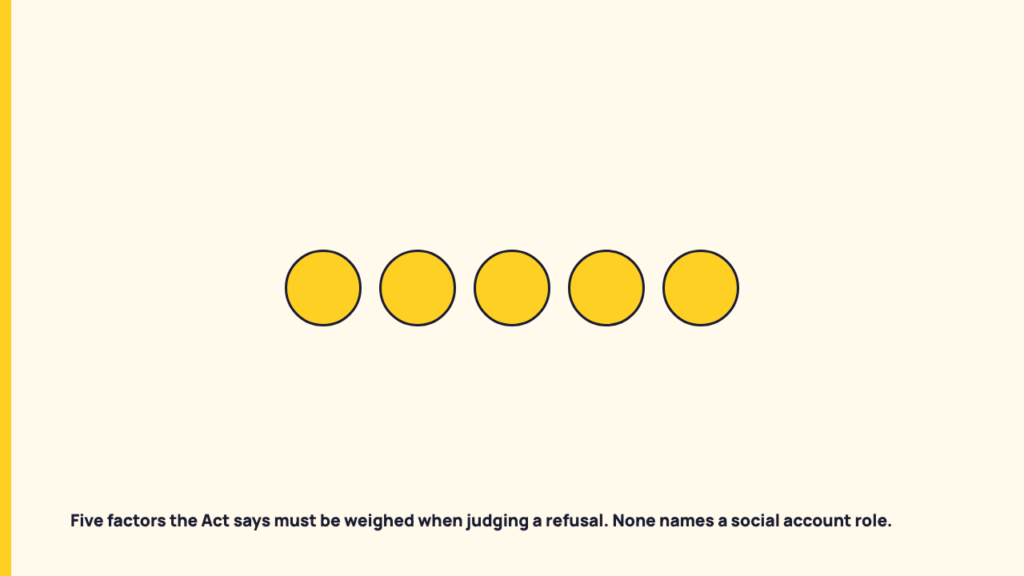
The right is not absolute. Everything turns on the word “unreasonable”. Subsection 333M(3) lists matters that “must be taken into account”, without limiting what else may be considered. The text sets out factors to weigh. It does not list roles or industries that are exempt or covered. The table gives each factor in the Act’s order and wording, with a question to bring to the weekend-launch hypothetical. These are questions, not conclusions.
| Factor as the Act words it | What to ask about the weekend launch |
|---|---|
| (a) the reason for the contact or attempted contact | What is each alert or message actually about? Is it a routine notification or something that cannot wait? |
| (b) how the contact or attempted contact is made and the level of disruption the contact or attempted contact causes the employee | Is it a phone call, a text, a platform push alert? How often, and at what hours does it land? |
| (c) the extent to which the employee is compensated to remain available to perform work during the period in which the contact is made, or for working additional hours outside ordinary hours of work (the Act’s note says this includes any nonmonetary compensation) | Is anything given in return for being reachable on this weekend, in any form? Is it written down anywhere? |
| (d) the nature of the employee’s role and the employee’s level of responsibility | Does your role description mention account monitoring or crisis response? How much authority do you have to act on what you see? |
| (e) the employee’s personal circumstances (including family or caring responsibilities) | What else are you responsible for that weekend, and does anyone at work know? |
Where the text is silent about a job built around being reachable
This is a reading of the text, not a legal conclusion. I searched the full text of sections 333M to 333R for “social”, “scheduled” and “roster”. None appears. The word “monitor” appears only in the phrase “refuse to monitor, read or respond to contact”. The provision is framed around refusing contact outside working hours, and it turns on “unreasonable”. It does not, in those sections, define what a particular role’s working hours are, and it does not name social accounts, scheduled posting or monitoring duties.
That leaves a reader in one of at least three positions, and the Act does not settle where the line falls between them.
- Ad hoc contact from a manager. Subsection (1) applies directly, and factors (a), (b) and (e) are the obvious ones: why the manager is reaching out, how, and what it costs you personally.
- Monitoring that is a stated part of the role or of an agreed roster. Factor (d) is the likely focus, since it asks about the nature of the role. Factor (c) may also be in play if the roster comes with anything in return.
- Being compensated to be available. Factor (c) names this directly, as compensation “to remain available to perform work”, including nonmonetary compensation. How much weight it carries against the others is not stated.
Authoritative answers come from elsewhere: the regulator, the terms of an award or enterprise agreement (subsection 333M(6) points to enterprise agreement terms), or a lawyer. This post is none of those.
What the regulator says, or why this post does not quote it
The Fair Work Ombudsman’s own guidance could not be retrieved while this was written: fairwork.gov.au did not respond to requests made in this session. So this post rests on the Act’s text alone. Check the regulator’s current page before relying on any reading here. Subdivision B of the Act also says disputes should first be attempted to be resolved at the workplace level and then may be taken to the Fair Work Commission (section 333N), which is the process the text itself describes.
Who the text does not reach, and what other jurisdictions do
- Section 333M is about employees. People working as contractors sit outside employee protections generally. For the status question, which is a separate one, see how the IRS common-law test separates employees from contractors. That post covers the US test, not the Australian one.
- This post covers Australia only. I could not read primary text for any other jurisdiction in this session, so I make no comparison.
What to take from this, and what to check before the weekend
Here are things to look up in your own paperwork, not instructions:
- Does your contract, award or enterprise agreement mention monitoring or on-call duties, or a right to disconnect term of its own?
- Is availability compensated in any form, and is that written down?
- Is there a roster, and who is the named contact when something goes wrong?
- Is the request coming from your employer, or from a third party such as a customer or a platform?
The question of pay for hours worked is separate and belongs elsewhere; see what US federal pay tests turn on, which is a US-only discussion. To close: this is not legal advice, it covers Australia only, and the text leaves the question of monitoring as a duty to be decided on the facts.
Where to go from here
Read the provision yourself. It is a page long. Then take your specific questions to the Fair Work Ombudsman, a union or industrial association if you have one, or a qualified adviser.
FAQ
Does the right to disconnect mean a social media manager can ignore all weekend notifications?
The text does not say that. In Australia, section 333M of the Fair Work Act 2009 (Cth) lets an employee refuse to monitor, read or respond to contact outside working hours unless the refusal is unreasonable, and lists factors to weigh. It does not name social accounts, so the outcome turns on those factors. This is not legal advice.
When did the Australian right to disconnect begin?
The Act that inserted it gives 26 August 2024 as the commencement for Schedule 1, Part 8. For small business employers, the application provision says the amendments do not apply for 12 months beginning on that day.
Sources
- Fair Work Act 2009 (Cth), legislation.gov.au (HTTP 200, 4 November 2026; the page body is script-rendered, so the section text was read from the Act’s Word compilation C2026C00355 served by the legislation.gov.au API)
- legislation.gov.au API, Fair Work Act 2009 title record (HTTP 200, fetched 4 November 2026)
- Fair Work Act 2009 versions, legislation.gov.au (compilation list read via the API, fetched 4 November 2026)
- Fair Work Legislation Amendment (Closing Loopholes No. 2) Act 2024, legislation.gov.au (HTTP 200, commencement table read 4 November 2026)