Two things happened to the humble link post this year, five months apart.
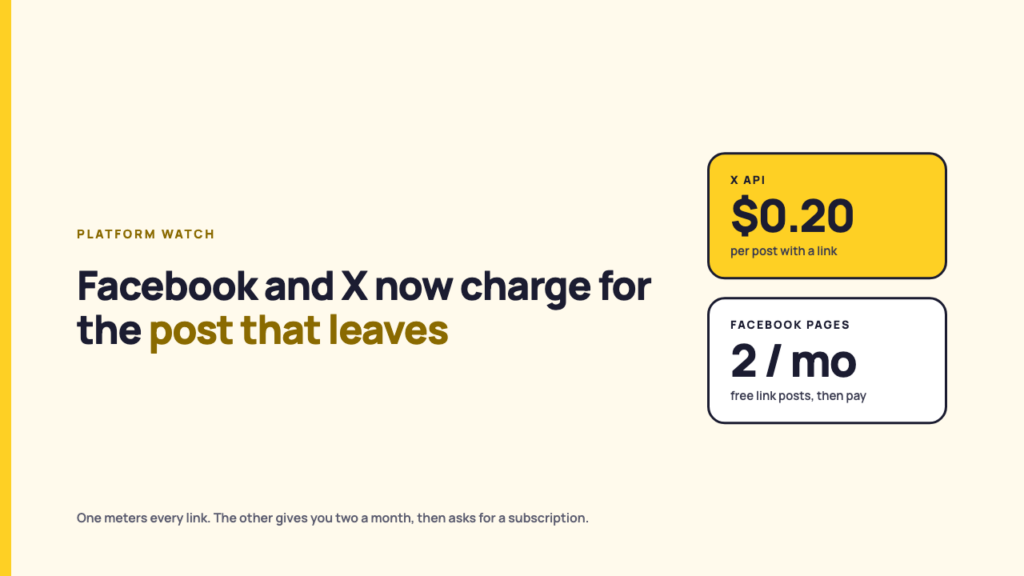
In April, X raised the price of publishing a post that contains a URL through its API from $0.01 to $0.20. A post without a link costs $0.015. So the link alone now makes a post about thirteen times more expensive to publish.
In September, Meta widened a test it started in December 2025. Facebook Pages without a paid subscription are limited to two organic link posts a month. Anything beyond that sits behind Meta One for Business, the paid tier Meta launched on 15 September.
It is tempting to read this as “the product was always the users, and now the users pay too.” I run a scheduling company that pays X for every link our customers post, so I have looked at this closely, and I do not think that reading is right. Nobody is charging people to post. What both platforms have put a price on is narrower and more deliberate: the post that sends someone somewhere else.
What actually changed, precisely
The details matter, because most of the coverage blurs them.
X. On 16 April the X developer team announced pricing changes effective 20 April 2026. On the current pricing page, Post: Create is $0.015 per request and Post: Create (with URL) is $0.200 per request. This is an API price. If you open the X app and paste a link into a post by hand, you pay nothing. The fee lands on anything that publishes through the API: scheduling tools, automations, news bots, your own scripts. X said the change was “designed to drive healthier developer behavior and curb vectors of misuse.”
Facebook. Meta’s original notice to affected accounts read: “Starting December 16, certain Facebook profiles without Meta Verified, including yours, will be limited to sharing links in 2 organic posts per month.” Meta called it “a limited test to understand whether the ability to publish an increased volume of posts with links adds additional value for Meta Verified subscribers.” In mid-September the test expanded alongside Meta One for Business. Three details matter, as reported:
- Publisher Pages, meaning news and media, are not in the test.
- Links in comments are not counted.
- It applies to organic posts. Ads are, of course, unaffected.
Meta’s own announcement lists “links in organic posts and reels” under the Advanced business tier, which starts at $49.99 a month. The entry tier starts at $14.99 and the top tier at $499.
Two different ways to bill the same thing
What is interesting is that the two platforms chose opposite pricing models.
X meters. Every link post costs the same twenty cents, whether you post one a month or one a minute. Small users pay a little, heavy users pay a lot, and the bill scales exactly with behaviour.
Meta gates. You get two free, then you subscribe. The price does not care whether your third link post of the month is your only one or the first of forty. It is a flat monthly fee per Page.
That difference changes who feels it. Here is the same posting plan billed both ways, using the listed prices.
| Who | Link posts a month | X: cost at $0.20 each | Facebook: cost to go past 2 |
|---|---|---|---|
| A local business, 1 account | 12 | $2.40 | $49.99 (Advanced, one Page) |
| A freelancer, 5 client accounts | 60 (12 each) | $12.00 | $249.95 (Advanced on 5 Pages) |
| An agency, 20 client accounts | 400 (20 each) | $80.00 | $999.80 (Advanced on 20 Pages) |
On X, a small business posting a link three times a week pays less than a cup of coffee a month. On Facebook, the same business either lives with two link posts or pays about fifty dollars a month for the privilege. For an agency, the Facebook side of this table costs more than many agencies pay for their entire social media toolset.
A caveat on that last column: it assumes each client Page needs its own Advanced subscription. If your clients already pay for Meta One for other reasons, the marginal cost of links is zero.
Was the link worth much anyway?
Here is the part that tempers the outrage. Meta publishes a quarterly Widely Viewed Content Report, and one of its standing lines is the share of US Feed views that went to posts with a link to somewhere outside Facebook.
For Q2 2026: “98.9% of the views in the US during Q2 2026 did not include a link to a source outside of Facebook.” The quarter before it was 98.7%.
So roughly one view in a hundred on Facebook’s US Feed is a view of a post with an outbound link. The cap did not kill the Facebook link post. The feed did that years ago. What the cap does is turn a format that was already quietly failing into one you are now explicitly asked to pay for.
X says something similar in a different way. Its head of product, Nikita Bier, told critics that “there is no code that is deboosting links,” and that “to succeed with links, the linked content must bleed into the post.” In plain terms: a headline and a URL was never going to do well. The post has to carry the value, and the link is a footnote.
So who is actually paying?
Look at who is exempt and who is not, and the pattern becomes clear.
On Facebook, publishers are exempt. They are the accounts that post the most links. The cap lands on business Pages: a clinic linking to its booking page, a shop linking to a product, a SaaS company linking to a blog post. Those are exactly the posts that, until now, were free versions of an ad. A business Page sending customers to its own website is the organic cousin of a traffic campaign, and Meta has always sold traffic campaigns.
On X, the person posting from the app pays nothing. The fee lands on software. That includes the spam networks X says it is targeting, and it also includes every business that uses a scheduler instead of posting by hand at 9am.
So the honest answer to “are the people now paying the platform?” is no. Businesses that use the platform to send traffic elsewhere are now paying the platform, one way or another. For casual users nothing has changed. For anyone who treats a social account as a distribution channel for their own site, the free ride on outbound links is ending, and it is ending in the two places where it was most established.
Is this the direction for everyone? I would not predict it. LinkedIn, Threads, Pinterest, Bluesky and TikTok have not put a price on links as of this week, and Pinterest in particular is built around the outbound click. What I would say is that when the two platforms most associated with link sharing both move in the same direction in the same year, it is worth planning as if a third might follow.
What to do about it, platform by platform
None of this needs a panic. It needs a change of habit.
On Facebook:
- Spend your two free link posts deliberately. A launch, an event, an offer with a deadline. Not your weekly blog roundup.
- Put the link in the first comment. Comment links are not counted against the cap as reported. There have been reports of Meta testing limits here too, so treat it as a current workaround, not a guarantee.
- Make the post itself the content. A carousel, a short video or a text post that makes the point in full, with “details in the comments” for anyone who wants more. Given the 1.1% figure, this was the better-performing format before the cap existed.
- Price the subscription against what the links are worth. If link posts drive real bookings for a client, $49.99 a month may be cheap. Check the click data before you decide either way.
On X:
- Know what the fee applies to. It is per post containing a URL, published through the API. A thread where only the last post carries the link costs twenty cents once, not per post.
- Cut links that are not doing work. If a post reads fine without the URL, drop it. Many automated feeds attached a link to every post out of habit.
- Keep the links that earn it. Twenty cents is trivial against a single conversion. The fee is a reason to audit, not a reason to stop.
How scheduling tools are handling the X fee
Because the X fee is charged to whoever calls the API, every scheduling tool had to decide what to do about it in April. There were broadly three responses: drop X support, absorb the cost quietly into plan prices, or pass the cost through to the customer who posts the link.
We went with the third. RecurPost added a prepaid X link wallet in the week after the change. A post with a link draws $0.20 from the wallet when it goes out, and if the post never reaches X (a failed media upload, a retry), the charge is refunded. Posts without links do not touch the wallet at all; we cover those. The reason was simple: a flat price increase would have made customers who never post links subsidise the ones who post hundreds.
It is not the only reasonable choice. A tool that bundles the fee into a higher plan price is easier to budget for. A tool that drops X is being honest that it does not want the cost. What I would check, whichever tool you use, is which of the three it chose. The worst outcome is the fourth option: a tool that neither charges nor warns, and link posts that start failing without a clear reason.
What this cannot tell you
- Meta’s link cap is still described as a test. Not every Page is in it, and the exact tier that unlocks Facebook links, and how many, may differ by account and region. Check the notice on your own Page.
- The cost table uses list prices as announced. Meta lists its business tiers as “starting at,” so real prices can be higher.
- The 98.9% figure covers US Feed views of widely viewed content. It says nothing about clicks, and it is not specific to business Pages.
- X’s API prices are, in X’s own words, “subject to change.” The current rate is on the developer pricing page.
- I have not included RecurPost’s own link-post volumes here. That data is ours to publish, and I would rather do it properly in a separate piece than drop a number in without context.
Source ledger
- X API pricing page,
Post: Create$0.015 andPost: Create (with URL)$0.200 per request, read 24 September 2026: docs.x.com/x-api/getting-started/pricing - X developer announcement of the pricing update effective 20 April 2026: devcommunity.x.com
- X’s stated reason and Nikita Bier’s comments, as reported by TechCrunch on 22 April 2026: techcrunch.com
- Meta’s December 2025 notice text and “limited test” statement, as reported by Social Media Today: socialmediatoday.com
- The September 2026 expansion and publisher exemption, Social Media Today, 17 September 2026: socialmediatoday.com
- Meta One tiers and the “links in organic posts and reels” line under Advanced, from Meta’s own announcement on 15 September 2026: about.fb.com
- Share of US Feed views with an external link, Q2 2026 and Q1 2026: Meta Transparency Center, Widely Viewed Content Report
- Comment links not counting toward the cap, as reported by Mari Smith: marismith.com
- RecurPost’s X link wallet: first-hand, from our own product.