Picture a colleague leaning over and asking why the brand’s Bluesky account has no check next to its name, and whether the handle being something other than the company’s website means anything. You would like to answer without guessing. The trouble is that Bluesky’s own pages describe three different things that people tend to call “verified”, and they have three different deciders.
The scenario: a handle that is not the domain and no badge
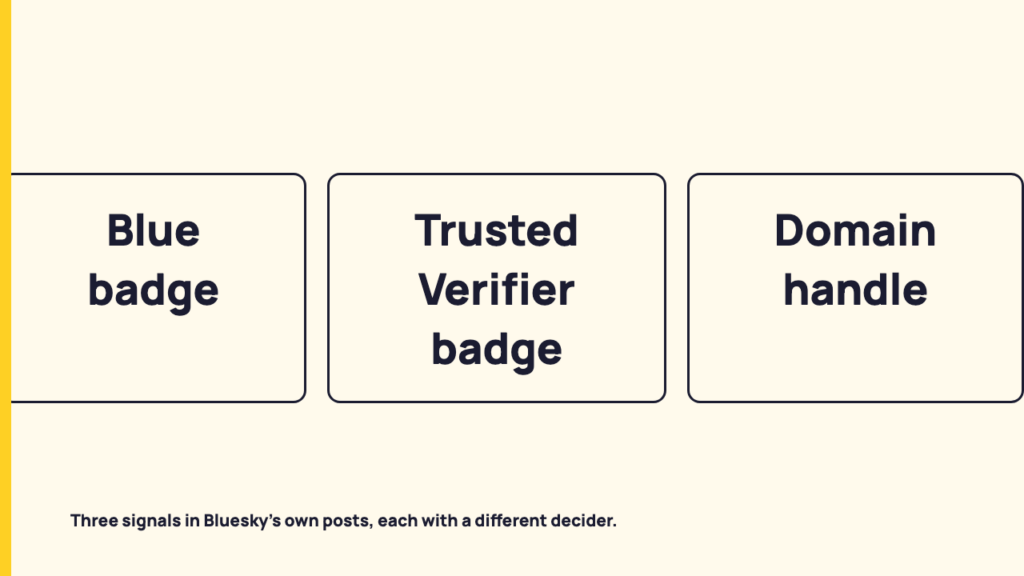
The scenario above is hypothetical. It is not a report of something that happened to any account. What follows is a close reading of what Bluesky has published, and the three things its posts describe are these: a blue badge that Bluesky issues itself, a scalloped badge that a Trusted Verifier issues, and a domain handle, which Bluesky says is separate from a badge.
Every claim below is read from Bluesky’s own pages, fetched on 2026-10-13. This post does not speak for Bluesky, and nothing in it was tested. No account was checked, no application was made and no domain handle was set up by the writer.
What Bluesky announced on 21 April 2025
The primary source is a post titled “A New Form of Verification on Bluesky”, published on 21 April 2025 by The Bluesky Team. It starts from what already existed: in 2023 Bluesky launched what it calls “our first layer of verification”, letting people and organisations set their domain as their username. It then adds a second layer. In its words: “Bluesky will proactively verify authentic and notable accounts and display a blue badge next to their names.”
The same paragraph introduces the second route: “through our Trusted Verifiers feature, select independent organizations can verify accounts directly. Bluesky will review these verifications as well to ensure authenticity.” Later in the post, Trusted Verifiers are defined as “organizations that can directly issue verification badges”, and “are marked by scalloped badges”. The post’s example is the New York Times, which “can now issue verification badges to its journalists directly in the app.”
The post also describes what a reader sees. Tapping a verified account’s badge shows which organisations have granted verification. And badges can be hidden: the post says to navigate to Settings > Moderation > Verification Settings to toggle it off.
Is there a request form? What the text says, and what it does not
There is a form, according to the April 2025 post. The sentence reads: “To apply for verification or to be a Trusted Verifier, please fill out this form.” A later section of the post repeats the point and sets the audience: “Notable and authentic accounts interested in receiving a verification badge or becoming a Trusted Verifier can apply here.”
So the common assumption that Bluesky has no application route is not what the post says. It is also worth reading the sentence for what it does not promise. It is an application. The audience is limited to “notable and authentic accounts”, and nothing fetched on 2026-10-13 gives a numeric threshold or a definition of “notable” for a brand account. That is “not found as of 2026-10-13”, not “does not exist”.
The form itself was not fetched, so its fields and eligibility wording may have changed since April 2025, and this post does not link it.
Three signals, three deciders
Within Bluesky, the published text separates the signals like this.
| Signal | Who decides | What it looks like | What Bluesky’s text says it shows |
|---|---|---|---|
| Bluesky-issued blue badge | Bluesky, which “will proactively verify authentic and notable accounts” | A blue badge next to the account name | An account Bluesky judged authentic and notable |
| Trusted Verifier scalloped badge | A selected independent organisation, with Bluesky reviewing each verification | The post says trusted verifiers themselves “are marked by scalloped badges”; tapping a verified account’s badge shows which organisations granted it | An account that a named organisation verified directly |
| Domain handle | The account holder, by controlling a domain | The website as the username, for example a domain in place of a name ending in bsky.social | Per the 2025 post, it “links your web presence to your social account” and is “different from a verification badge” |
The domain handle: the route that needs no one’s approval
Bluesky introduced domain handles in a post dated 6 March 2023, “Domain names as handles in Bluesky”. It states the idea in one line: “Custom domain handles are a decentralized way for us to achieve a level of account verification.”
The 28 April 2023 tutorial, “How to verify your Bluesky account” by Emily Liu, describes the mechanics. It opens: “On Bluesky, you can set your website as your username. This is one form of verification on Bluesky.” For a standard domain it describes adding a TXT record at the domain’s DNS host, waiting for the change to propagate, and then clicking “Verify DNS Record”. The writer did not perform this. For organisations, the tutorial gives a subdomain pattern: a newsroom’s journalists could use handles like @name.newsroom.com.
The vocabulary shifted between those two dates. In 2023 the tutorial called a domain handle “one form of verification”. In 2025 the announcement lists domain handles as the first layer of verification, yet when it explains how to get a badge it puts the domain route in a separate paragraph and adds “(This is different from a verification badge.)” A domain handle proves that whoever runs the account controls the domain. A badge says that Bluesky, or an organisation it has approved, judged the account authentic and notable.
It follows that a brand whose handle is not its domain has not used this route. That is a statement about the handle only, not about any named account and not about whether the brand could use it. If you are sorting out who controls a domain or an account in the first place, the question of who owns an account when the manager leaves is the adjacent one, since a domain claim belongs to whoever controls the domain.
How many accounts carry each signal, per Bluesky
The counts below come from two Bluesky documents and are tied to their dates. None of them is a current figure.
- The 21 April 2025 announcement says “over 270,000 accounts have linked their Bluesky username to their website”.
- The 2025 transparency report, published 29 January 2026, says domain handle verification is used by “over 309,000 accounts”.
- The same report says 18 organisations were granted Trusted Verification in 2025, “from Wired and CNN, to the European Commission and the City of Toronto”.
- It also says: “By the end of 2025, we had verified 4,327 accounts total: 3,567 verified directly by Bluesky and 777 verified by our network of 21 Trusted Verifiers.”
One thing to note about those last figures. 3,567 plus 777 is 4,344, which is 17 more than the 4,327 the report gives as the total, and the text fetched does not explain the difference. This post does not guess at the cause.
Has anything changed since April 2025?
On 2026-10-13 the checks were: the Bluesky blog index, the April 2025 post, the 2025 transparency report, the community guidelines, and the support page. At the time of fetching, the blog index listed posts running from January 2026 to July 2026 and showed no later post devoted to verification. Its only verification entries were the April 2025 announcement and the 2023 tutorial. The support page and the FAQ page carried no verification text. The accurate summary is “none found as of 2026-10-13”, not “no change”.
The transparency report of 29 January 2026 describes the same structure that the April 2025 post did: direct verification by Bluesky plus Trusted Verifiers, on top of domain handles.
The community guidelines, last updated September 19, 2025 per the page, include a line on verification in the Account Authenticity section. Under “Do not abuse platform Trust & Safety systems by” the first item is “Falsifying documents or misrepresenting your verification status.”
The form link and eligibility wording are as of the April 2025 post. For another platform’s version of the same kind of question, the sibling post on how YouTube’s verification page changed across three dated versions is a separate read.
What a brand account can and cannot do, from the published text
Three things are separate. A brand that controls a domain can set it as its handle, per Bluesky’s tutorial. A brand that considers itself notable and authentic can apply to Bluesky, per the form in the April 2025 post. And a brand cannot choose to be verified by a Trusted Verifier. On the text, those are organisations that verify accounts, not services open to applicants, and the post describes no process for being verified by one. That last point is a reading of the text, not a statement from Bluesky.
Applying “to be a Trusted Verifier” is also a different thing from being verified by one. The post’s wording covers organisations wanting to issue badges, not accounts wanting to receive them from someone else.
Here is a paragraph you could send the colleague: “Bluesky’s own posts describe three separate things. A blue badge, which Bluesky gives to accounts it judges authentic and notable. A scalloped badge, which marks an organisation Bluesky has approved to verify accounts itself, such as a news outlet verifying its journalists. And a domain handle, where the username is the organisation’s website. Bluesky says the domain handle is different from a badge. Our handle is not our domain, so we have not used that route, and as far as the April 2025 post says, the badge route is an application to Bluesky for notable and authentic accounts. Bluesky has not published what counts as notable that we could find.”
FAQ
Is a domain handle the same as a blue check on Bluesky?
No. Bluesky’s April 2025 post says setting your domain as your username is “different from a verification badge”. The 2023 tutorial did call it “one form of verification”, so the vocabulary has moved, but the 2025 post keeps the two apart.
Can a brand apply to Bluesky for a verification badge?
The 21 April 2025 post links an application form for verification and for becoming a Trusted Verifier, addressed to “notable and authentic accounts”. It is an application, not a promise, and no eligibility detail beyond those two words was found published as of 2026-10-13.
Sources
- A New Form of Verification on Bluesky, The Bluesky Team, 21 April 2025, fetched 2026-10-13
- Bluesky 2025 Transparency Report, 29 January 2026, fetched 2026-10-13
- Domain names as handles in Bluesky, 6 March 2023, fetched 2026-10-13
- How to verify your Bluesky account, Emily Liu, 28 April 2023, fetched 2026-10-13
- Bluesky Community Guidelines, last updated 19 September 2025, fetched 2026-10-13
- Bluesky blog index, fetched 2026-10-13