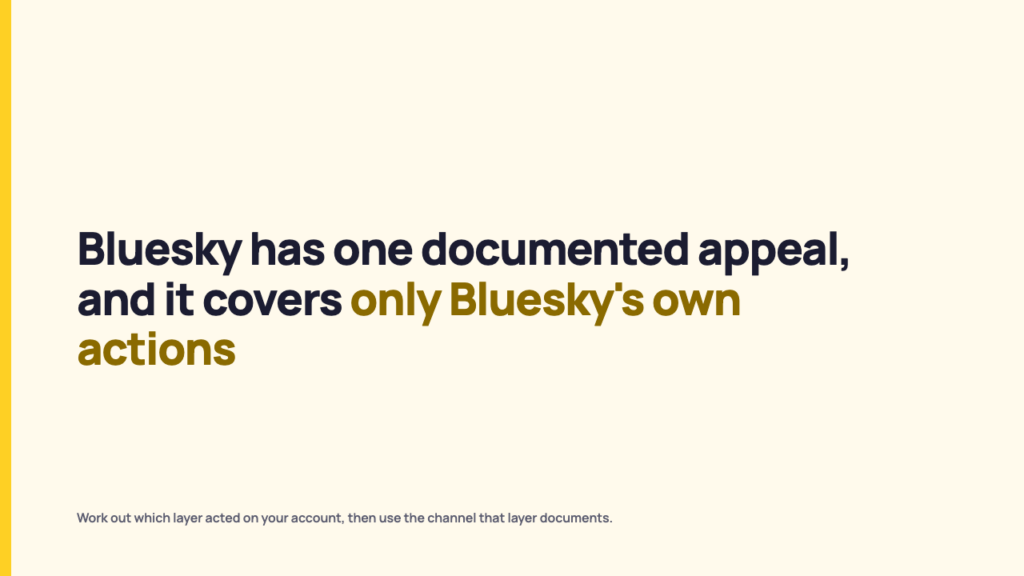
You run an organisation’s Bluesky account and something has been applied to it: a warning on a post, a label on the profile, a place on someone’s list. Who do you ask? It depends on which layer did it, because Bluesky and the AT Protocol do not treat moderation as one decision in one place.
Three layers, not one switch
The AT Protocol labels guide opens its “About labels” section with this: “Moderation in atproto consists of multiple, stackable systems, including: Network takedowns which filter the content from the APIs; Labels placed on content by moderation services; User controls such as mutes and blocks.” The guide says “including”, so the list is not exhaustive.
The AT Protocol moderation guide adds a framing for why the layers exist. In its words, “speech and reach should be two separate layers, built to work with each other”. It says moderation is implemented using labels, with Ozone as the labeling service and web frontend.
So the answer to “who do I ask” depends on which layer is acting. One caveat on vocabulary: “brand account” is this publication’s inference. The documents describe accounts in general, and none of them discusses organisations as a category.
Labels: what one is and what it does to an account
The labels guide defines a label as metadata about any account or content, published by a moderation service that is either hardcoded into the application or chosen by the user. Labels can be time-limited. For an account holder, these are the published fields that matter:
| Field | What the guide says it is |
|---|---|
| src | The DID of the actor who created the label. This is who made it. |
| uri | The AT URI of the record, account or other resource the label applies to. This is the target. |
| val | The short string name of the label’s value or type. |
| neg | If true, a negation label that overwrites a previous label. |
| exp | When the label expires. |
The value decides the behaviour. The guide lists global values defined by the protocol: !hide (a warning that cannot be clicked through, which also filters content from listings), !warn (a click-through warning), both not configurable by the user; !no-unauthenticated (content inaccessible to logged-out users in applications that respect it); porn, sexual and graphic-media (image warnings gated by age and adult-content settings); nudity (a warning that defaults to ignore); and bot (an automated account).
On who can apply what, the guide says only globally defined values can be used as self-labels, meaning labels set by a user who is not a labeler. Labelers can also define custom values in their own namespace, except those beginning with !, which are reserved.
The same label can look different to different viewers. Label definitions carry a blurs attribute (content, media or none) and a severity attribute (alert, inform or none), which the guide says give nine possible behaviours for custom values. The guide also says a user may choose to hide, warn or ignore each label from a labeler. So a label is a value plus each viewer’s settings, not one fixed outcome.
Where the label sits also matters. The subscriptions guide says a label on an account has account-wide effects, while a label on a profile affects only the profile record, for example the avatar, and never hides any content. A label on content affects that record specifically.
Labelers: independent services you did not choose
A labeler is a moderation service with its own identity. The subscriptions guide says each labeler has a service identity, a DID document, and that this is the DID that appears in a label’s src field. Users subscribe to labelers and may send reports to any of them. The creating-a-labeler guide says a labeler publishes a record declaring its policies.
As background, Bluesky’s blog post of March 12, 2024 described independent moderation services layered on the app. It is over two years old, so nothing here rests on it as current fact.
A label from Bluesky’s own moderation service and one from a third-party labeler come from different sources, and the src field is the published way to tell them apart. The pages read do not say how the app displays the source.
The documents read do not describe any route for an account holder to contest a third-party labeler’s label. The only documented channel is the labeler’s own report and contact process.
Lists and mutes: the layer with no central owner
The March 2024 post says “Today, you can already run a mute list or block list that other users can subscribe to.” Its stated drawback is that such a list “often gets tied to your account in a way that makes it hard to delegate responsibility to others.” Both are March 2024 background.
The community guidelines have a rule that touches this layer. Under the “Respect Others” section, in the anti-harassment item, they say: “Do not abuse Bluesky features (lists, labels, community moderation tools), engage in bad-faith mass reporting, use automated harassment systems, or create single-purpose harassment accounts.” That is a rule about the conduct of whoever runs a list, not a documented appeal for the listed account.
The pages read do not name a route for a listed account to be removed from a user-made list, and according to the March 2024 post the list belongs to its creator. Nor do the fetched documents quantify what being on a list, or carrying a label, does to an account’s visibility. They describe mechanisms such as blur, warning and hiding, and give no figures. That is the one open uncertainty, and it is not guessed at.
Bluesky’s own enforcement and the appeal the guidelines mention
The community guidelines, which show “Last Updated: September 19, 2025” on the page fetched on November 11, 2026, say Bluesky moderates “using human moderators, working alongside automated systems”. They say Bluesky remains responsible for “setting and enforcing baseline rules”, and that its “appeals process gives you an opportunity to tell us if you think we have gotten something wrong”. They add that “this discretion rests with us”, so final decisions rest with Bluesky.
The guidelines point to the Terms of Service for the procedures. The Terms page, which shows “Last Updated: 14 August, 2025”, has a section titled Complaints and Appeals. If an account has been suspended, terminated or otherwise restricted under the Terms, the holder may appeal using the in-app appeal tool or by emailing moderation@blueskyweb.xyz, within two weeks of the action. Separate EU and EEA procedures are described. For the legal side of that, this publication has a separate read of appeal rights under the EU Digital Services Act.
That appeal covers accounts restricted by Bluesky. The Terms page does not say it also covers a third-party label or list membership.
Under the authenticity rules, clearly labeled parody, satire or fan accounts that identify their nature in both display name and bio are described as acceptable, and the rules on intellectual property list impersonating brands or businesses as something not to do. Verification is a different mechanism and is not covered here; see how Bluesky’s verification and trusted verifiers work.
Which layer is acting? A who-do-I-ask map
This table uses only what the sections above established. Where a route is absent, the cell says “not described in the pages read”, which is different from saying none exists. Cells marked (2024) rest on the March 2024 blog post.
| Layer | Who controls it | What the docs say it does | Documented route to ask | What the docs leave unstated |
|---|---|---|---|---|
| Network takedown or Bluesky enforcement | Bluesky | Takedowns filter content from the APIs. Baseline rules set by Bluesky. | In-app appeal tool or the Terms’ moderation email, within two weeks, for suspended, terminated or restricted accounts. | Whether appeals cover other kinds of action. Outcomes. |
| Label from Bluesky’s moderation service | Bluesky | Labels whose display depends on value and viewer settings. | Not described in the pages read, apart from the general appeals text above. | How the app shows the source. How labels map to appeals. |
| Label from a third-party labeler | The labeler | Same label mechanics. Users subscribe and can send it reports. Independent services (2024). | The labeler’s own report or contact process. No contest route described in the pages read. | Any escalation beyond the labeler. |
| User mute or block | The individual user | Named as the third layer, “user controls such as mutes and blocks”. | The pages read do not cover this layer beyond naming it. Not described in the pages read. | Everything beyond that naming. |
| User-made list | The list’s creator (2024) | Lists others subscribe to (2024). Abusing lists breaks the guidelines. | Not described in the pages read. | Any removal route. The effect on visibility. |
What the documentation does not tell you
The documents describe mechanisms, not outcomes. No page fetched for this post gives a figure for what a label or a list does to an account’s visibility or following, so none is given here. This is a desk reading of public documents: this publication has tested nothing on an account and has no account holder to cite, so no real organisation’s case is described. The pages can change. Every page listed under Sources was fetched on November 11, 2026, so check the originals before relying on any detail.
Identify the source of the label or list first, using the src field or the list’s creator. Then use the channel that source documents.
FAQ
Is there a way to appeal a Bluesky label?
For Bluesky’s own enforcement, the Terms of Service describe an appeal through the in-app tool or by email, filed within two weeks, for accounts that are suspended, terminated or restricted. The pages read do not describe an appeal against a third-party labeler’s label other than contacting that labeler through its own report or contact process.
Who owns a Bluesky block or mute list?
According to the March 2024 blog post, the user who created it, since the list is tied to the creator’s account. The pages read name no process for a listed account to contest its membership.
Sources
- AT Protocol: Labels guide, fetched 2026-11-11
- AT Protocol: Moderation guide, fetched 2026-11-11
- AT Protocol: Subscriptions guide, fetched 2026-11-11
- AT Protocol: Creating a labeler guide, fetched 2026-11-11
- AT Protocol: Using Ozone guide, fetched 2026-11-11
- Bluesky Community Guidelines, last updated September 19, 2025, fetched 2026-11-11
- Bluesky Terms of Service, last updated 14 August, 2025, fetched 2026-11-11
- Bluesky’s Stackable Approach to Moderation, March 12, 2024, fetched 2026-11-11