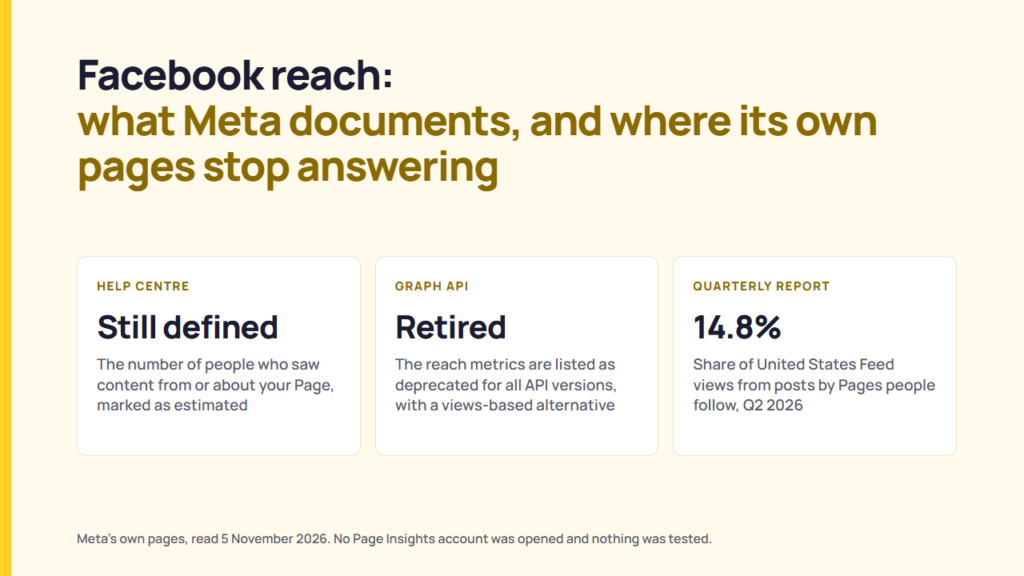
Facebook reach is the number of people who saw any content from your Page or about your Page, and Meta marks the metric as estimated. Meta documents it in places that no longer agree: a Facebook Help Centre article that still defines it, a Graph API reference that has retired the reach metrics for all API versions, and a quarterly report that puts posts from Pages people follow at 14.8% of United States Feed views.
A client’s Page reach has halved, the review is tomorrow morning and the dashboard shows the fall without explaining any of it. The first instinct is to look up what Meta says reach is. The scenario is hypothetical.
This piece is a reading of Meta’s own pages on 5 November 2026: the Facebook Help Centre articles on reach, Page Status and recommendations, the Transparency Center pages on Feed ranking and reducing distribution, the Widely Viewed Content Report, the Content Distribution Guidelines and their change log, the Graph API Page Insights reference and two Meta for Creators posts. No Page Insights account was opened and nothing was tested; no third-party study was used.
Three findings matter most in that meeting. Meta’s Help Centre names the general factors behind a fall in organic reach and calls such changes normal. Page Status and post-level insights are where Meta says a Page can look for its own distribution problems. Meta’s published advice for more distribution comes down to five best practices, led by posting original content.
What is Facebook reach?
Meta’s Facebook Help Centre gives the definition. Reach counts “the number of people who saw any content” from your Page or about your Page, and the article says the metric is estimated. It counts people, not appearances. A second Help Centre article splits the measure by how a post got in front of those people.
| Type of reach | What Meta says it counts |
|---|---|
| Post reach | People who saw any of your posts at least once. Meta marks it as estimated. |
| Organic reach | People who had an unpaid post from your Page enter their screen. |
| Paid reach | People who had a paid post from your Page enter their screen. |
| Viral reach | A part of organic reach: people who saw Page content because a friend followed the Page, engaged with a post, shared a photo of the Page or checked in to it. |
| Non-viral reach | The rest of organic reach: people who saw Page content without one of those friend actions. |
| Group post reach | People who saw the post at least once. In a public group this includes non-members, and post insights need a group of at least 250 members. |
These figures overlap. Someone reached through both paid and organic distribution counts once in organic reach, once in paid reach and once in post reach, so Meta warns that organic and paid reach will not always add up to post reach. The metric people often confuse with reach is engagement. The Graph API reference defines page_post_engagements as “The number of times people have engaged with your posts through reactions, comments, shares and more”, which counts interactions, not people reached.
One of these articles can look empty. Opened at its Business Help Centre address on 5 November 2026, in Chrome, it rendered a heading, a block labelled “Common support topics” with four unrelated links, and no definition. A logged-out reading on 28 October 2026 showed the same thing. The same article number at facebook.com/help/ rendered the full text, so anyone who lands on the business address can reasonably conclude that Meta has no definition. It has one, one address away.
Facebook reach vs impressions vs views
Reach counts people. Impressions and views count times. That is the difference a client report most often blurs, because dashboards put the three side by side.
| Metric | What it counts | Same person, three times |
|---|---|---|
| Reach | People who saw content from or about your Page | One |
| Impressions | Times any content from or about your Page entered a person’s screen | One, in Meta’s photo example |
| Views | Times a reel or video was played, or a photo or text post was on screen | Three |
| Page views | Times a Page’s profile was viewed, including by logged-out people | Not a measure of post distribution |
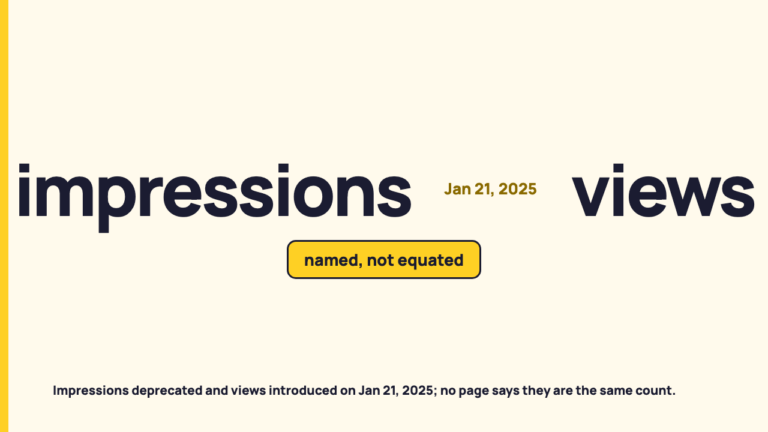
Meta announced views as Facebook’s primary metric on 14 November 2024. Its post says “For Stories, photo or text posts, views will replace impressions”, and gives the example of a person viewing a photo three separate times in a day, which counts as three views instead of one impression. The same post said reach would remain unchanged. For how the word “view” shifts between platforms, read A View Is Not a Unit.
Has Facebook removed the reach metric?
Facebook has removed the reach metrics from its API, according to its developer documentation. Whether the in-app figure has changed is a separate question this reading did not settle. On 5 November 2026, the Graph API Page Insights reference stated: “By June 15, 2026, a number of the Page Insights metrics will be deprecated for all API versions.” It adds that calling any of them returns an invalid metric error.
Meta’s deprecated metrics documentation lists page_impressions_unique and page_posts_impressions_organic_unique among the retired metrics. It names page_total_media_view_unique as the alternative for page_impressions_unique, a count of unique media viewers rather than the former reach metric. It lists no alternative beside page_posts_impressions_organic_unique, the field that stated organic reach plainly. Impressions followed: page_impressions is listed as deprecated on 15 November 2025, with page_media_view as its alternative.
Meta’s Deprecated Facebook Page Insights Metrics page, updated on 2 March 2026, says “By June 15, 2025”, although the Graph API reference gives 15 June 2026. The dates conflict, so the Graph API reference is used here for the retirement date.
Meta does not say the views-based figures match the former reach figures, and a report that moved from one field to the other should not treat them as one continuous line. That is a reading of the documentation, not a statement from Meta. Its Help Centre articles still describe post reach inside Insights, and what the API change means for the Insights screens inside Facebook was not established here. Read the Developer Changelog Before It Breaks Your Report covers how to spot this kind of change early.
Where to see Facebook reach
Meta’s Help Centre gives three routes. They are reported as Meta writes them; none was opened for this piece.
- Page Insights. Switch into the Page from your profile photo, open Professional dashboard in the left menu, then Insights. Meta notes the dashboard now appears as Creator Dashboard or Business Dashboard.
- Meta Business Suite. Switch into the Page, open Meta Business Suite, click Insights, then Overview under Content to see posts and stories.
- A group post. Group admins can click View insights below a post, in groups with at least 250 members.
Page Insights data is available for the last two years only, which limits any comparison with an older peak. How far back each platform’s reporting goes is a separate reading.
Why has my Facebook reach dropped?
Meta answers this question in general terms, in the same Help Centre article that defines organic reach. It lists how people engage with your Page’s content, how they have engaged with similar content before, the quality of the content, and other factors such as time of day and the device people use. It says it is “normal for reach to change” with these factors.
That is not a diagnosis of one Page. Meta does point to places inside Facebook where a Page can look for one, and these were not opened for this piece.
- Page Status. Anyone with Facebook access to the Page can see recent Community Standards violations, fact-checker ratings, intellectual property violations, content identified as clickbait, violations for too much unoriginal content, and content that is not eligible for suggestions. Meta says it also shows how some violations may affect distribution, and warns that it does not cover every violation.
- Post-level insights. Meta’s 14 July 2025 post for creators says these insights in the professional dashboard can help explain why content may not be getting distributed.
- The Support home screen. The same post says this screen, in the main menu of a Page or professional profile, shows whether you are at risk of content recommendation or monetisation penalties.
Two other readings are worth ruling out before anyone calls it a demotion. The fall may belong to the report, if a dashboard’s reach figure now comes from a different API field. It may also be a matter of scale, since posts from Pages people follow are 14.8% of United States Feed content views. Both are reasoning from Meta’s documents, not statements from Meta. When the Same Account Reports Three Different Numbers covers the first in more depth.
How Meta describes the ranking that produces reach
Meta describes Feed ranking for connected content in four steps, and publishes them on its Transparency Center. Recommended content is added afterwards, followed by ads.
| Stage | What Meta says |
|---|---|
| Inventory | Meta gathers “all potential new posts, or posts with new activity”, from friends, followed Pages and joined Groups, leaving out content flagged for violating the Community Standards. |
| Signals | Meta considers thousands of “signals” to make predictions about what you will find most interesting. |
| Predictions | Meta uses “these signals to make a series of personalized predictions about which content you’ll find most relevant and valuable”. |
| Ranking | “the system calculates a ‘relevance score’ for each post and puts the posts in order based on this score”. |
Meta groups the signals into three categories: data specific to you, data specific to the post being ranked, and data specific to you and the post together. Its examples include the types of content you have interacted with, whether the actor is posting to a profile, Page or Group, the number of confirmed Community Standards violations on an account, and the total number of people following a Page.
Three of the predictions Meta names work in the other direction. Meta says it makes predictions about “whether a piece of content is problematic and should receive reduced distribution” and lists, among the models used to reduce distribution, how likely you are to hide, snooze or unsubscribe from the post, how likely you are to report it, and how likely you are to react with anger.
What Meta says it reduces distribution for
Meta’s page on reduced distribution starts with one sentence of scope. Content that does not violate the Community Standards but “might still be problematic or otherwise low-quality” may have its distribution reduced, “consistent with user controls”. The named categories fall into three groups.
| Grouping | Named category, in Meta’s wording |
|---|---|
| Responding to people’s direct feedback | “clickbait” and “engagement bait”; links to sites “covered with ads, slow to load or broken”; comments “repeatedly copied and pasted” |
| Incentivizing publishers to invest in high-quality content | “Limited originality content that is principally repurposed from other sources”; “Low-quality videos that abuse video or live video formats”; misinformation |
| Fostering a safer community | Content some people may find problematic, which Meta makes “harder to encounter”, including “Content by creators that repeatedly violate our policies” |
Two of these categories have published definitions worth quoting to a client. Meta’s engagement bait guideline covers “Posts that explicitly request engagement”, meaning requests for likes, shares, comments, tags or votes for “purposes other than a specific call to action”. It excludes posts that “ask people to engage in order to show they do or do not support an issue” and posts that “share time-sensitive information regarding natural disasters and life-threatening events”.
Meta’s clickbait guideline covers “Posts that lure people into clicking on an included link” by “creating misleading expectations about the post or article’s content”. It gives sensationalist phrasing and misleading punctuation as examples.
The list is also shorter than it used to be. Meta’s change log records removing three guidelines in September 2022, one in March 2023, three in October 2023, and fourteen, with one updated, in July 2025. One entry from October 2024 records a change that had been missing from the log altogether. Anyone quoting a Facebook demotion rule in a client meeting should include the date beside it.
The two pages also do not line up. The reduced distribution page was last updated on 25 April 2025 and still names low-quality videos, copied comments and repeat violators. The change log removed the Low Quality Videos guideline in October 2023, saying Meta no longer reduces the distribution of those videos, and removed the guidelines for Low Quality Comments and Content Posted by Repeat Violators of Our Policies in July 2025. Which page describes current practice for those categories was not established here.
What Meta’s own report says people actually see
Meta publishes a quarterly Widely Viewed Content Report covering Feed views in the United States. It is the nearest published comparison for a Page owner. That is a reading of the report, not a statement from Meta. The report counts a content view “whenever a piece of content appears in Feed”. How to read a platform’s published reports explains what an edition like this can and cannot support.
| Share of Feed content views in the United States | Q2 2026 | Q1 2026 |
|---|---|---|
| Posts shared by people’s friends | 20.2% | 19.2% |
| Posts from Groups people had joined | 14.6% | 14.3% |
| Posts from Pages people follow | 14.8% | 14.7% |
| All three together | 49.6% | 48.1% |
| In-Feed recommendations from unconnected accounts | 36.6% | 39.0% |
| Other, such as Events and logging discrepancies | 13.8% | 12.8% |
| Posts containing an external link (across all sources) | 1.1% | 1.3% |
Source: Meta Transparency Center, Widely Viewed Content Report, Q2 2026 (1 April to 30 June 2026) and Q1 2026 (1 January to 31 March 2026), read 2026-11-05. United States Feed views only. Totals as published by Meta, which notes that rounding means some totals may not equal the sum of their parts.
The report states its own method. Where a post contains several pieces of content, “the view is assigned to the post”. The counts are “based on views on both public and private content”. Content viewers are described as estimated and the report “doesn’t include ads or content viewed outside of Feed”.
Posts from Pages people follow accounted for 14.8% of United States Feed content views in the second quarter of 2026. Posts containing an external link accounted for 1.1%, and Meta says those views typically came from a Page the person followed. A client asking why a Page’s reach is small is asking about a share of Feed that Meta’s own report puts at 14.8%, and that is a different conversation from a demotion. That is a reading of the report, not a statement from Meta.
What makes a Facebook Page eligible for recommendations
Feed ranking and recommendation eligibility are not the same thing. Meta also recommends Pages, Groups and posts to people who do not already follow them. These recommendations appear in places such as Suggested for You posts in Feed and Pages You May Like.
Meta’s Recommendation Guidelines set a higher standard for recommendations than its Community Standards. This means content can be allowed on Facebook but still be excluded from recommendations. Meta says these guidelines aim to prevent the recommendation of content that may be low-quality, objectionable or particularly sensitive. Its Help Centre sorts that content into three categories: content that impedes a safe community, content associated with low-quality publishing such as unoriginal content, and false or misleading content.
Account-level eligibility also matters. Meta generally does not recommend Pages, Groups or accounts that have recently violated its Community Standards, repeatedly shared content that falls under its non-recommendable categories, or used misleading practices to build a following. This is different from a finding that one particular post has been demoted.
People searching for “Facebook page not recommendable” are asking about this eligibility. Meta’s Help Centre article uses the phrase “non-recommendable account or entity”. Page Status is the place Meta names for content that is not eligible for suggestions. What the platforms publish about account restrictions covers the appeal path.
The 36.6% figure for recommendations from unconnected accounts in Q2 2026 shows how much of Feed viewing came from this source. It does not show whether a particular Page is eligible for recommendations or why its reach has fallen.
How to increase Facebook reach: what Meta itself advises
Meta publishes nothing that promises more reach. The closest it comes is a list of five best practices in its 14 July 2025 post for creators on unoriginal content, offered as a way to set content up for distribution. These are Meta’s statements. They were not tested here, and Meta gives no figure for what any of them adds. None of them involves paying for distribution.
- Post original content. Meta says Pages and profiles get “the greatest distribution” when they consist mainly of material they filmed or created.
- Make meaningful enhancements. Approved content from other sources needs creative editing, voiceover or commentary. Stitching clips together or adding a watermark does not qualify.
- Tell a story. Meta says authentic storytelling is more likely to perform well, and advises against super-short videos that offer little value.
- Avoid watermarks. That covers visible third-party watermarks and content visibly recycled from other apps.
- Use high-quality captions. Keep captions and hashtags relevant. Meta reports that captions with no links, minimal capital letters and no more than five hashtags “perform best”.
The same post carries the warning behind that list. Accounts that repeatedly reuse someone else’s videos, photos or text posts lose monetisation access for a period and receive reduced distribution on everything they share, and duplicate videos have their distribution reduced in favour of the original.
Meta’s other pages add two checks. The engagement bait and clickbait definitions above are precise enough to test a post against. Its ranking page also lists the predictions it uses most frequently, including how likely someone is to share a post, comment on or react to it, click on it, or spend time viewing it. Those are descriptions of a system, not instructions, and what to do about them remains the client’s decision.
What an account manager can take into the meeting
Seven questions, each tied to a document.
| What the client asks | What Meta’s documents support |
|---|---|
| What exactly is reach? | The estimated number of people who saw content from or about your Page, in the Help Centre’s wording. Meta has retired the matching metrics from the Graph API and names a views-based alternative. |
| Why has it fallen? | Meta lists general factors and calls such changes normal. None of the public pages read here diagnoses one Page. |
| Are we being demoted? | Page Status, post-level insights and the Support home screen are where Meta says to look. Page Status does not cover every violation, and these screens were not opened for this piece. |
| Is it because we post links? | Meta reports posts with an external link at 1.1% of United States Feed content views in Q2 2026. That is a composition figure, not a penalty, although Meta’s caption advice does favour captions with no links. Meta’s test limiting some Pages to two organic link posts a month is covered in two free links a month on Facebook and X. |
| Has Meta changed the rules? | Its change log records fourteen guidelines removed and one updated in July 2025 alone. |
| Would posting at a different time help? | Meta names time of day among the factors affecting reach and gives no figure. The evidence on publishing method is read separately in whether scheduling a post changes its reach. |
| How do we get more reach? | Meta’s five best practices, led by original content, and its definitions of what it reduces. Meta promises no result from either. |
Meta’s public documents provide an unusual amount of information about reach, but almost none of it concerns an individual Page. They support a definition, a description of ranking, a dated category list and a published breakdown of Feed views. They do not support a diagnosis, which has to start inside the Page’s own status screens. An account manager can make that distinction clear at the start of a meeting rather than having to defend it later. What to do about the fall remains the client’s decision.
What could not be confirmed
This reading cannot settle seven points:
- The blank Business Help Centre address was read in one browser on two days. It may render differently elsewhere.
- The Graph API deprecation note is reported as written. What it means for the Insights screens inside Facebook was not established.
- Page Insights, Page Status, post-level insights and the Support home screen were not opened for this piece. Their contents and paths are reported from Meta’s descriptions.
- The Widely Viewed Content Report covers the United States only, and excludes advertising and anything seen outside Feed.
- The pages read give no figure for how much any demotion reduces distribution, and no average organic reach rate.
- Meta’s five best practices are its own statements, written for creators and Pages in July 2025, and were not tested here.
- Where the reduced distribution page and the change log differ, which one reflects current practice was not established.
FAQ
What is Facebook reach?
Facebook reach is the number of people who saw any content from your Page or about your Page, and Meta marks it as estimated. Organic reach counts people reached by unpaid posts, paid reach counts people reached by paid posts, and post reach counts people who saw any of your posts at least once.
What is the difference between reach, impressions and views on Facebook?
Reach counts people, while impressions and views count times. Meta introduced views on 14 November 2024 as the number of times a reel or video was played or a photo or text post was on screen, and said “For Stories, photo or text posts, views will replace impressions.” Views include repeat appearances, while reach counts each person once.
Why is my Facebook reach down?
Meta’s Help Centre lists general factors, including how people engage with your Page’s content, the quality of the content, time of day and the device people use, and calls such changes normal. It does not diagnose an individual Page. Meta points to Page Status and post-level insights for that. Its quarterly report also puts posts from Pages people follow at 14.8% of Feed content views in the United States in the second quarter of 2026.
What does Facebook reduce the reach of?
Meta says it may reduce distribution for clickbait, engagement bait, links to sites “covered with ads, slow to load or broken”, comments “repeatedly copied and pasted”, “Limited originality content that is principally repurposed from other sources”, “Low-quality videos that abuse video or live video formats”, misinformation and content from creators that repeatedly violate its policies. Its change log has since removed some related guidelines.
How do you increase Facebook reach organically?
Meta promises no increase, but its July 2025 best practices are to post original content, make meaningful enhancements to approved content, tell a story, avoid watermarks and keep captions and hashtags relevant. It also advises checking your status for recommendation penalties. Whether to act on any of that is the client’s decision.
What is a good organic reach percentage on Facebook?
The Meta pages read here publish no average or target organic reach rate. Percentages quoted elsewhere come from third-party samples with their own methods, and a Page’s own history is a sounder baseline than an industry average.
Sources
- Facebook Help Centre, “Differences between Facebook Page views, reach and impressions“, read 2026-11-05.
- Facebook Help Centre, “Learn the difference between organic, paid and post reach“, read 2026-11-05.
- Meta Business Help Centre, “What’s the definition of Facebook organic, paid and post reach?“, read 2026-10-28 and 2026-11-05.
- Facebook Help Centre, “See Page Insights on Facebook“, read 2026-11-05.
- Facebook Help Centre, “See insights for your Facebook Page posts“, read 2026-11-05.
- Facebook Help Centre, “View reach and engagement for a post in a Facebook group that you admin“, read 2026-11-05.
- Facebook Help Centre, “About Facebook Page Status“, read 2026-11-05.
- Facebook Help Centre, “About recommendations on Facebook“, read 2026-11-05.
- Meta for Creators, “Introducing views to simplify content distribution metrics“, 14 November 2024, read 2026-11-05.
- Meta for Creators, “Combating unoriginal content to protect and elevate creators“, 14 July 2025, read 2026-11-05.
- Meta for Developers, “Graph API Page Insights reference“, read 2026-11-05.
- Meta for Developers, “Deprecated Facebook Page Insights Metrics“, read 2026-11-05.
- Meta Transparency Center, “Our Approach to Facebook Feed Ranking“, read 2026-11-05.
- Meta Transparency Center, “Reducing the distribution of problematic content“, read 2026-11-05.
- Meta Transparency Center, “Widely Viewed Content Report“, read 2026-11-05.
- Meta Transparency Center, “CDG Corrections and adjustments“, read 2026-11-05.
- Meta Transparency Center, Content Distribution Guidelines, “Engagement Bait“, read 2026-11-05.
- Meta Transparency Center, Content Distribution Guidelines, “Clickbait Links“, read 2026-11-05.