Every social media report implies a claim about the past: this month against last month, this quarter against the same quarter a year ago. That claim depends on the platform still holding the data.
Mostly, it does not.
I read the current developer documentation for the platforms whose reporting APIs a social team actually touches, and pulled out what each one says about how far back it will go, how often it updates, and who is allowed to ask. These are quotes from the platforms’ own pages, read on 5 September 2026.
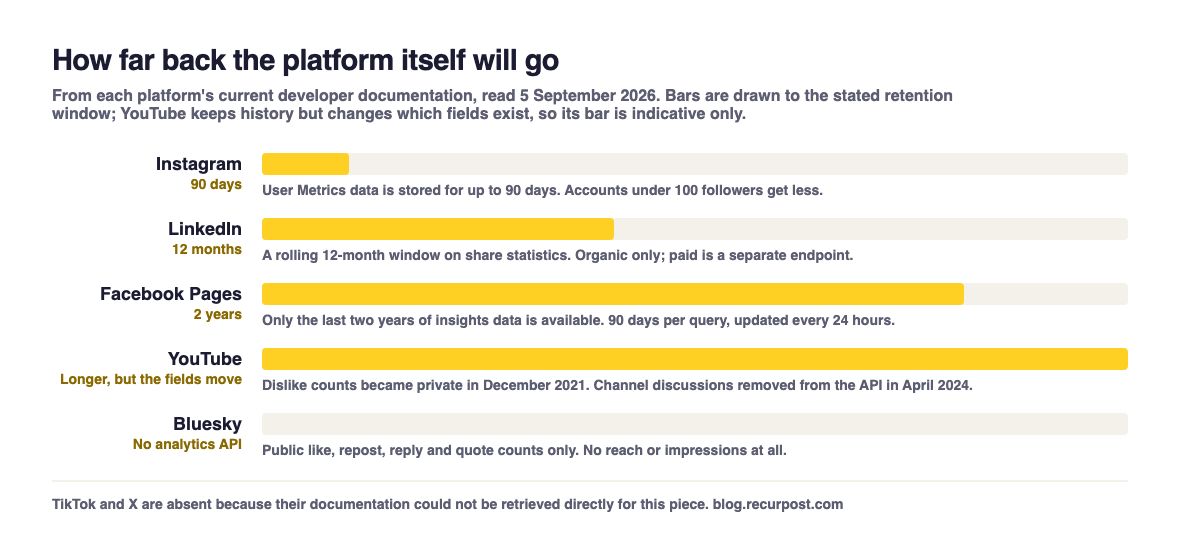
What each platform says
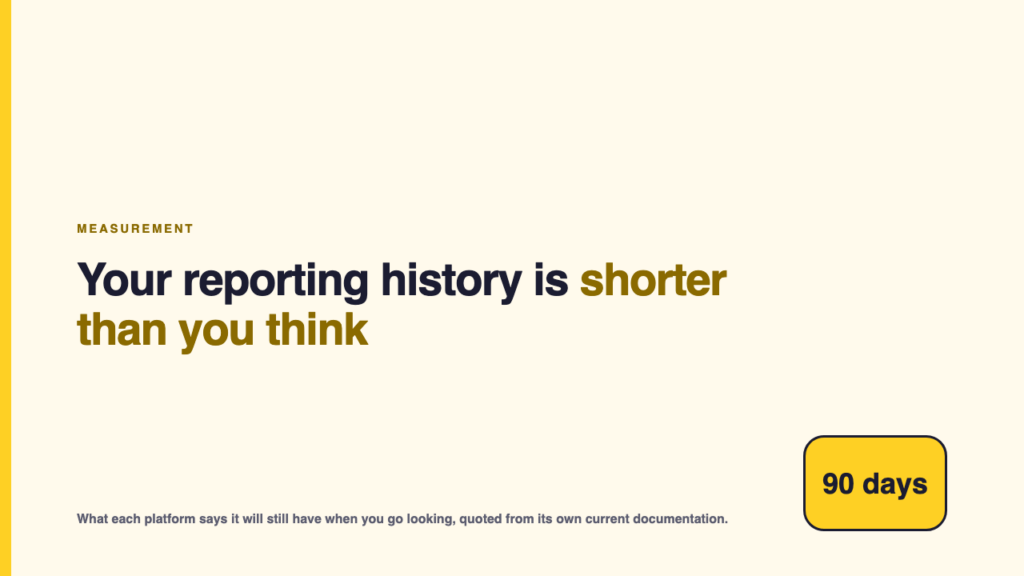
Instagram. From the Instagram Platform insights guide: “User Metrics data is stored for up to 90 days.” The same page adds a floor on who gets anything at all: “Some metrics are not available on Instagram accounts with fewer than 100 followers.”
Ninety days. If your annual review compares this September with last September, the platform’s own API cannot supply the second half of that sentence.
Facebook Pages. From the Page insights reference: “Page Insights data is only available on Pages with 100 or more likes. Most metrics will update once every 24 hours. Only the last two years of insights data is available.” And on how much you can pull at once: “Only 90 days of insights can be viewed at one time when using the since and until parameters.”
Two years of history, retrievable in 90 day slices, refreshed daily rather than live.
LinkedIn. From the organization share statistics documentation: “The organizationalEntityShareStatistics endpoint returns share data only within the past 12 months, using a rolling 12-month window.” The same page is explicit about what is excluded: “This endpoint returns organic statistics only. Sponsored activity is not counted in this endpoint.”
Rolling twelve months, and organic and paid arrive from two different places, which is why they so often fail to reconcile.
YouTube. The retention position is more generous, but the field list is not stable. From the Data API revision history: on 15 December 2021, “in conjunction with changes to make video dislike counts private across the entire YouTube platform, the video resource’s statistics.dislikeCount property is now private.” On 30 April 2024, “channel discussions are no longer supported within the YouTube Data API.” On 6 August 2026, references to three activity fields were “removed from public documentation as these fields are not returned by the API”.
Bluesky. There is no analytics API. The public API returns like, repost, reply and quote counts on a post, and nothing about reach, and that is the whole surface.
The two things this changes
One: your baseline has an expiry date. On Instagram, a first party history longer than 90 days does not exist unless you kept it. On LinkedIn, twelve months. Anything older than that in your report came from a spreadsheet somebody maintained, or it is not real.
This is the practical case for the least glamorous habit in social media measurement: export on a schedule and keep it. Not because the export is interesting, but because in 90 days it will be the only copy.
Two: the export surface shrinks. The YouTube revision history is the clearest illustration, because it is published as a dated list. A metric that a report was built on in 2021 stopped existing in December of that year. A surface that reports were built on disappeared in April 2024. Neither was a bug.
Any report that a platform can silently invalidate should be built so that the invalidation is visible: name the source of every number, name the date it was pulled, and keep the raw export.
A short checklist
- Know your own retention limit per platform, and write it at the foot of the report. Ninety days for Instagram, twelve rolling months for LinkedIn, two years for Facebook Pages.
- Export monthly, into storage you control. The month you skip is the month that becomes unrecoverable.
- Store the raw response, not just your summary. When a metric is redefined or removed, the raw response is the only thing that lets you explain the discontinuity.
- Reconcile paid and organic deliberately. On LinkedIn they are two endpoints by design, and no amount of chart-making merges them.
- Expect a 24 hour lag on Facebook Page metrics rather than treating a same-day number as final.
- Date every figure you quote, including in the report itself. Counts move, definitions move, and the fields themselves sometimes leave.
What this cannot tell you
- This covers the platforms whose current documentation was reachable and readable on the collection date: Instagram, Facebook Pages, LinkedIn, YouTube and Bluesky. TikTok and X are absent because their documentation could not be retrieved from the network used for this piece, and a piece like this is worthless on secondhand sourcing. They will be added when they can be read directly.
- Documentation describes intent, not always behaviour. What an API returns in practice can be narrower than the page says, and access also depends on which permissions and product tiers an app holds.
- Retention windows change. Every quote here carries its read date for that reason.
- This is about first party API access, not about what a third party tool shows you. A tool that has been collecting your data for three years can show you three years of it, which is exactly the point about keeping your own copy.
Source ledger
- Instagram Platform insights, Meta for Developers, page marked “Updated: Jan 21, 2025”, read 5 September 2026 in a browser because the host rejects plain automated requests.
- Page/insights reference, Graph API Reference, read 5 September 2026 in a browser for the same reason.
- Share statistics, LinkedIn Marketing API documentation, read 5 September 2026, HTTP 200.
- YouTube Data API revision history, read 5 September 2026, HTTP 200. Entries quoted are dated 15 December 2021, 30 April 2024 and 6 August 2026.
- Bluesky: the public AppView API surface,
app.bsky.feed.getPostsandapp.bsky.feed.getAuthorFeed, which return public engagement counts and no reach data.