A like is a person acknowledging you exist. A reply is a person expecting something back. Any team staffing a social account is really staffing the second one, and almost nobody measures how much of it their account actually generates.
Over the 90 days to 5 September 2026 I collected every post published by 60 public brand and publisher accounts on Bluesky from the public API. For the 31 accounts with at least 100 original posts, here is how much conversation each one produced, measured as replies received against likes received.
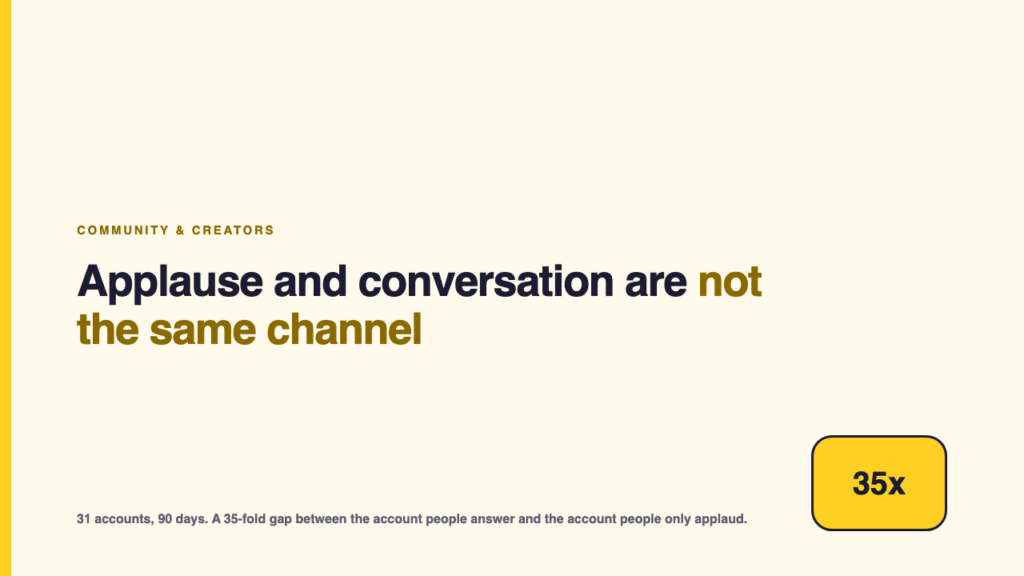
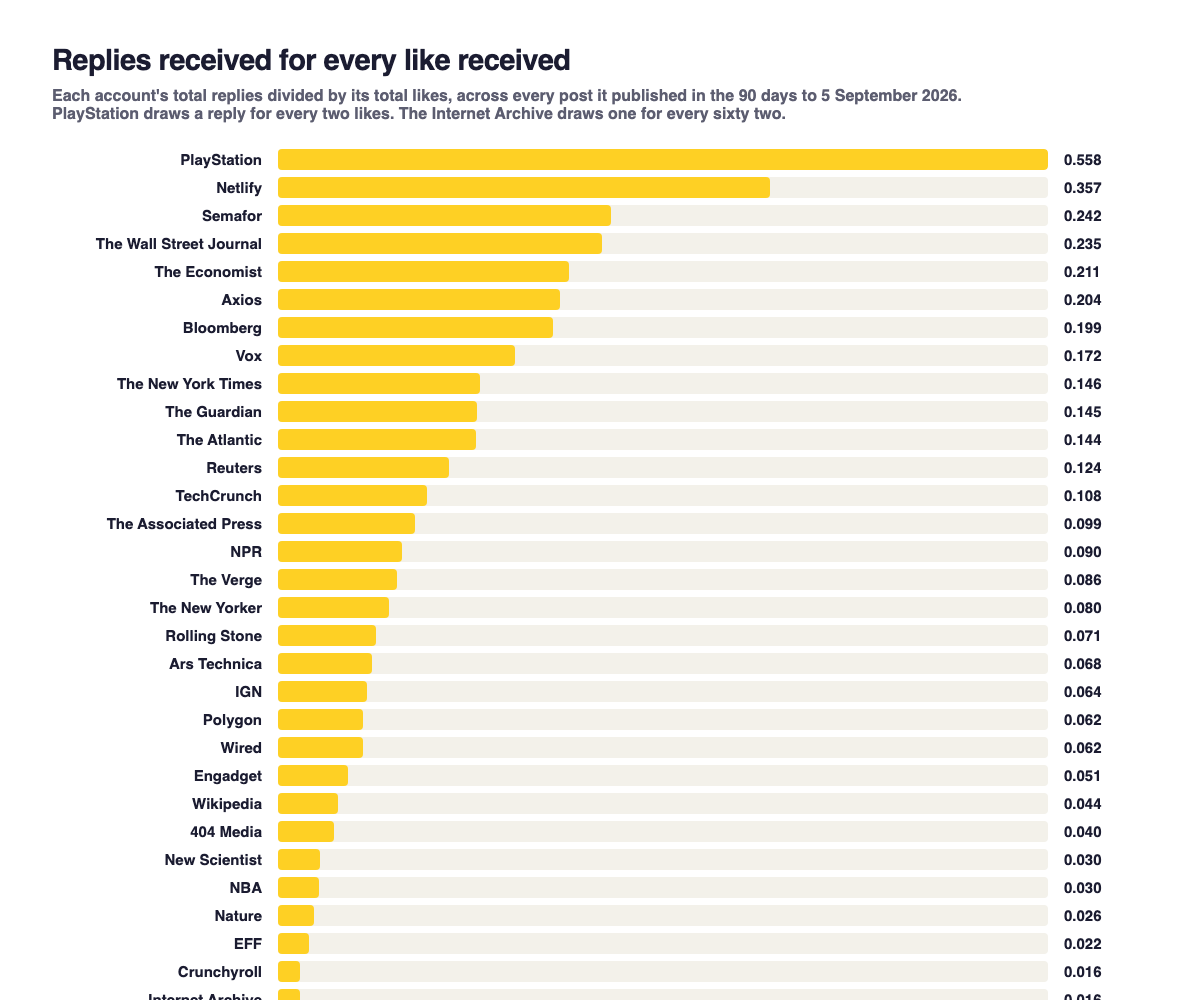
The median account gets 0.086 replies per like. About one reply for every twelve likes. But the range across these 31 accounts is a factor of 35, and the accounts at the two ends are doing recognisably different jobs.
| Account | Posts | Replies received | Likes received | Replies per like | Posts with no reply at all |
|---|---|---|---|---|---|
| PlayStation | 121 | 9,370 | 16,785 | 0.558 | 0% |
| Netlify | 180 | 66 | 185 | 0.357 | 69% |
| Semafor | 1,420 | 1,854 | 7,665 | 0.242 | 40% |
| The Wall Street Journal | 2,465 | 10,223 | 43,506 | 0.235 | 29% |
| The Economist | 2,492 | 3,719 | 17,641 | 0.211 | 49% |
| Axios | 383 | 5,915 | 28,935 | 0.204 | 2% |
| Bloomberg | 2,403 | 10,502 | 52,656 | 0.199 | 21% |
| Vox | 505 | 1,477 | 8,595 | 0.172 | 24% |
| The New York Times | 2,279 | 28,686 | 196,110 | 0.146 | 5% |
| The Guardian | 2,495 | 19,882 | 137,478 | 0.145 | 13% |
| The Atlantic | 2,375 | 15,672 | 109,141 | 0.144 | 14% |
| Reuters | 2,454 | 5,970 | 48,184 | 0.124 | 46% |
| TechCrunch | 1,452 | 3,234 | 30,031 | 0.108 | 25% |
| The Associated Press | 2,480 | 23,088 | 232,629 | 0.099 | 9% |
| NPR | 2,204 | 39,590 | 439,371 | 0.090 | 3% |
| The Verge | 1,753 | 14,781 | 172,361 | 0.086 | 25% |
| The New Yorker | 2,071 | 4,962 | 61,658 | 0.080 | 37% |
| Rolling Stone | 635 | 4,525 | 63,709 | 0.071 | 26% |
| Ars Technica | 1,221 | 3,618 | 52,942 | 0.068 | 23% |
| IGN | 309 | 485 | 7,564 | 0.064 | 39% |
| Polygon | 2,500 | 1,403 | 22,587 | 0.062 | 72% |
| Wired | 1,033 | 9,157 | 148,865 | 0.062 | 6% |
| Engadget | 1,633 | 383 | 7,533 | 0.051 | 83% |
| Wikipedia | 150 | 390 | 8,957 | 0.044 | 3% |
| 404 Media | 449 | 4,822 | 119,137 | 0.040 | 6% |
| New Scientist | 2,355 | 459 | 15,326 | 0.030 | 84% |
| NBA | 585 | 2,117 | 71,409 | 0.030 | 26% |
| Nature | 786 | 521 | 19,880 | 0.026 | 62% |
| EFF | 540 | 1,278 | 57,793 | 0.022 | 29% |
| Crunchyroll | 204 | 119 | 7,488 | 0.016 | 63% |
| Internet Archive | 123 | 495 | 31,729 | 0.016 | 9% |
The account that gets talked to
PlayStation sits at 0.558 replies per like, six times the median. Its 121 posts drew 9,370 replies and 16,785 likes, and not one of its posts went without a reply. The median PlayStation post collects 36 replies.
Axios is at 0.204, with only 2 percent of posts drawing no reply at all. The Wall Street Journal is at 0.235, Semafor at 0.242, The Economist at 0.211.
What those accounts have in common is not follower count or posting volume. It is that the subject matter invites an opinion. A games publisher and a set of news and opinion publications post things people want to answer.
The accounts that get applause
The Internet Archive sits at 0.016. Its 123 posts drew 31,729 likes and 495 replies. Crunchyroll is at the same ratio: 7,488 likes, 119 replies across 204 posts.
Those are not weak accounts. The Internet Archive earns more likes per post than almost anything else in this set. People approve of it enthusiastically and have nothing to add.
The most striking version of this is the share of posts that draw no reply at all. The median account has 25 percent of its posts pass without a single reply. Engadget is at 83 percent, New Scientist at 84 percent, Polygon at 72 percent, Netlify at 69 percent. For those accounts, most of what they publish generates no conversation whatsoever, and there is nothing in the numbers to suggest that is a failure. It is a different relationship.
Why this matters for staffing
Community management is usually resourced as a fixed cost: someone owns the inbox, an hour a day, forever. This data says the inbound volume it has to absorb is a property of the account, not of the plan.
PlayStation’s median post lands 36 replies. Nature’s median post lands zero. Both are large accounts on the same platform in the same window. A community rota built for one would be either overwhelmed or idle on the other.
Two practical consequences:
- Measure your reply rate received before you set a response target. Replies received divided by posts, and the share of posts with no replies at all. Both are visible on your own account without any tool.
- When the mix changes, the workload changes. An account that shifts from links to opinion, or from product news to something people argue about, will change its inbound reply volume long before anyone updates the staffing plan.
And almost none of it is answered
The counterpart to all this is what these accounts do with the conversation they receive. Across the same collection, these accounts sent 78 replies to another account in 90 days, against 228,763 replies received by the 31 accounts here.
PlayStation, the account that draws the most conversation per like in the set, sent none. Axios, with 5,915 replies received, sent none. NPR, with 39,590 received, sent none.
That is not necessarily wrong. Answering at that volume is a staffing decision most organisations have quietly declined to make, and several route it to a separate support handle this data cannot see. But it is worth being clear about what the shape means: the accounts generating the most conversation are, in this set, the least likely to be part of it.
What this cannot tell you
- One platform, 90 days, one collection date, 31 accounts weighted towards news and technology publishers. The ratios on Instagram or LinkedIn will differ, and this says nothing about them.
- Replies received counts every reply on a post, including replies people made to each other under it. It is a measure of conversation generated, not of questions asked of the brand.
- Direct messages are invisible here, and for many brands that is where the real inbound volume sits.
- Nine of the highest volume accounts hit the collection page cap, so their totals are floors. Ratios are unaffected.
- Counts move. Everything here is as read on 5 September 2026, and recent posts have had less time to accumulate replies than older ones.
Source ledger
- Post records: the public Bluesky AppView API (
public.api.bsky.app), endpointsapp.bsky.actor.getProfileandapp.bsky.feed.getAuthorFeed, read without authentication on 5 September 2026. 60 accounts, 45,026 posts; this piece uses the 31 accounts with at least 100 original posts in the window. - Replies received are the
replyCounton each post as returned by the API. Replies sent are taken from the same collection, with each reply’s parent author read from the record, described in 45,026 posts, 78 replies to another human.