Community management is the duty most often written into a social media job advert. When I read 43 live job postings last week, replying to comments, handling DMs and moderating appeared in more of them than strategy did.
So here is a measurement of the other half of that: not whether brands answer their own comment sections, but whether they ever say anything in somebody else’s.
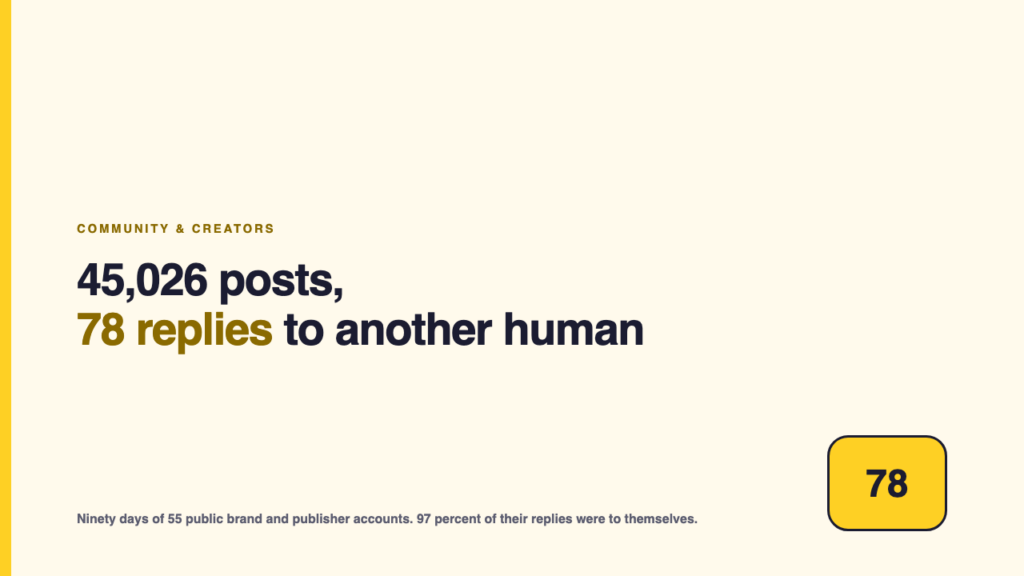
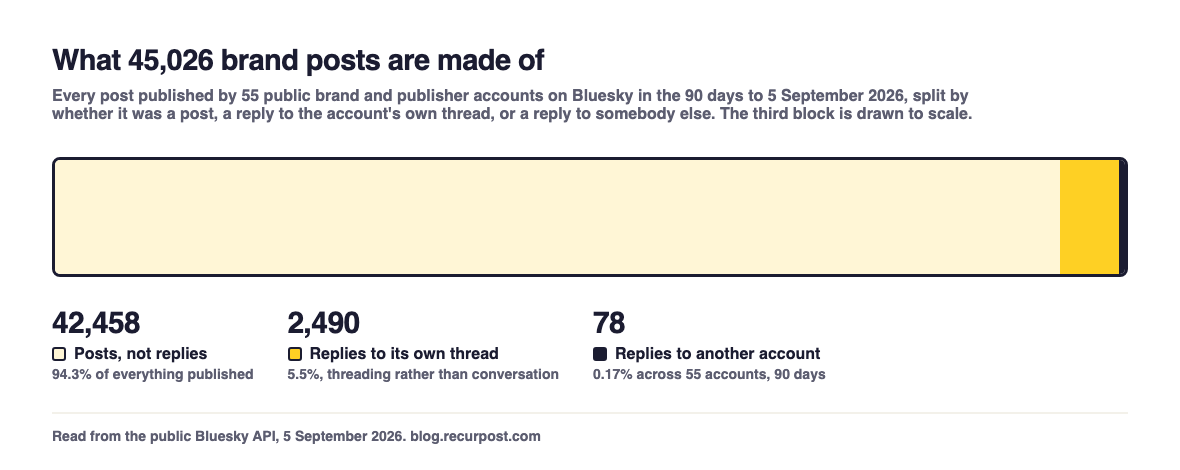
Over the 90 days to 5 September 2026 I collected every post published by 55 public brand and publisher accounts on Bluesky, from the public API, no login. 45,026 posts. For every one that was a reply, I read the parent post’s author, which is carried in the record itself, so a reply the account made to its own thread can be separated from a reply it made to another account.
- 2,568 of the 45,026 posts are replies, which is 5.7 percent.
- 2,490 of those replies, 97 percent, are the account replying to itself: threading, continuing a story, adding a link under its own post.
- 78 replies in 90 days went to another account. That is 0.17 percent of everything these 55 accounts published.
Eighteen of the accounts published more than 1,000 posts each in the window. Between all eighteen of them, over 90 days, there are three replies to another account.
The accounts that talk to people are small, and they are not publishers
| Account | Posts in 90 days | Replies to its own thread | Replies to someone else |
|---|---|---|---|
| Firefox | 41 | 5 | 17 |
| Proton | 26 | 6 | 15 |
| EFF | 596 | 48 | 8 |
| 404 Media | 504 | 49 | 6 |
| Internet Archive | 210 | 82 | 5 |
| PostHog | 170 | 112 | 4 |
| Mozilla | 23 | 3 | 4 |
| The Verge | 1,808 | 52 | 3 |
| Wikipedia | 324 | 171 | 3 |
| Netlify | 304 | 121 | 3 |
| Patagonia | 57 | 35 | 3 |
| Tailscale | 61 | 7 | 2 |
| Bandcamp | 36 | 18 | 2 |
| iFixit | 56 | 0 | 1 |
| DuckDuckGo | 37 | 8 | 1 |
| Raycast | 27 | 3 | 1 |
| Polygon | 2,500 | 0 | 0 |
| The Associated Press | 2,500 | 20 | 0 |
| The Guardian | 2,495 | 0 | 0 |
| Reuters | 2,494 | 40 | 0 |
| The Economist | 2,492 | 0 | 0 |
| The Wall Street Journal | 2,474 | 9 | 0 |
| New Scientist | 2,413 | 58 | 0 |
| Bloomberg | 2,404 | 1 | 0 |
| The Atlantic | 2,380 | 5 | 0 |
| The New York Times | 2,281 | 2 | 0 |
| NPR | 2,207 | 3 | 0 |
| Semafor | 2,093 | 673 | 0 |
| The New Yorker | 2,071 | 0 | 0 |
| Engadget | 1,633 | 0 | 0 |
| Wired | 1,559 | 526 | 0 |
| TechCrunch | 1,452 | 0 | 0 |
| Ars Technica | 1,221 | 0 | 0 |
| NBA | 842 | 257 | 0 |
| Nature | 788 | 2 | 0 |
| Rolling Stone | 660 | 25 | 0 |
| Vox | 553 | 48 | 0 |
| Axios | 383 | 0 | 0 |
| IGN | 322 | 13 | 0 |
| Crunchyroll | 204 | 0 | 0 |
| PlayStation | 121 | 0 | 0 |
| GitHub | 42 | 25 | 0 |
| Obsidian | 36 | 23 | 0 |
| washingtonpost.com | 28 | 21 | 0 |
| The Onion | 19 | 2 | 0 |
| vercel.com | 15 | 1 | 0 |
| Xbox | 13 | 0 | 0 |
| Docker | 9 | 8 | 0 |
| cnn.com | 8 | 2 | 0 |
| Kickstarter | 8 | 5 | 0 |
| Sentry | 8 | 0 | 0 |
| Signal | 5 | 0 | 0 |
| Ghost | 5 | 1 | 0 |
| espn.com | 4 | 0 | 0 |
| Fastmail | 4 | 0 | 0 |
Firefox and Proton are the only two accounts in this set where replying to other people is a normal part of what the account does: 17 of Firefox’s 41 posts in the window are replies to somebody else, and 15 of Proton’s 26. Mozilla, EFF, 404 Media, the Internet Archive, PostHog, Netlify and Wikipedia each manage a handful.
Thirty nine of the 55 accounts never replied to another account once in 90 days. Fifteen of them never posted a reply of any kind, including to their own threads.
The pattern is not really about size, though the largest accounts are the quietest. It is about what the account is for. The accounts that reply are running a support or community function through the same handle they broadcast from. The accounts that never reply are distributing a publication.
Threading is not conversation, and it is most of what looks like conversation
If you looked only at the raw reply count, several of these accounts would look conversational. Wikipedia replied 174 times. PostHog replied 116 times. Netlify 124. The Internet Archive 87.
Almost all of it is self-threading. Wikipedia’s 174 replies contain three to another account. PostHog’s 116 contain four. Netlify’s 124 contain three.
This matters if you are auditing an account, your own or a competitor’s, because reply counts are the easy metric and they measure the wrong thing. An account that threads heavily and never answers anybody will look, in any tool that counts replies, exactly like an account that spends its day in other people’s mentions.
The distinction takes one field to make: whose post is the parent. Any audit worth running should split those two numbers.
Why almost nobody does it
I want to be careful not to turn a measurement into a morality tale. There are real reasons a large publisher does not reply from its main handle.
Replying from a brand account is a judgement call every time, made in public, with no undo. It scales badly: a newsroom that answers one reader in the open has implicitly declined to answer the other four hundred. Many organisations route that work to a separate support handle, which this dataset would not see. And a reply from a brand account is a comment on someone else’s post, which is a different legal and reputational surface than posting your own.
What the numbers say is not that brands are lazy. It is that replying outward is not a default behaviour, it is a staffed decision, and 39 of these 55 organisations have not made it.
What to do with this if you run an account
- Split your reply metric in two. Replies to your own threads and replies to other accounts are different activities with different costs. Reporting them as one number tells you nothing about whether anyone is in the conversation.
- If outward replies are the plan, staff them like a shift, not like a habit. The accounts doing it here do a handful a week, not hundreds. Firefox’s 17 replies over 90 days is roughly one every five days, and that is enough to change how the account reads.
- Decide which handle carries it. A separate support handle is a legitimate answer and most of the large accounts here have effectively chosen it, whether deliberately or by default.
- The bar is genuinely low. Three replies across eighteen high-volume accounts in three months means almost any consistent outward presence makes an account unusual in its category.
What this cannot tell you
- One platform, 90 days, one collection date, 55 named accounts weighted towards news and technology publishers. Behaviour on Instagram or LinkedIn is a separate question and this data says nothing about it.
- Replies made from a separate support or careers handle are invisible here, and several of these organisations run one.
- Direct messages are invisible. An account that answers everything in DMs will look silent in this data.
- Deleted replies are not counted. Nine high volume accounts hit the collection page cap, so their post totals are floors, which if anything understates how lopsided the ratio is.
- The parent author is taken from the reply record’s own parent URI, so the self versus other split is exact for the replies collected. It is not a sample.
Source ledger
- Post and reply records: the public Bluesky AppView API (
public.api.bsky.app), endpointsapp.bsky.feed.getAuthorFeedandapp.bsky.feed.getPosts, read without authentication on 5 September 2026. 55 accounts, 45,026 posts, 2,568 replies, each reply’s parent author read from thereply.parent.urifield of the record. - The measured Instagram counterpart to this question, how fast brands answer comments on their own posts, is What response time is actually realistic.
- The job posting analysis referenced at the top is What forty three live social media job postings say the job covers.