There is a gap everyone in this work recognises between the job you applied for and the job you ended up doing. It is usually described from memory, in threads, after the fact. This piece tries to do something narrower and more checkable: read what the job adverts themselves say, right now, and count it.
On 5 September 2026 I collected every open social media role I could find on the public job boards of a fixed list of 630 company board names, using the Greenhouse, Lever and Ashby board APIs. Thirty three of those companies had a matching role open. After removing three talent pool listings with no defined role and nine postings whose text was duplicated across locations, that left 43 live postings from 33 companies. Every one of them is linked at the foot of this piece, so nothing here has to be taken on trust.
One thing to hold on to before the numbers start. These counts are an exact record of what the postings say, and a low estimate of what the jobs involve. A posting that says “manage our channels” and stops there scores zero for community management, zero for reporting and zero for video, because it named none of them. So read every figure below as “this many employers wrote it down”, never as “this many jobs require it”. The wording is the subject.
The median posting names three duties. One names eleven.
Across the 43 postings, the median number of distinct responsibility areas named in the text is three. The mean is 3.2. Three postings name none at all, in the sense that they describe the company and the person rather than the work. At the other end, Datadog’s Social Media Manager posting names eleven, running from the content calendar through community monitoring, performance analysis, corporate communications, employee advocacy, newsletters and event support.
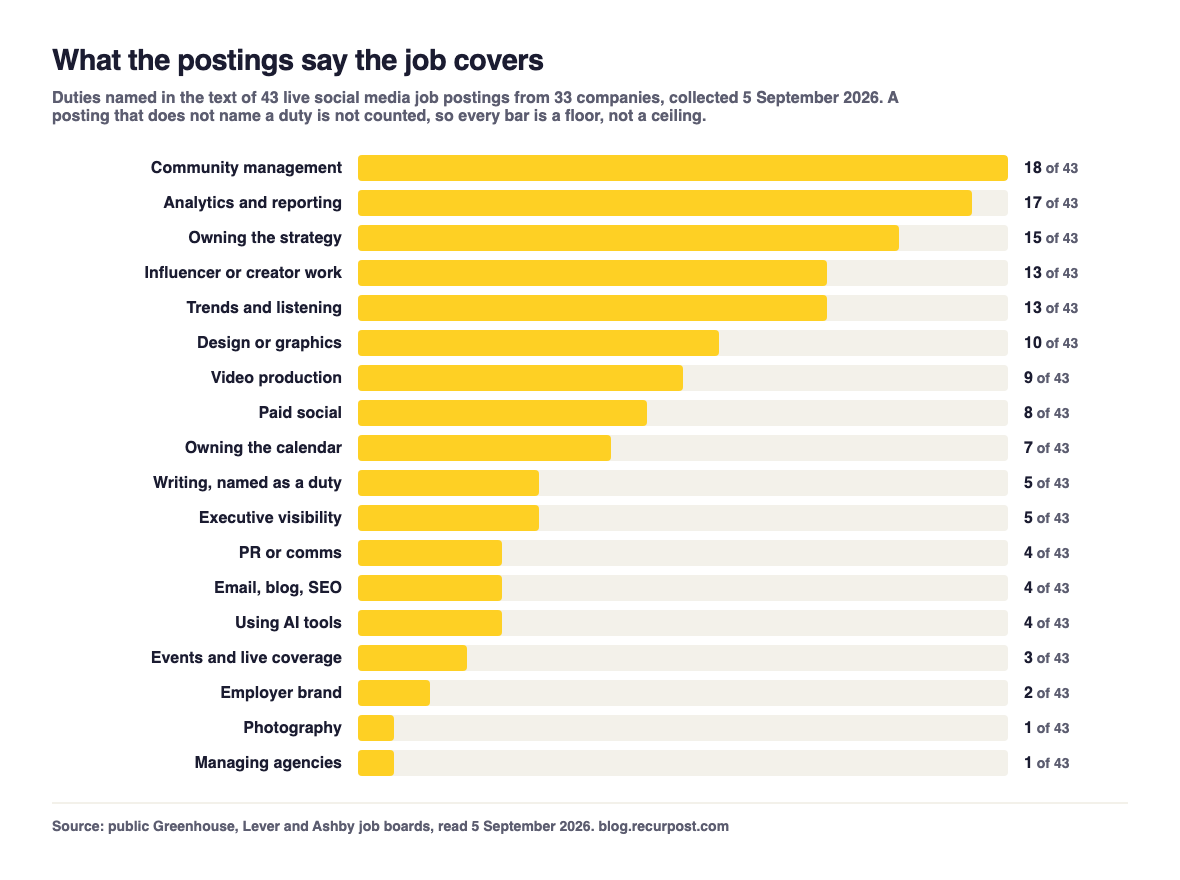
Here is the full count, in the postings’ own words.
| What the posting asks for | Postings | Share of 43 |
|---|---|---|
| Community management: replying to comments, DMs or moderating | 18 | 42% |
| Analytics and reporting | 17 | 40% |
| Owning the social strategy | 15 | 35% |
| Influencer or creator work | 13 | 30% |
| Trend monitoring and social listening | 13 | 30% |
| Design or graphics | 10 | 23% |
| Video production or editing | 9 | 21% |
| Paid social | 8 | 19% |
| Owning the content calendar | 7 | 16% |
| Writing and editing, named as a duty | 5 | 12% |
| Executive or founder visibility | 5 | 12% |
| PR or corporate communications | 4 | 9% |
| Email, blog, SEO or website work | 4 | 9% |
| Using AI tools, stated as an expectation | 4 | 9% |
| Events and live coverage | 3 | 7% |
| Employer brand or employee advocacy | 2 | 5% |
| Photography | 1 | 2% |
| Managing agencies, vendors or freelancers | 1 | 2% |
Two things in that table are worth sitting with.
The first is that community management is the single most commonly written down duty, in 18 of 43 postings. Replying to comments, handling DMs, moderating, routing things to other teams. It is the part of the job that is hardest to schedule, hardest to show in a portfolio, and it now appears in the advert more often than strategy does.
The second is that writing is named as a duty in only five postings. That is not because these jobs do not involve writing. It is because writing is assumed. It has stopped being a thing employers think to list, the way “must use a computer” stopped being listed. Datadog is one of the few that says it out loud, asking for someone who “can write a scroll-stopping post and explain exactly why it worked”. Design and video, by contrast, are named in 10 and 9 postings, because they are still treated as separate skills worth requesting.
Who you report to is usually left out
Twelve of the 43 postings say who the role reports to. One says how big the team is.
That single posting is Synthesia’s Social Media Associate, which tells you that you would report to the Head of Social Media and “work alongside a team of six, including videographers, editors, and creators who produce exceptional content in-house”. Whatever else is true of that role, a candidate can picture their working week from that sentence.
Where the reporting line is given, it is revealing. Social sits under communications at Asana (Head of Global Communications) and Datadog (Senior Group Manager of Corporate Communications). It sits under brand at Quince (Head of Brand Strategy and Narrative) and Rothy’s (VP of Brand and Communications). At Bombas it sits under acquisition, reporting to the Director of Acquisition, which is a materially different job with the same title on the door. Airbnb’s China operations role reports to a Social Lead. Betterment’s associate role reports to a Social Media Manager, and Glossier’s to a Senior Social Media Manager, which are the two postings in the set where a candidate can see a person one rung above them doing the same craft.
For the other 31 postings, the answer is not in the document. You find out at interview, or later.
The always on question, in the postings’ own words
The expectation that this job never really stops is one of its defining complaints. So it is worth asking how often employers put it in writing.
I flagged every posting mentioning weekends, evenings, nights, on call, after hours or around the clock, then read all eight matches by hand, because a keyword pass gets this badly wrong in both directions. Three of the eight were describing “always-on content”, which is a content type, or an early finish Friday benefit. That left five postings of 43 that state work outside standard hours.
They are not the roles you would guess.
- Rover’s Social Media Specialist (Trust and Safety): “To be considered for this role, you must be able: Able to work evenings, weekends and holidays.” The same posting is careful to add, “Note: This is not a Marketing or content creation role.”
- Stripe’s two Social Media, Customer Support Associate postings, in Bengaluru and Mexico: “You’re willing to work a weekend day for which you will receive a weekday off in lieu.” One of the two carries “(Includes Weekend Rotation)” in the job title itself.
- Vox Media’s Head of Social, Vulture, covering red carpets, premieres and award shows: “This occasionally involves night and weekend work.”
- Bombas’ Social Marketing Manager, which asks for a “flexible work schedule based on channel optimization needs (e.g. comfortable with weekend platform management based on performance).”
Four of the five are support, trust and safety, or live event coverage, where the out of hours requirement is structural and the employer says so plainly, and in two cases pays it back in time off in lieu. Only the fifth is a brand social role, and it is the one that phrases the expectation as flexibility rather than as hours.
The honest reading is not that the always on problem is invented. It is that it mostly is not written down. Thirty eight postings describe a job that runs on posting schedules, live moments, comment threads and platform incidents, and say nothing at all about when the person doing it is expected to be available. The expectation arrives later, unnegotiated, because it was never a term of the role.
The platforms named, and the fourteen postings that name none
| Platform named in the posting | Postings | Share of 43 |
|---|---|---|
| YouTube | 18 | 42% |
| 17 | 40% | |
| TikTok | 16 | 37% |
| 14 | 33% | |
| X | 14 | 33% |
| 10 | 23% | |
| 8 | 19% | |
| Discord | 5 | 12% |
| Threads | 4 | 9% |
| Twitch | 3 | 7% |
| 2 | 5% | |
| Bluesky | 1 | 2% |
YouTube appears in more postings than Instagram or TikTok. That surprised me, and it is worth being careful about: this set skews to technology and consumer brands with public applicant tracking systems, several of them games and developer companies where YouTube, Reddit, Discord and Twitch are the home platforms. Reddit is named in 10 postings and Discord in 5, which would not happen in a sample drawn from consumer retail.
The median posting names three platforms. Four ask for seven. Fourteen name none at all, which usually means one of two things: either the posting was written at a level of abstraction above the work, or the channel mix is assumed to be obvious. Neither is good news for a candidate trying to work out what Monday looks like.
Seniority, experience and the missing bottom rung
Of the 43 postings, 24 carry a manager, lead or head title, five sit at director level or above, and five are junior: associate, coordinator or specialist. Two are explicitly senior. The rest do not signal a level in the title.
Twenty one postings state a minimum number of years, with a median of four and a range from one to eight. The junior roles, where they state anything, ask for one to three years.
Twelve of the 43 are contract, freelance, fixed term or part time rather than permanent employment, including two twelve month fixed term contracts, a six month project hire and several freelance strategist roles.
Put those together and the shape of the market in this snapshot is a wide band of mid level roles, thin at the bottom, with about a quarter of the openings being temporary by design.
The tools employers name
Postings name tools rarely, and when they do it is usually as familiarity rather than a requirement. Across the 43: Adobe products in 6, Figma in 5, Canva in 5, Sprout Social in 3, Hootsuite in 2, CapCut in 2, Tagger in 2, and one mention each of Later, Emplifi, Sprinklr, Notion and Slack.
Four postings state an expectation about AI tools. Gusto’s Social Content Strategist is the clearest: “AI is a fundamental part of how work gets done at Gusto. We expect all team members to actively engage with AI tools relevant to their role and grow their fluency as the technology evolves.” Datadog asks for curiosity about “opportunities to use tools such as large language models to improve social media workflows”. This is a small number today. It is the sort of line that tends to be in every posting two years later, which makes the 9 percent worth writing down now.
What this cannot tell you
- It is 43 postings from 33 companies on one day, not a census. Companies that hire through agencies, referrals, LinkedIn only, or their own careers software do not appear at all, and neither does most agency side hiring.
- The universe was built from a fixed list of company board tokens, which skews technology, consumer brands and United States roles.
- Coding is a lower bound. Vague postings score low even when the underlying job is broad.
- A posting is a marketing document. It describes what the employer wants applicants to believe about the role, which is exactly why the omissions, especially the reporting line and the hours, are the interesting part.
- Postings are live. Some of these roles will be filled or withdrawn by the time you read this. Every figure here is as read on 5 September 2026.
The full list
All 43 coded postings, with the duty and platform counts described above.
Source ledger
- Public job board APIs queried on 5 September 2026: Greenhouse (
boards-api.greenhouse.io), Lever (api.lever.co), Ashby (api.ashbyhq.com). 34 of the coded postings came from Greenhouse, 5 from Lever, 4 from Ashby. - Every posting URL in the table above was requested on 5 September 2026. Forty returned HTTP 200. Three returned HTTP 403 to an automated request and were read through the same public board API that listed them: both Epic Games postings and the HelloFresh posting.
- Quotations are verbatim from the posting bodies as returned by those APIs on 5 September 2026.
- The salary side of this question was collected separately on 28 August 2026 and published in 19 social media job postings that published a salary range.