The always on complaint is the most repeated thing about this job and the least measured. Last week I read 43 live social media job postings and found that only five of them say anything at all about working outside standard hours. The advert is silent. So what does the output look like?
Post timestamps are public. Over the 90 days to 5 September 2026 I collected every post published by a set of public brand and publisher accounts on Bluesky, straight from the public API. Restricting to the 28 United States based accounts with at least 100 original posts in the window, that is 35,107 posts, each one carrying the moment it was published, converted to Eastern time.
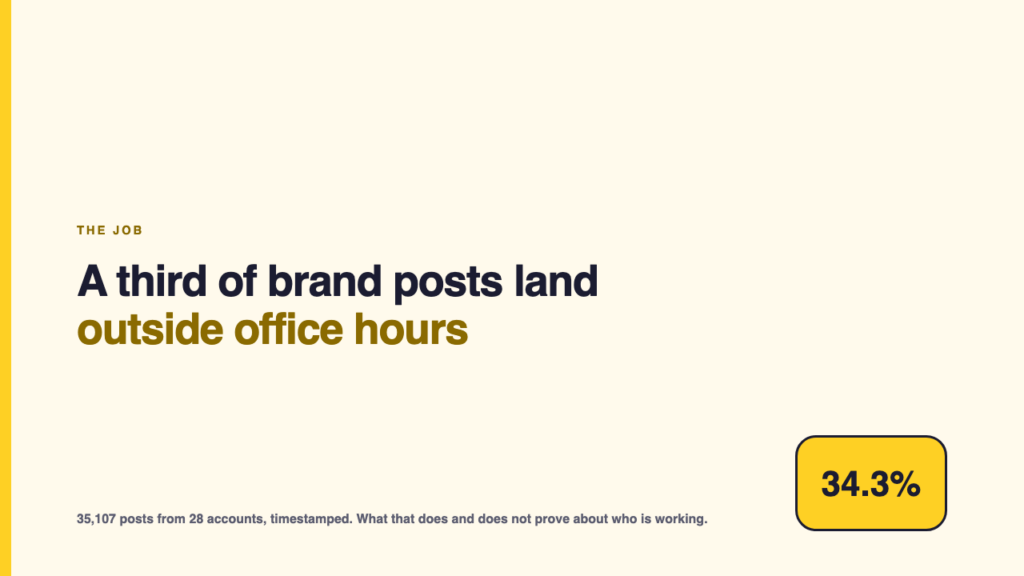
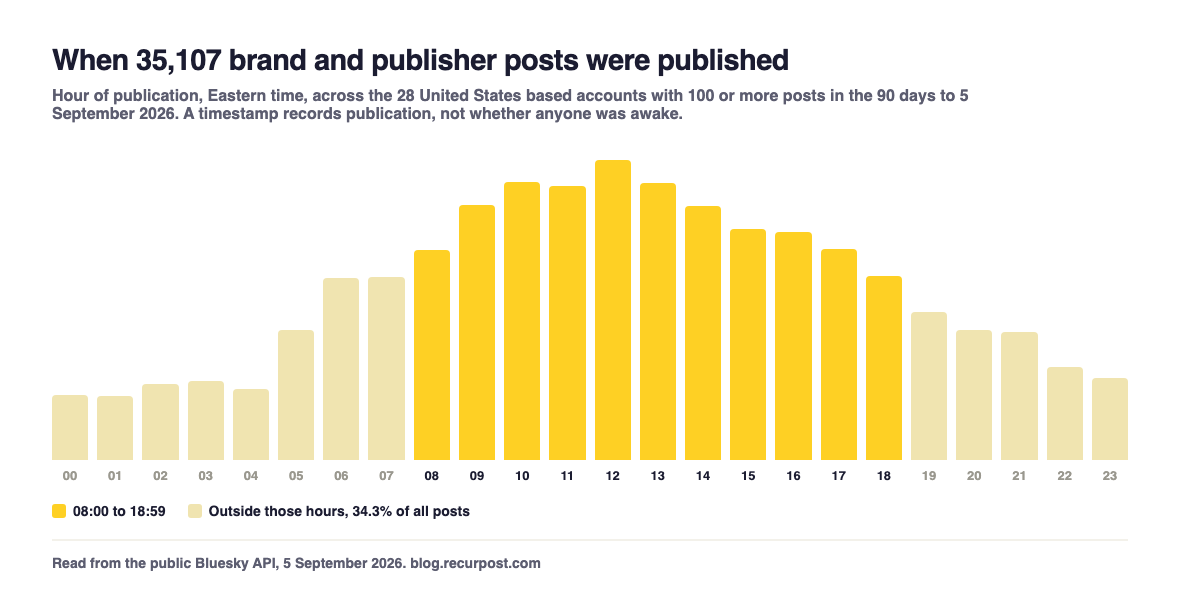
34.3 percent of those posts were published outside 08:00 to 19:00 Eastern. 16.6 percent landed on a Saturday or a Sunday.
Before that number gets used as evidence of anything, the caveat has to come first, because it is large.
A timestamp is not a person
A post published at 03:00 tells you a post was published at 03:00. It does not tell you that somebody was awake.
Scheduling is the entire reason. So is automation: a publishing system wired to a CMS will push a story to social the moment it goes live, which for a wire service is all night. So is a distributed team, where 22:00 Eastern is a normal afternoon somewhere else.
What the timestamps can honestly support is narrower and still useful: they show which accounts run a publishing surface that never closes, and which ones run one that keeps office hours. And because the shape varies enormously between accounts doing similar work, the variation is the finding.
The spread between accounts is the story
| Account | Posts | Outside 08:00 to 19:00 Eastern | On weekends |
|---|---|---|---|
| IGN | 309 | 80% | 38% |
| Crunchyroll | 204 | 53% | 30% |
| NBA | 585 | 51% | 23% |
| Reuters | 2,454 | 50% | 7% |
| Bloomberg | 2,403 | 48% | 17% |
| Polygon | 2,500 | 47% | 18% |
| Wired | 1,033 | 47% | 21% |
| The Wall Street Journal | 2,465 | 47% | 19% |
| The Associated Press | 2,480 | 45% | 24% |
| Nature | 786 | 43% | 13% |
| Vox | 505 | 41% | 11% |
| Internet Archive | 123 | 39% | 17% |
| The New York Times | 2,279 | 36% | 19% |
| NPR | 2,204 | 36% | 27% |
| The New Yorker | 2,071 | 36% | 20% |
| The Atlantic | 2,375 | 33% | 26% |
| Axios | 383 | 30% | 14% |
| Engadget | 1,633 | 18% | 15% |
| Semafor | 1,420 | 16% | 1% |
| The Verge | 1,753 | 14% | 12% |
| TechCrunch | 1,452 | 13% | 9% |
| PlayStation | 121 | 12% | 1% |
| EFF | 540 | 11% | 18% |
| Ars Technica | 1,221 | 9% | 4% |
| Rolling Stone | 635 | 5% | 2% |
| Netlify | 180 | 4% | 1% |
| 404 Media | 449 | 4% | 20% |
| Wikipedia | 150 | 1% | 14% |
Look at the two ends of that table.
Ars Technica publishes 9 percent of its posts outside office hours and 4 percent at weekends. Rolling Stone: 5 percent and 2 percent. Netlify: 4 percent and 1 percent. 404 Media: 4 percent out of hours. These are working publications, some of them daily news operations, whose social output stops in the evening and mostly stops at the weekend.
IGN publishes 80 percent of its posts outside 08:00 to 19:00, and 38 percent at weekends. Crunchyroll is at 53 and 30. The NBA, whose product happens at night and at weekends, is at 51 and 23.
Both patterns are deliberate. Neither is an accident of the platform. Somebody decided.
The clearest way to see that is to put accounts side by side that do comparable work at comparable volume. Ars Technica, Engadget and The Verge all cover consumer technology daily and all published between 1,200 and 1,800 posts in the window. Ars Technica put 9 percent of them outside office hours and 4 percent at weekends. The Verge put 14 percent outside office hours and 12 percent at weekends. Engadget put 18 percent and 15 percent. Same beat, same order of volume, and the weekend share differs by a factor of four.
Across the 28 accounts the median is 35.9 percent out of hours and 16.8 percent at weekends, but that median hides a set that is genuinely split: 5 accounts sit below 10 percent out of hours, 11 sit above 40 percent.
The shape of the day
Aggregated across all 28 accounts, posting rises from 05:00, peaks between 10:00 and 13:00 Eastern, then declines through the afternoon and evening without ever stopping. The floor, between 00:00 and 04:00, still holds about 1.5 to 1.9 percent of daily volume each hour.
Weekdays carry between 15 and 18 percent of posts each. Saturday holds 8.6 percent and Sunday 8.0 percent, which is roughly half of a weekday. Not zero, and not a normal day either.
What this means for the job
Put this next to the job advert finding and the picture is coherent, and slightly uncomfortable.
Almost no employer writes down an expectation of evening or weekend availability. In the postings I read, the five that did were mostly support and trust and safety roles, where the requirement is structural and paid for with time off in lieu. Brand social roles said nothing.
Meanwhile a third of brand and publisher output lands outside office hours, and the split between accounts is wide enough to prove that this is a decision rather than a fact of the medium.
The practical version, if you are the person holding the account:
- Ask what the pattern actually is before you take the job. The advert will not tell you. The account will. Scroll its posts and look at the timestamps, which are public on every platform. An account posting at 23:00 every night is describing your evenings.
- If your account genuinely needs to be live outside office hours, that is a coverage question, not a willingness question. Rotas, time off in lieu, a defined escalation path. Two of the five postings that asked for weekend work paid it back in a weekday off, in writing.
- If the pattern is drift rather than design, the timestamps are the argument. Three months of your own posting history, split by hour, is a stronger case than any description of how it feels.
- Scheduling is the tool that separates publishing from presence, and this data cannot tell them apart. That cuts both ways: posts prepared in advance can cover a Sunday without anyone working, and they can also hide the fact that somebody is working every Sunday.
What this cannot tell you
- Timestamps record publication, not labour. Scheduled and automated posts are indistinguishable from live ones in this data, and no part of this piece can claim someone was working at a given hour.
- One platform, 90 days, one collection date. Bluesky’s brand mix skews to news and technology publishers, which plausibly run later than most brand accounts.
- Time zone is assigned by the organisation’s headquarters, not by the person posting. A distributed team’s local hours are invisible here, and 28 accounts were included only because they are United States based.
- Nine of the highest volume accounts hit the collection page cap, so their windows are shorter than 90 days. Proportions by hour are unaffected by that.
- Replies are excluded throughout. Only posts the account published itself are counted.
Source ledger
- Post records: the public Bluesky AppView API (
public.api.bsky.app), endpointsapp.bsky.actor.getProfileandapp.bsky.feed.getAuthorFeed, read without authentication on 5 September 2026. The full collection is 60 accounts and 45,026 posts over the 90 days to 5 September 2026; this piece uses the 28 United States based accounts with 100 or more original posts, totalling 35,107 posts. - Timestamps are the
createdAtvalue on each post record, converted from UTC to America/New_York. - The job posting analysis referenced above is What forty three live social media job postings say the job covers, collected 5 September 2026.