The account is locked, or it is posting things nobody on your team wrote, and two tabs are open. One is the platform’s recovery form. The other is a blank document where a statement is supposed to go. Whichever gets the next twenty minutes, the other waits. That call usually gets made on instinct, and instinct is a bad guide here, because only one of the two tabs is running against somebody else’s clock.
Two different problems, two different documents
The crisis communications advice that circulates among people who run accounts, passed along in threads and conference talks and half-remembered agency training, has no citable primary source. You cannot look up the document it came from, because there isn’t one. So this piece compares two document classes that can actually be read.
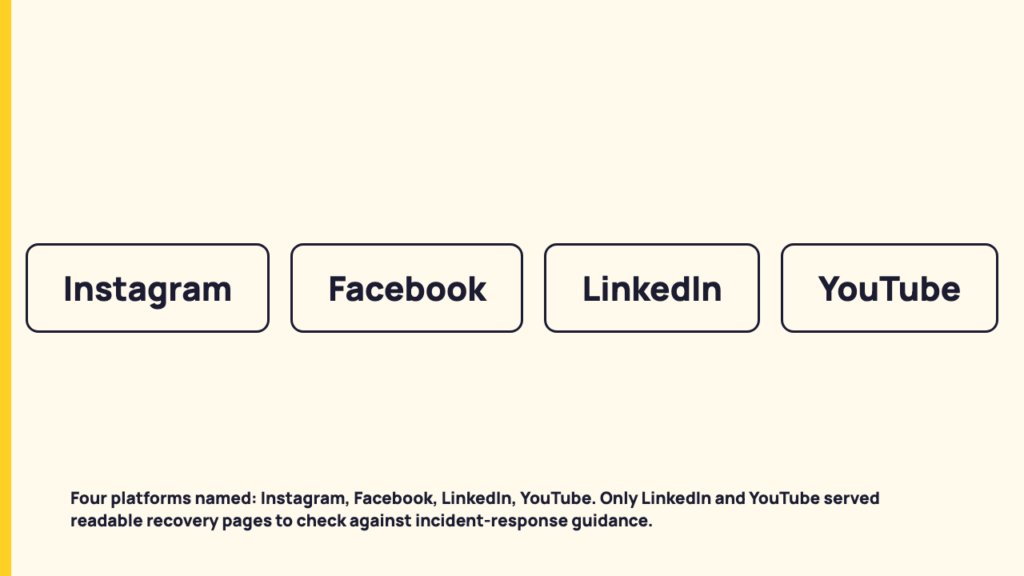
The first is platform compromised-account and appeal documentation: the help-centre pages Instagram, Facebook, LinkedIn, and YouTube publish telling an account holder what to do and what form to file. They are procedural artifacts, and they exist to get access back. The second is published incident-response and breach-notification guidance, specifically NIST Special Publication 800-61 Revision 3 and the Federal Trade Commission’s Data Breach Response: A Guide for Business. Those address in writing when an organisation communicates during a security incident, and to whom.
The claim here is narrow: the two solve different problems, and treating them as one thing is what wastes the first hour. The recovery form does not care what your statement says. The incident-response literature does not know your platform’s form exists.
What each platform’s own documentation instructs
The table below covers the two platforms whose help pages served readable article text to a fetch on 5 September 2026. Meta’s Instagram and Facebook pages did not, so nothing about their contents is described here rather than filled in from memory.
| Platform | Documented path | Documented clock |
|---|---|---|
| Submit the Report Unauthorized Account Access or Changes form as soon as possible, with your profile URL. LinkedIn states that after receiving it, it verifies the account is yours and then helps you regain access. If you can still log in, it also tells you to change the password, turn on two-factor authentication, sign out of unfamiliar active sessions, and check the email addresses and phone numbers on file. A second page covers cleanup once access is back, via its own request form. | None stated on either page | |
| YouTube | Three documented steps: recover and secure the Google Account tied to the channel, revert unwanted changes, then reduce the risk of further access. Channel recovery is Google Account recovery. If the channel was terminated after the hack, YouTube states the appeal may not be accepted if account recovery is incomplete, so the order is a documented dependency, not a preference. The appeal itself runs through YouTube Studio: Begin Review, read the stated reason, start the appeal, give a contact email and a reason, submit. | Two, both binding the account holder rather than YouTube: support is limited to hacking incidents from the past nine months under the stated data retention policy, and creators have up to one year from termination to appeal. An anticipated review time is shown inside Studio, but no number is published. |
A note on that first row. The two LinkedIn help URLs originally slated for this comparison turned out to cover a security footer in LinkedIn emails and a policy on prohibited software. Neither is a recovery page. The row above uses the pages that actually cover the scenario, found by reading titles rather than trusting URLs.
What the published incident-response frameworks actually say about sequencing
NIST SP 800-61 Revision 3 was published in April 2025 and supersedes Revision 2 from 2012, so the four-phase lifecycle most people half-remember is the retired one. Revision 3 is a Cybersecurity Framework 2.0 Community Profile, and it organises incident response around the six CSF 2.0 Functions instead: Govern, Identify, Protect, Detect, Respond, and Recover. Govern, Identify, and Protect are preparation, and the document says plainly that they are not part of the incident response itself. The response is Detect, Respond, and Recover, which it describes as covering incident reporting, notification, and other incident-related communications alongside the technical work.
Communication is therefore not a phase bolted onto the end. It sits inside Respond, in a high-priority category called Incident Response Reporting and Communication, which splits it four ways: coordination with the parties who have response roles, notification formally informing affected customers, employees, partners, or regulators, public communication about the incident’s status, and information sharing that passes threat data onward. Only the third is what most people mean by a statement, and the recommendation attached is that the team coordinates once the incident is analysed and prioritised. Analysis comes first in the written sequence. NIST also says organisations should use whichever lifecycle model suits them best, so this is an ordering it documents, not a rule it imposes.
The FTC guide, dated August 2023, runs in three parts: secure your operations, fix vulnerabilities, notify appropriate parties. Notifying appropriate parties usually means the channel you still control rather than the one you have lost access to, which is why the company’s own site, and the website hosting keeping it online, often carries the first accurate statement. Communications appears in two of them. Under fixing vulnerabilities it asks for a plan covering employees, customers, investors, and business partners, and it is specific about content: no misleading statements, no withholding of details that would help consumers protect themselves, plain-language answers to the obvious questions. Notification comes third, and its timing advice is conditional rather than numeric. Early notification lets people limit the damage, the guide says, then it tells you to consult your law enforcement contact so the notice does not impede the investigation, and to designate one person for releasing information.
The boundary matters more than any of that. The guide is written for a business whose breach exposed personal information, and it points at state, territory, and sector-specific notification law that attaches to exactly that. A social account that is locked, defaced, or posting spam, with no personal or customer data exposed, is not automatically a reportable breach under it. Reaching for its obligations because an account got taken over applies a legal framework to a case it was not written for.
Where the documentation goes quiet
- Neither of the two platforms read here, LinkedIn and YouTube, commits to a response time. LinkedIn’s pages state a process and no duration. YouTube’s two published deadlines both bind the account holder. Its termination page points to an anticipated review time inside Studio, which means a number exists in the product but not in anything you can read before you need it.
- That is a planning fact, not a failing. A recovery queue is not a service desk with a contract. Any commitment you make about when the account comes back is yours alone, and nothing in the documentation backs it.
- Nothing documents a coordinated or mass-reporting campaign. None of the documentation fetched here describes a procedure for an account targeted by an organised reporting campaign. No dedicated form, no escalation path, no separate queue. That gap will not be filled in by presenting ordinary reporting-dispute steps as though they were built for it.
A sequencing decision for the first hour, grounded in what’s documented
- File the recovery or appeal request first, because it is the only move on a clock you do not control. Nothing happens on the platform’s side until the form exists, and YouTube’s support window runs from when the incident occurred rather than from when you noticed.
- Respect the documented dependencies inside that track. YouTube states the appeal may not be accepted if account recovery is incomplete, and that channel recovery is Google Account recovery. Where the documentation names an order, follow it rather than parallelising.
- Draft the statement, but treat it as unblocked rather than urgent. No platform clock runs on it. NIST’s documented ordering puts coordination and notification after the incident is analysed and prioritised, which in practice means knowing what happened before saying what happened. Drafting while containment is underway costs nothing. Publishing before you know costs a correction. And do not promise a restoration time, because no source read here supports one.
- Change the calculus entirely if data may be exposed. If the compromise touched personal or customer information rather than just the account, the FTC guide and your legal counsel own the sequence, not this piece.
- Treat this as a sequencing principle, not a playbook. It is derived from two document classes and nothing else. It is no substitute for the incident response plan your organisation should have written down while nothing was on fire.
Where this sits next to why the account was restricted in the first place
Everything above starts after the incident, with access already gone and only the next hour in question. What got you here, meaning which behaviours the platforms document as triggering enforcement, is a separate question with a separate evidence base, answered in our piece on why the account was restricted in the first place. Read that one when nothing is broken. Read this one when something is.
FAQ
Does any platform state how long an account recovery or appeal review will take?
Neither of the two platforms whose documentation could be read for this piece states one. LinkedIn documents a process and no duration. YouTube publishes two time limits, nine months of support eligibility and one year to appeal a termination, but both bind the account holder rather than YouTube, and its termination page defers the review estimate to a figure inside Studio. Instagram’s and Facebook’s help pages could not be retrieved as readable text here, so nothing is claimed about them. No typical wait time is offered, because no source read supports one.
What should be done first: filing the recovery request or drafting a statement?
File the request. It is the only one of the two gated by somebody else’s process and somebody else’s clock, per the platforms’ own documentation. Drafting a statement is not gated by anything, and NIST SP 800-61 Revision 3 documents coordination and notification as following analysis and prioritisation, not preceding them. That is a sequencing principle drawn from two classes of document, not universal advice. An incident that exposed customer data changes what the first hour looks like.
Sources
- LinkedIn Help Center, Report a compromised account, fetched 5 September 2026.
- LinkedIn Help Center, Compromised account cleanup, fetched 5 September 2026.
- YouTube Help, Recover a hacked YouTube channel, fetched 5 September 2026.
- YouTube Help, Channel or account terminations, fetched 5 September 2026.
- NIST SP 800-61 Revision 3, Incident Response Recommendations and Considerations for Cybersecurity Risk Management: A CSF 2.0 Community Profile, published April 2025, fetched 5 September 2026. Full text.
- Federal Trade Commission, Data Breach Response: A Guide for Business, dated August 2023, fetched 5 September 2026.