Picture a common moment, not a reported incident: someone senior sends a viral meme, or a screenshot of a funny post, with the instruction to put it on the brand account today. You are the person who has to decide whether that is a problem. Two beliefs usually decide it before anyone checks anything: “it’s fair use” and “it’s everywhere, so it’s fine.” This post tests both against what the US Copyright Office has actually published.
Are memes fair use? Not automatically. The Copyright Office’s Fair Use Index says “Courts evaluate fair use claims on a case-by-case basis”, weighing the four factors in Section 107. A brand account’s commercial purpose counts under the first factor, and the Office says that does not mean all “commercial uses are not fair”. It is one factor, not a verdict.
Some limits up front. This is a reading of three pages from the US Copyright Office, covers US law only, and is not legal advice. The Office says so itself on its Fair Use Index page: “the Copyright Office is unable to provide specific legal advice to individual members of the public about questions of fair use.” This post will not tell you that any meme is safe or unsafe. What it can do is show you what the Office says, so you know which questions you are really asking.
The request, and the two beliefs behind it
The first belief treats “fair use” as a label you can attach to a post. The second treats wide circulation as a kind of permission. Both feel reasonable when a meme has been seen a million times. Do the Office’s own words support either? The sections below read the Fair Use Index (the page shows “Index last updated July 2026”, fetched 2026-11-02) and the Office’s FAQ on using someone else’s work, fetched the same day.
What the Copyright Office actually says fair use is
The Index defines it this way: “Fair use is a legal doctrine that promotes freedom of expression by permitting the unlicensed use of copyright-protected works in certain circumstances.” It adds that Section 107 of the Copyright Act “provides the statutory framework for determining whether something is a fair use.”
Section 107, according to the Index, names certain types of uses as examples of activities that may qualify: criticism, comment, news reporting, teaching, scholarship and research. They are examples, not automatic passes. Posting a meme for engagement is not on that list. That is an observation about the wording of the list, not a claim about any court ruling.
The same page says the Index is “not a substitute for legal advice,” and that for a concern about a particular use “it is best to consult an attorney.”
Are memes fair use for a brand account? The four factors
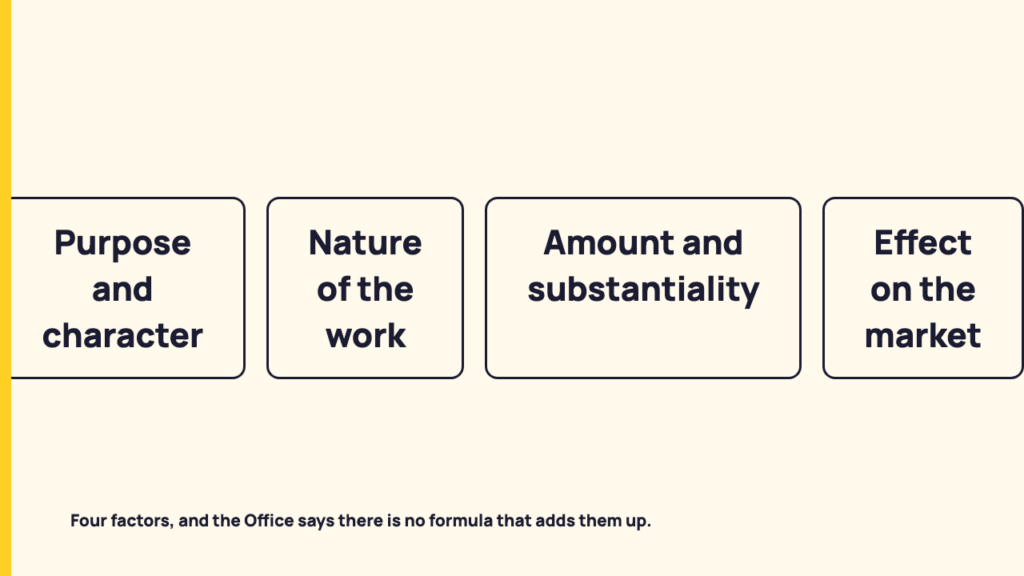
The Index lists four factors that Section 107 calls for a court to consider. The table puts the Office’s wording next to the question each raises for a repost. The questions are not answers, and none of them predicts an outcome.
| Factor | What the Office says | The question it raises |
|---|---|---|
| Purpose and character | Courts look at “whether the use is of a commercial nature or is for nonprofit educational purposes” and “are more likely to find that nonprofit educational and noncommercial uses are fair.” Then: “This does not mean, however, that all nonprofit education and noncommercial uses are fair and all commercial uses are not fair; instead, courts will balance the purpose and character of the use against the other factors below.” Transformative uses “add something new, with a further purpose or different character, and do not substitute for the original use of the work.” | A brand account is commercial, but the Office says that does not settle it. Does an unchanged meme with a caption add anything new, or simply carry the original? |
| Nature of the work | “Using a more creative or imaginative work (such as a novel, movie, or song) is less likely to support a claim of a fair use than using a factual work (such as a technical article or news item).” | Where do an image macro, a screenshot of a post, or a film still fall: nearer creative expression, or nearer fact? |
| Amount and substantiality | Courts look at “both the quantity and quality of the copyrighted material.” If the use includes a large portion, “fair use is less likely to be found.” Yet “some courts have found use of an entire work to be fair under certain circumstances,” and a small amount has been held not fair where it was “the ‘heart’ of the work.” | A meme is usually the whole image. What follows, given that quantity and quality both count and neither direction is guaranteed? |
| Effect on the market | Courts consider “whether the use is hurting the current market for the original work” and “whether the use could cause substantial harm if it were to become widespread.” | Could the repost stand in for the original? Who would be asked to pay for the original, and would they still need to? |
Notice what the commercial passage does and does not say. It does not make a brand account automatically ineligible, and it does not make noncommercial uses automatically fair. Both are balanced against the other factors.
No formula: why the factors do not add up to a rule
The last paragraph of the Index’s “About Fair Use” section is the one a manager most needs to hear. It says: “Courts evaluate fair use claims on a case-by-case basis, and the outcome of any given case depends on a fact-specific inquiry.” And then: “This means that there is no formula to ensure that a predetermined percentage or amount of a work” may be used without permission, nor a “specific number of words, lines, pages, copies.”
The FAQ is plainer: “There are no legal rules permitting the use of a specific number of words, a certain number of musical notes, or percentage of a work. Whether a particular use qualifies as fair use depends on all the circumstances.”
That removes a tool you might have hoped to use. Neither page offers a number or a category that works as a safe harbour.
It also says what happens when someone uses a work without authorization: “the owner may be entitled to bring an infringement action against you.” And it adds: “in cases of doubt, the Copyright Office recommends that permission be obtained.”
Finally, the FAQ answers the question of who gets the last word. In a passage about a copy shop declining to reproduce old photographs, it says that even if a person decides a use is fair under the Section 107 factors, “a copy shop or other third party need not accept the person’s assertion that the use is noninfringing. Ultimately, only a federal court can determine whether a particular use is, in fact, a fair use under the law.” The passage is about a copy shop, but the point carries over: “it’s fair use” is an assertion, and a platform or a client does not have to accept it as an answer.
‘It’s everywhere’ and what the pages say about it
On permission, the FAQ says you can ask for it: “If you know who the copyright owner is, you may contact the owner directly.” Anyone who uses a work without authorization may face an infringement action. Neither fetched page contains an exception for wide circulation or for “everyone is doing it.” That is a statement about those two pages, not about every legal source.
A work’s wide availability does not appear in the Office’s list of four factors. That is all I will claim from the pages on this point.
The nearest the Office comes to the topic is inside the market factor: a court considers whether the use “could cause substantial harm if it were to become widespread.” Widespread copying appears there as a reason for concern, not comfort. It cuts toward caution.
A practical decision path that stays inside what the sources support
Here are questions a manager can ask before posting. Each ties back to a line quoted above.
- Is the account commercial? The Office says this matters but does not decide the outcome.
- Does the post change or comment on the work, or only carry it? The Office describes transformative uses as adding “something new, with a further purpose or different character.”
- Is the work creative, and how much of it is used? The Office says more creative works are less likely to support fair use, and that large portions make fair use less likely.
- Could the post stand in for the original? This is the market factor: the use “hurting the current market for the original work.”
- Can the owner be found and asked? The FAQ says you can ask for permission, and explains how to search Copyright Office records for ownership. Registrations and documents recorded from 1978 onward can be searched online, and staff will search on request.
Answering these does not produce a yes or no, because the Office says there is no formula. The honest outputs are three: get permission, use a licensed or original alternative, or ask a lawyer for a view. Where there is doubt, the Office recommends obtaining permission.
Platform rules are a separate layer; see what each platform’s terms say about reposting. When the meme is a GIF, the host it came from adds one more layer, covered in what GIF hosts like GIPHY and Imgur let you keep.
What this guidance cannot settle
The Fair Use Index is a database of court opinions the Office has summarised, and the Office says it “does not include all judicial opinions on fair use.” No individual case is cited here, because none was read.
How a court would weigh the factors for a specific brand post is the one question this post cannot resolve. It also covers US law only. Other countries have different rules, and none of them are discussed here. Copyright is also only one of the federal rules a brand account answers to; buying followers or engagement falls under another, the FTC’s fake social media indicators rule.
What to take to a lawyer or a client
Three things: the four factors as the Office words them, the no-formula passage quoted above, and the Office’s recommendation to seek permission in cases of doubt. They will not tell you whether a post is safe. They will let you explain why no one can say so from a chat message. If the owner does grant permission, put the terms in writing; a social media agreement template is one starting point to adapt with your lawyer.
FAQ
Is there a number of words, seconds or a percentage that is safe to use?
The Office says no. The Index says “there is no formula” for a predetermined percentage or amount, and the FAQ says “there are no legal rules permitting the use of a specific number of words, a certain number of musical notes, or percentage of a work.” This is not legal advice.
If a meme is everywhere, can a brand post it?
Neither fetched page contains a wide-circulation exception. The FAQ says use without authorization may draw an infringement action, and that in cases of doubt the Office recommends obtaining permission. That describes those two pages only and is not legal advice.
Do memes have copyright?
A third Copyright Office page, its general FAQ read on 2026-11-03, says copyright protects “original works of authorship including literary, dramatic, musical, and artistic works”, and that a work “is under copyright protection the moment it is created and fixed in a tangible form”. The FAQ does not mention memes, so whether the image or text in a given meme is protected, and who holds that protection, depends on the work, and this is not legal advice.
Sources
- U.S. Copyright Office Fair Use Index, “Index last updated July 2026”, fetched 2026-11-02 (HTTP 200)
- Can I Use Someone Else’s Work? Can Someone Else Use Mine?, U.S. Copyright Office FAQ, fetched 2026-11-02 (HTTP 200)
- Copyright in General, U.S. Copyright Office FAQ, fetched 2026-11-03 (HTTP 200)