You have been asked to write down who may reply from the company account, who keeps the posts if the platform disappears, and who is allowed to speak for the business. Public bodies answer to records offices and privacy regulators, and some wrote their expectations down. This post reads what they wrote, for the duties it hands to the person running the account.
Why read a policy written by someone with obligations
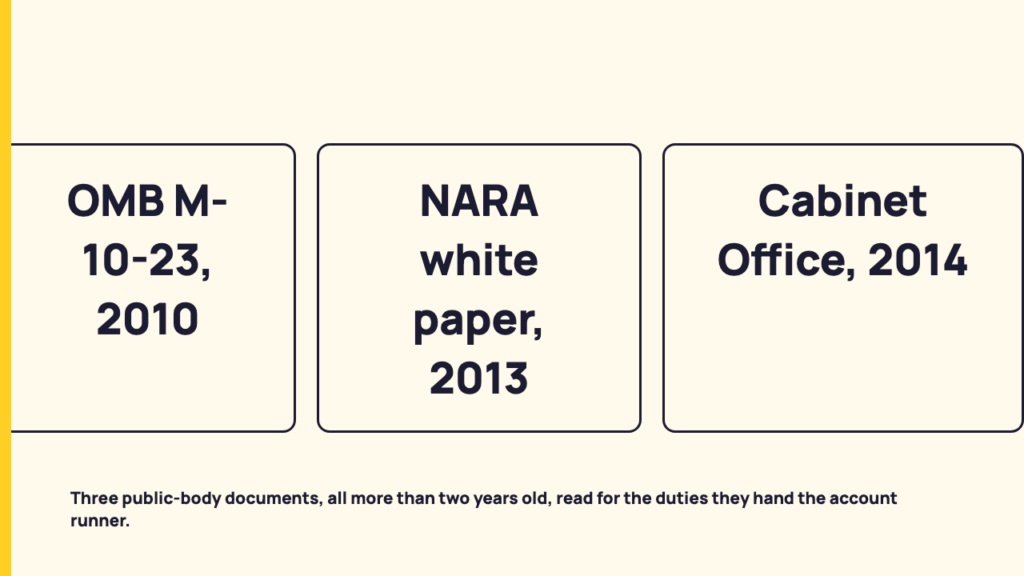
Three documents were read, and each is named here with its publisher and date.
- OMB Memorandum M-10-23, “Guidance for Agency Use of Third-Party Websites and Applications”, from the US Office of Management and Budget, dated 25 June 2010.
- “Best Practices for the Capture of Social Media Records”, a white paper from the US National Archives and Records Administration (NARA), dated May 2013.
- “Social media guidance for civil servants”, from the UK Cabinet Office, published 17 May 2012 and last updated 20 October 2014.
The US memo was found through Digital.gov’s social media topic page, which lists OMB M-10-23 under “Related Policy”. That hub page is a pointer, not a duty document, and nothing on it is relied on below.
Every one of the three is more than two years old, and the date is part of the finding. These are not current practice and are not offered as such. What was done here is a reading of three texts. No one was interviewed, nothing was tested, and nothing is claimed about how any agency behaves day to day.
Who is allowed to reply, and who is not
The Cabinet Office guidance is the one most likely to surprise a manager who assumes a public account must answer everyone. Its section on engaging with the public says: “this doesn’t mean we need to answer all the queries and questions directed at us via social media.” It adds that “on other accounts it may not always be realistic or practical for government to assist or answer everyone who asks a question of us.”
The reply duty it does set is about routing, not speed. “We should always check who someone is before responding.” The document’s own example is that it may not be obvious when the person asking is a blogger or journalist, “in which case we should refer them to our department’s media team.”
The guidance also notes that “some social media accounts are dedicated to respond to public queries”. So it distinguishes between accounts built to answer and accounts that are not. The document does not treat “the account” as one thing with one rule.
What a private-sector manager could borrow, on the document’s own logic, is a written rule for who answers and who hands off, in place of an unspoken expectation that whoever holds the login replies to everything.
The account is a record, and someone has to own capturing it
The NARA paper treats social media activity as something that may produce records. Its background section says such activity “may result in the creation of Federal records that must be captured and managed in compliance with Federal records management laws, regulations, and policies.” That is about US federal agencies in 2013, nothing more.
Its sharpest observation is about policy documents themselves. Most agencies, it says, have social media policies covering “what tools are being used, who is allowed to create content, and what can be said”, and “Capture of social media records is often left out of these more general social media policies.” Again, a 2013 NARA finding about federal agencies.
Under “Building a Foundation” the paper lists three practices:
- Institute a social media working group of agency records management staff, web managers, social media managers, information technology staff, privacy and information security staff, and other relevant stakeholders.
- Apply the definition of a Federal record when making agency-specific determinations about social media content and what components form a complete record.
- Review existing records retention schedules to see whether social media records are covered. “In the absence of an appropriate records retention schedule, records must be treated as permanent until they are scheduled.”
Under “Implementation” it gives two further duties worth noting. One is to “Determine and delegate roles and responsibilities for capture on internal and external sites.” The other is to incorporate specific language about capture and availability of content for export into the Terms of Service for each new platform used.
None of this states a retention obligation for a private organisation, and this post does not. What the paper does is raise a question any account owner can put to themselves: if the platform closed the account tomorrow, what could you export, and whose job was it to have exported it?
The paper says platform-specific guidance is not feasible because tools change, and its tool survey is “as of May 2013”, so that landscape is out of date and not summarised here.
What ‘official’ means on someone else’s platform
OMB M-10-23 is, in its own words, about privacy when agencies use third-party sites. It still answers a question every account runner faces: how does anyone know this account is really the organisation’s? The memo says “an agency should add its seal or emblem to its profile page on a social media website to indicate that it is an official agency presence.” Marking the profile makes the account verifiable as the organisation’s own.
It also says the platform should not be the only door. People “should be able to obtain comparable information and services through an agency’s official website or other official means”, and where an agency uses a third-party service to solicit feedback, it “should provide an alternative government email address where users can also send feedback.”
The memo assigns privacy duties too. The agency should examine the third party’s privacy policy before use and “monitor any changes” to it. It should alert visitors when a link leads outside the official domain. Where PII becomes available to the agency, an adapted Privacy Impact Assessment is required, and “In general, each PIA should be posted on the agency’s official website.”
The memo uses “should” for most items, and it is reported that way. Its scope is US federal agencies. Section 1 adds a clause that speaks directly to anyone running an account for someone else: “The guidance also applies when an agency relies on a contractor (or other non-Federal entity) to operate a third-party website or application to engage with the public on the agency’s behalf.” It is the one clause of the three that addresses someone operating an account for another party.
The borrowable idea, offered honestly, is a rule that the platform is never the only way to reach the organisation. Nothing read here requires private organisations to do it.
Personal and professional accounts: the line the Cabinet Office draws
The Cabinet Office guidance covers use “both in and out of work”, and says the principles for social and other digital media in “a work and personal capacity are the same”. That makes the individual, not only the official account, the unit of duty. (For the working-hours side of this, see the 2am post alert and the right to disconnect.) Its “Top 5 things to remember” are:
| Item | As written |
|---|---|
| Common sense | “social media helps us work openly and connect with the citizens we serve” |
| Civil Service Code | “adhere to the Civil Service Code” |
| Doubts | “doubts? If in doubt, don’t post it” |
| Accuracy | “check the accuracy and sensitivity of what you are posting before pressing submit” |
| Permanent | “remember once something is posted online it’s very difficult to remove it” |
The guidance tells civil servants to “make sure they are aware of their departments’ policy and comply with any departmental restrictions”, and states that posting content “considered inappropriate” in an official or personal capacity “may result in disciplinary action which could lead to dismissal.”
It also says staff “should not” comment on government policies and practices “without the proper authorisation”. The authority to speak is assigned, not assumed. A private manager could borrow exactly that: write down who is authorised to speak for the organisation.
What the documents do not say, and why the dates matter
Each document is dated, and each pre-dates today’s platforms: OMB M-10-23 (June 2010), the NARA white paper (May 2013), the Cabinet Office guidance (updated October 2014). The NARA paper itself says its tool survey is as of May 2013.
The fetched text of each was searched for correct, retract, accessib, alt text and caption. In the documents read, none sets out rules for correcting or retracting a post, or for the accessibility of posted media. The terms matched only other senses, such as information “accessible to the agency”, not those two subjects. Nothing here says newer government guidance has or has not filled these gaps, because no newer source was fetched.
Accessibility is better read from sources that address it directly. See what YouTube and W3C document about captions and what the European Accessibility Act lists for brand social posts. Tone is a separate question, taken up in ten published brand voice guides.
Four duties worth assigning in writing
Argued only from the three documents, four duties stand out.
- Who replies and who hands off? The Cabinet Office guidance separates accounts dedicated to answering from those that are not, and routes journalists to a media team. Is it written down, or only assumed?
- Who captures and keeps the record? NARA says to delegate roles for capture, and notes the task is often missing from general policies. If a platform closed your account, who would have the export?
- How is the account marked as official, and what is the alternative channel? OMB says to brand the profile and to offer another route to the organisation. Could a customer confirm the account is yours, and reach you without it?
- Who is authorised to speak? The Cabinet Office ties comment on policy to proper authorisation. Is the list of people who may speak for you written down?
In all four, the documents assign the duty to a role or a group, a media team, a working group, a named officer, not to whoever has the login.
Where to go next
Take the four questions above to the people who would have to answer them, and see which ones nobody can.
FAQ
Does a government body have to answer every message sent to its social media account?
Not according to the Cabinet Office guidance for UK civil servants, last updated October 2014. It says civil servants do not need to answer all queries, should check who someone is before responding, and should refer a blogger or journalist to the department’s media team. It is guidance, not a statement of law.
Are government social media posts treated as records?
The May 2013 NARA white paper says US federal agency social media activity may create Federal records that must be captured and managed under Federal records management laws, and that capture is often left out of general social media policies. That is scoped to US federal agencies and to its date. It says nothing about private organisations.
Sources
- OMB Memorandum M-10-23, 25 June 2010, fetched 2026-11-06.
- NARA, Best Practices for the Capture of Social Media Records, May 2013, fetched 2026-11-06.
- Cabinet Office, Social media guidance for civil servants (updated 20 October 2014), fetched 2026-11-06.
- Cabinet Office publication page (published 17 May 2012, last updated 20 October 2014), fetched 2026-11-06.
- Digital.gov, social media topic page (Related Policy), fetched 2026-11-06.