Someone in a meeting says accessibility is now mandatory in the EU, and you look at the content calendar and wonder whether every video you publish on brand accounts just became a legal duty. This post is a reading of published text, not legal advice. The author is not a lawyer and has not consulted one. It was read on 2026-11-01 from the Publications Office copy of Directive (EU) 2019/882 and from the European Commission’s European Accessibility Act page.
The assumption being tested is specific: that every captioned video or accessible post a brand publishes became a legal duty on 28 June 2025. The check below goes against the directive’s own text, not against agency or law-firm summaries.
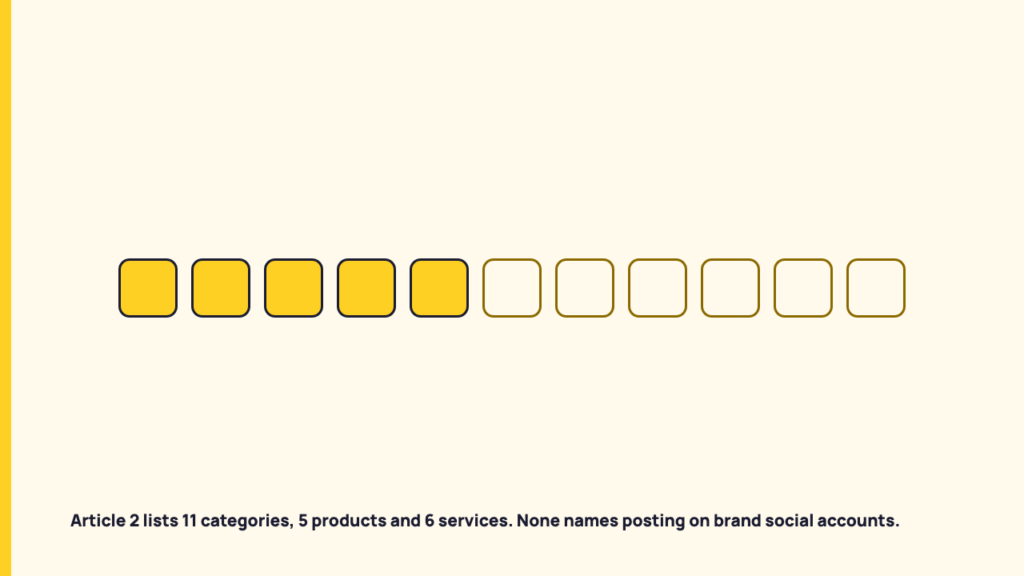
The Act covers a defined list. Article 2(1) names five product categories: consumer computer hardware and operating systems, self-service terminals, consumer terminal equipment for electronic communications, the same for audiovisual media, and e-readers. Article 2(2) names six services: electronic communications, access to audiovisual media, elements of passenger transport, consumer banking, e-books and e-commerce.
What the directive says it is for
Article 1 gives the purpose: “to contribute to the proper functioning of the internal market by approximating the laws, regulations and administrative provisions of the Member States as regards accessibility requirements for certain products and services”. The word to hold onto is “certain”. This is a harmonisation law about a defined set of things. The Commission describes it in similar terms: the Act “is a directive that aims to improve the functioning of the internal market for accessible products and services, by removing barriers created by different rules in Member States”.
A directive binds Member States, which then write national laws. Article 31 sets the dates: Member States adopt and publish those laws by 28 June 2022, and under Article 31(2), “They shall apply those measures from 28 June 2025.” The Commission says the same about the first date: “Member States had to incorporate the European Accessibility Act into their national law by June 2022.” A company’s actual obligations sit in those national laws. This post has not read any of them.
The European Accessibility Act scope: Article 2, item by item
Article 2 is short enough to check in under a minute. Here it is as a table. The count at the bottom is the author’s own tally of the lettered items in Article 2(1) and 2(2) as fetched.
| Provision | Letter | What it lists |
|---|---|---|
| 2(1) products placed on the market after 28 June 2025 | (a) | consumer general purpose computer hardware systems and operating systems for those hardware systems |
| 2(1) | (b) | self-service terminals: payment terminals, plus terminals dedicated to services covered by the directive (automated teller machines, ticketing machines, check-in machines, interactive self-service terminals providing information) |
| 2(1) | (c) | consumer terminal equipment with interactive computing capability, used for electronic communications services |
| 2(1) | (d) | consumer terminal equipment with interactive computing capability, used for accessing audiovisual media services |
| 2(1) | (e) | e-readers |
| 2(2) services provided to consumers after 28 June 2025 | (a) | electronic communications services, with an exception for machine-to-machine transmission services |
| 2(2) | (b) | services providing access to audiovisual media services |
| 2(2) | (c) | elements of air, bus, rail and waterborne passenger transport services (websites, mobile apps, e-tickets, transport information, self-service terminals) |
| 2(2) | (d) | consumer banking services |
| 2(2) | (e) | e-books and dedicated software |
| 2(2) | (f) | e-commerce services |
Five product categories plus six service categories is eleven. On the text as fetched, none of the eleven names publishing posts on a brand’s social media accounts, and the phrases “social media” and “social network” do not appear anywhere in the directive. That is a reading of what the list contains. It is not a statement that social posts are exempt or safe. The text does not list them, and this post stops there.
The two entries a social team will wonder about
Two service categories sit closest to social content: e-commerce services and services providing access to audiovisual media services. Read what the definitions say.
Article 3(30) defines “e-commerce services” as “services provided at a distance, through websites and mobile device-based services by electronic means and at the individual request of a consumer with a view to concluding a consumer contract”. The contract-concluding element is the centre of it. A shop’s checkout is the obvious fit. Whether a given social shop feature or link-out is covered turns on facts and on national law, and that is a question for counsel.
Article 3(6) defines “services providing access to audiovisual media services” as services “used to identify, select, receive information on, and view audiovisual media services”. The definition is about the service that provides access to such media, and it expressly includes electronic programme guides. Think programme guides and players.
Article 3(5) says “audiovisual media services” are “services as defined in point (a) of Article 1(1) of Directive 2010/13/EU”. That definition was replaced by Directive (EU) 2018/1808, and the original 2010 wording differs from the amendment, so only the amended text is quoted here. The amended Article 1(1)(a)(i) covers a service “where the principal purpose of the service or a dissociable section thereof is devoted to providing programmes, under the editorial responsibility of a media service provider, to the general public, in order to inform, entertain or educate”.
What this post does not decide: whether a particular brand video series would count as an audiovisual media service, or whether a particular platform’s video feature is a “service providing access”. The text points to the editorial-responsibility and programme tests. Anyone with a real publishing operation should ask counsel. The Commission’s own page words this category as “access to audio-visual media services such as television broadcast and related consumer equipment”, which reads as broadcasters and the equipment and services that deliver them.
Who the European Accessibility Act applies to: the economic operator and the microenterprise rule
The directive places its duties on “economic operators”. Article 3(21) defines an economic operator as “the manufacturer, the authorised representative, the importer, the distributor or the service provider”, and Article 3(4) defines a service provider as “any natural or legal person who provides a service on the Union market or makes offers to provide such a service to consumers in the Union”. On the product side, Article 3(19) defines an importer as a person “established within the Union who places a product from a third country on the Union market”. The service provider definition says nothing about where the provider is established. Article 2(2) covers services “provided to consumers”, and Article 3(22) defines a consumer as a natural person acting “for purposes which are outside his trade, business, craft or profession”. How that applies to a seller outside the EU, or to a business-to-business service, is a question for counsel. No UK source was read, and this post states no UK position. (Articles 2, 3 and 4 re-read 2026-11-03.)
- Article 4(1). Member States ensure, subject to Article 14, “that economic operators only place on the market products and only provide services that comply with the accessibility requirements set out in Annex I”. The duty attaches to the product or service listed in Article 2, not to every piece of content a company publishes.
- Article 3(23). A microenterprise is “an enterprise which employs fewer than 10 persons and which has an annual turnover not exceeding EUR 2 million or an annual balance sheet total not exceeding EUR 2 million”.
- Article 4(5). “Microenterprises providing services shall be exempt from complying with the accessibility requirements referred to in paragraph 3 of this Article and any obligations relating to the compliance with those requirements.” Paragraph 3 has two sentences, one on Section III of Annex I and one on Section IV, and the exemption refers to paragraph 3. Which Annex sections it reaches should be checked by counsel. The exemption is for a microenterprise providing a listed service. It does not mean small companies are exempt.
- Article 3(24). SMEs are defined as enterprises meeting headcount and financial limits, “but excludes microenterprises”. A company that is an SME and not a microenterprise gets no Article 4(5) exemption.
- Article 14. The requirements “shall apply only to the extent that compliance” does not require a fundamental alteration and “does not result in the imposition of a disproportionate burden on the economic operators concerned”. Under Article 14(3), “Economic operators shall document the assessment”. It is a separate mechanism with paperwork attached, not a way out to assume.
- Article 32. “Service contracts agreed before 28 June 2025 may continue without alteration until they expire, but no longer than five years from that date.” That concerns existing service contracts, not content calendars.
What the Commission says, and what it does not
The Commission page lists the products and services covered as: computers and operating systems, ATMs, ticketing and check-in machines, smartphones, TV equipment related to digital television services, telephony services and related equipment, access to audio-visual media services, services related to air, bus, rail and waterborne passenger transport, banking services, e-books and e-commerce. It was fetched on 2026-11-01.
So far as the author could see, the page does not mention social media, social networks or brand content. That is an observation about one page, not a Commission position on social media. The page also says the Commission set up an expert group of national administrations, market surveillance authorities, civil society organisations and accessibility experts, and that AccessibleEU supports application of key EU accessibility laws through training and capacity building. It reports no fines or enforcement actions, and this post cites none.
No Commission FAQ or guidance document on the scope was fetched in this session. The AccessibleEU site returned a page, but nothing dated that addresses scope was found. This post therefore reports no Commission interpretation beyond that page and the directive text.
What this leaves a social team with
On the text read, the directive is a law about listed products and services, so the claim that every captioned video is now a legal duty does not follow from Article 2, though a company’s own listed services, such as a web shop’s checkout or a streaming or media service, can be in scope.
Questions to take to counsel, each tied to an article:
- Is any service we provide to consumers one of the six in Article 2(2)?
- Are we a microenterprise under Article 3(23), by headcount and by turnover or balance sheet?
- Which Member State’s transposing law applies to us?
- Do any of our video products meet the Article 1(1)(a) tests?
Captions and alt text on brand image posts can be good practice and are separate from what this directive lists. For the platform side, see what the accessibility documentation actually requires for captions. Styled Unicode lettering in captions is a separate question again, covered in what the standard says about bold Unicode text. For the same primary-source method on another rule, see the FTC rule read line by line.
This is a reading as of 2026-11-01 of published text, and national laws vary. Article 33 requires the Commission to report on the directive’s application by 28 June 2030, and the reports “shall also address” Article 14 “as well as the exemptions for microenterprises”, and “whether it would be appropriate to include new products and services”. The scope is still open to review.
Next step
Open Article 2 yourself, count the lettered items, and bring the four questions above to whoever advises your company on EU law.
FAQ
Does the European Accessibility Act apply to social media posts?
The Article 2 lists, as read, do not name brand social media posting. They do include e-commerce services and services providing access to audiovisual media services, so a company’s own listed services may be in scope on their facts. This post gives no legal verdict.
Do I have to caption every video under the EAA?
The directive’s duties attach to the listed products and services, not to each video a brand publishes, and that is a reading of the text. National law and counsel decide your case. For platform guidance, see the captions post linked above.
What are the European Accessibility Act exemptions?
The text has two mechanisms. Article 4(5) says “Microenterprises providing services shall be exempt from complying with the accessibility requirements referred to in paragraph 3 of this Article and any obligations relating to the compliance with those requirements”, which covers microenterprises providing services, not products. Article 14 says the requirements “shall apply only to the extent that compliance” does not require a fundamental alteration of a product or service and does not result in “the imposition of a disproportionate burden on the economic operators concerned”, and Article 14(3) requires economic operators to document that assessment. Both were re-read on 2026-11-03.
Sources
- Directive (EU) 2019/882, Publications Office copy, fetched 2026-11-01 (HTTP 200)
- Directive (EU) 2018/1808, Publications Office copy, fetched 2026-11-01 (HTTP 200)
- European Commission, European Accessibility Act (EAA), fetched 2026-11-01 (HTTP 200)