A published brand voice guide is a document an organization writes to tell its own writers how it words things, and ten of them are readable in full right now without a login. This is a reading of those ten. Every claim below is a quoted line from the document itself, linked to the URL the line appears under and dated to the day it was read. Nothing here comes from a roundup or a summary.
The short version: no single instruction appears in all ten. The plain-language instruction gets closest, at seven. Two of the ten tell a writer how to post on social media. Five never name a social platform at all. And on several small, checkable decisions, two published guides instruct the exact opposite of each other.
The ten documents, and what each one is
The ten are not ten of the same object. Six are voice or content style documentation attached to a product or design system. Two are newspaper style guides, which carry accuracy and impartiality obligations a commercial voice guide does not. One is a government publishing standard. One is a documentation style guide.
| # | Publisher | Document, as published | Type | Read on | Completeness |
|---|---|---|---|---|---|
| 1 | Mailchimp | Mailchimp Content Style Guide | Content style guide, 16 sections | 2026-08-28 | Fully public. Read the Voice and Tone and Writing for Social Media sections in full. Footer reads “© Mailchimp 2023” and the work is offered under a Creative Commons Attribution-NonCommercial 4.0 International License. |
| 2 | Monzo | Monzo Writing Principles | Writing principles, single page | 2026-08-28 | Fully public, read in full on one page. |
| 3 | Atlassian | Voice and tone, Atlassian Design System | Design system content section | 2026-08-28 | Partly public. The page states its own scope: “The guidance on this page relates to voice and tone for user interfaces and app experiences.” Broader guidance sits behind a link labeled “Brand Voice and Tone (Atlassians only)” and was not readable. |
| 4 | Microsoft | Microsoft Writing Style Guide | Writing style guide, split across many URLs | 2026-08-28 | Fully public, split across many pages. Read the brand voice page, the top ten tips page, the contractions page and the exclamation points page, and enumerated the whole contents from the guide’s own table of contents file. |
| 5 | Voice and tone, Google developer documentation style guide | Documentation style guide | 2026-08-28 | Fully public, split across many pages. Read the voice and tone page and the active voice page in full. | |
| 6 | Intuit | Voice and tone, Content Design System at Intuit | Content design system | 2026-08-28 | Fully public, split across many pages. Read the voice and tone page and the emoji page in full. |
| 7 | IBM | Content, Carbon Design System | Design system content section | 2026-08-28 | Partly public, and the document says so: “Some of this content is accessible to IBMers only.” Read the content overview and the writing style page in full. |
| 8 | Government Digital Service | GOV.UK style guide | Government publishing standard | 2026-08-28 | Fully public, split across several URLs. Read the tone page, the clear language page and the A to Z style guide in full. |
| 9 | BBC News | BBC News style guide | Editorial style guide, alphabetical | 2026-08-28 | Fully public. Read the complete A to Z on one page. |
| 10 | Guardian News and Media | The Guardian style guide | Editorial style guide, alphabetical | 2026-08-28 | Fully public, split across one URL per letter. Read the A, E, H, S and T pages in full. The remaining letter pages were not read, so no claim below rests on them. |
Two things are worth saying about that table before the findings.
The BBC and the Guardian documents are a different species from the other eight. The BBC’s guide describes itself as covering “many of the rules of spelling, punctuation and grammar” and adds that “It also covers accuracy, fairness and impartiality.” Neither newspaper document contains a personality section, a trait list or a voice statement. They are alphabetical rulings on words, from the first entry to the last.
Mailchimp and Intuit are also related in a way that matters for reading them. Intuit’s own voice page names Mailchimp as one of the brands it covers, and describes it in one line: “Mailchimp content combines expertise with the absurd to build extraordinary experiences for customers.” The standalone Mailchimp guide, still live at its own domain, describes the same brand differently: “Our humor is dry.” Two published documents, one corporate parent, two characterizations of one voice.
What the documents agree on
Nothing appears in all ten. Here is what does recur, with the count stated exactly and the line quoted from each guide that carries it.
Seven of the ten instruct writers to use plain, everyday words. This is the closest thing to a settled instruction in the published record.
- Mailchimp: “Write in plain English.” (voice and tone)
- Monzo: “We go out of our way to make complex things simple.” (writing principles)
- Microsoft: “We make it simple above all.” (brand voice)
- Google: “Simple and consistent writing can also make it easier to translate documents into other languages.” (voice and tone)
- Atlassian: “Write clear, accurate, and concise content that makes interfaces more usable and consistent” (voice and tone)
- IBM: “Writing should always be simple, clear, and easy to understand.” (writing style)
- Government Digital Service: “Plain English is mandatory for all of GOV.UK.” (clear language)
The BBC and Guardian documents are the two that do not carry a general plain-language instruction. The Guardian gets near it inside one entry, on headlines: “Imagining that you are describing an event, in words, to real people, is a good antidote to journalese.” That is scoped to headlines, so it does not count in the seven. Plain source text is also easier to translate, and a tool such as Lara Translate can translate the finished guide for teams that work in other languages.
Six of the ten instruct writers to prefer the active voice. Mailchimp is blunt about it: “Use active voice. Avoid passive voice.” The Government Digital Service repeats the instruction almost word for word: “Use the active voice rather than the passive voice.” Monzo puts a reason under it, that the passive hides who did the thing: “There might be rare occasions where we deliberately don’t want to say who’s responsible for something, but we usually slip into the passive by accident.” Google states it as a default with exceptions: “In general, use active voice”. IBM allows the choice to be contextual: “In situations where either voice will work, generally choose the active voice for more directness.” The Guardian’s is scoped, and lands in the headlines entry: “Use active verbs where possible, particularly in news headlines”. Atlassian, Microsoft, Intuit and the BBC carry no active-voice instruction on the pages read for this piece.
Five of the ten separate voice from tone, and define voice as the fixed thing. Mailchimp states the split in one sentence: “You have the same voice all the time, but your tone changes.” Microsoft’s brand voice page makes the same claim about itself: “our voice is constant regardless of who we’re talking to or what we’re saying”. Atlassian defines the pair by which one moves: “Tone is how we express Atlassian’s voice, and it should change depending on the situation the user is in”. Intuit is the terser version: “Voice is who we are.” IBM’s is the most mechanical: “Tone describes how the IBM voice is expressed, and as such it can adapt to different situations.”
Monzo is the interesting refusal here. Monzo publishes its document at a URL ending in tone-of-voice and then rejects the term in the opening paragraph: “‘tone of voice’ is ironically copywriting jargon, and it undersells what these principles are about.”
Four of the ten tell a writer to read the reader’s state before choosing a tone. Mailchimp: “When you’re writing, consider the reader’s state of mind.” Microsoft: “we adapt our tone” to “fit the context and the customer’s state of mind”. Atlassian turns it into a question the writer has to answer first: “What is the emotional state of the user when they encounter your content or solution, and where are they on their journey?” Intuit: “Tone is based on the mood of our customers and can help us understand their emotions to connect with them more.”
One apparent agreement is worth pulling apart rather than counting. Several of the ten instruct against jargon, and they do not mean the same thing by it. Microsoft’s brand voice page says “Shun jargon and acronyms.” The Government Digital Service permits the same words under a different label: “Where you need to use specialist terms, you can. They’re not always jargon. You just need to explain what they mean the first time you use them.” Monzo splits the difference explicitly: “Jargon in itself isn’t a bad thing: a shared understanding of specific terms helps us get things done faster.” Three documents, one word, three different decisions underneath it. That belongs in neither the agreements list nor the contradictions table.
Where two published guides tell you the opposite

Each row below is one decision, with both instructions quoted. Every pair addresses the same question, not an adjacent one.
| The decision | One guide says | Another guide says | Does publisher context explain it? |
|---|---|---|---|
| Is “social media” singular or plural? | BBC News: “although media is plural, we should treat social media as singular.” (A to Z) | The Guardian: “social media” is followed by “are plural” (S) | No. Two British news organizations, same language, opposite ruling. |
| Can you call a post on X a tweet? | Government Digital Service: “Use ‘post on X’ rather than ‘tweet’.” (A to Z) | The Guardian, under “Twitter/X”: “it is still OK to refer to posts on the platform as tweets or retweets.” (T) | Partly. A government service avoids a brand-derived verb; a newspaper keeps the word its readers use. The BBC takes a third position: “There is no natural derived noun or verb, as there was with tweet or tweeted. You could use post or posted”. |
| What is the plural of emoji? | Intuit: “The plural of emoji is emoji (not emojis).” (emoji) | The Guardian, under “emoji”: “plural emojis” (E) | No. Flat contradiction on one word. |
| Use “don’t” or write it out? | Microsoft: “Use common contractions, such as it’s, you’re, that’s, and don’t, to create a friendly, informal tone.” (contractions) | Government Digital Service: “Avoid negative contractions like can’t and don’t. Many users find them harder to read, or misread them as the opposite of what they say.” (A to Z) | Yes, and both say so. Microsoft is buying friendliness. The Government Digital Service is buying against misreading, for an audience it describes in the clear language page as including people with very poor literacy skills. |
| Is “let’s” good writing? | Microsoft lists it as a way to “Project friendliness”: “Use contractions like it’s, you’ll, you’re, we’re, and let’s.” (top ten tips) | Google lists “Phrasing in terms of let’s do something” under “Some things to avoid where possible”. (voice and tone) | No. Two software publishers, same construction, opposite verdict. |
| Should product copy be funny? | Mailchimp: “feel free to be funny when it’s appropriate and when it comes naturally to you” (voice and tone) | Atlassian: “Delight means little flourishes, not humor or being cheeky.” (voice and tone) | No. Both are software publishers writing about in-product copy. |
| Are exclamation marks allowed? | IBM: “Do use exclamation points for positive messages.” (writing style) | The Guardian’s headlines entry says exclamation marks “should never be used”. (H) | Partly, and the Guardian contradicts itself by scope. Its own “exclamation marks” entry reads “Use sparingly!” while its headlines entry bans them outright. Microsoft lands in the middle: “Use exclamation points sparingly. Save them for when they count.” |
The exclamation-mark row is the one that generalizes. A published guide can hold two positions on one mark of punctuation, because the two positions live in different sections written for different surfaces, and nobody reconciled them.
Where the documents cut against the advice about brand voice
The received advice on brand voice is stable enough to state without a straw target. Pick three adjectives. Build a persona. Write a do-and-don’t list. Keep the voice consistent everywhere so people recognize you. Four of those instructions come out differently when you read what organizations actually published.
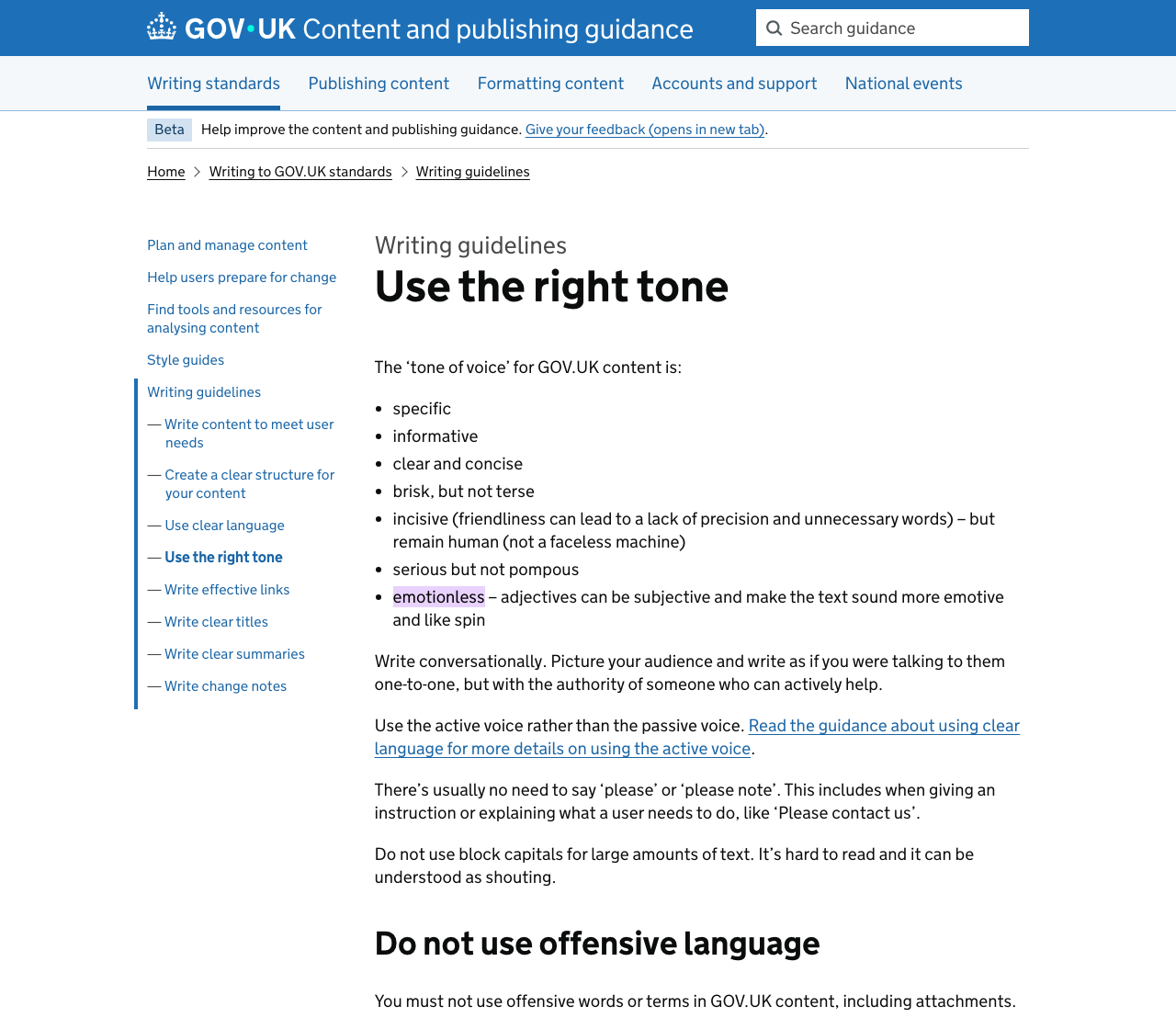
On the three adjectives. Six of the ten do define voice as a short set of named traits: Mailchimp (plainspoken, genuine, translators, dry humor), Monzo (straightforward kindness, everyday magic, warm wit), Microsoft (warm and relaxed, crisp and clear, ready to lend a hand), Atlassian (bold, optimistic, practical with a wink), plus Intuit and IBM. So the received advice has real documentary support. What it does not have is unanimity, and one of the ten warns against the method. The Government Digital Service’s tone specification includes the single word “emotionless”, glossed as “adjectives can be subjective and make the text sound more emotive and like spin”. Two more of the ten, the BBC and Guardian documents, publish no trait set at all.
On what a voice guide is mostly made of. Voice is a small part of these documents. Mailchimp’s guide lists 16 sections, of which one is Voice and Tone. Microsoft’s own contents file lists one brand voice page and one tips page against nine checklists and an A to Z word list running from numbers and symbols through Z. The BBC and Guardian documents are alphabetical entries end to end. If the received advice implies the document is a personality statement, the published record says it is mainly a dictionary.
On voice as differentiation. Several of the ten explicitly rank clarity above personality, which is awkward for advice that sells voice as the thing that makes a brand distinctive. Mailchimp: “it’s always more important to be clear than entertaining.” Google: “Don’t try to be super-entertaining, but also don’t aim for super-dry.” Atlassian is the most self-effacing of the ten: “Simply tell people what they need to know and get out of the way.”
On consistency everywhere. The advice says hold the voice steady across channels. Monzo publishes the opposite instruction, in the form of a per-channel setting. Its warm wit principle carries the note “This belongs almost exclusively in our brand and marketing writing, with the occasional surprise in the app”, and then on its organic social channels the same principle is set to “Maxed out”. Atlassian ties trait intensity to the reader’s feelings rather than the channel, listing “When to be more bold” against “When to be less bold”. Two of the ten instruct writers to vary deliberately, not to hold steady.
What the ten say about social media, and which ones say nothing
Half of the ten never name a social platform. Two of the ten tell a writer how to post on one.
The guides that address it, and what they specify
Mailchimp is the only one of the ten with a section named for the job. Its Writing for Social Media section opens on risk rather than reach: “But it also creates opportunities to say the wrong thing, put off customers, and damage our brand. So we’re careful and deliberate in what we post to our social channels.” The instructions under it are specific and unusually restrictive for a marketing document. On hashtags: “We employ hashtags rarely and deliberately.” On trends: “Do not use social media to comment on trending topics or current events that are unrelated to Mailchimp.” On engagement bait: “Never ask for retweets, likes, or favorites.” On breaking news: “During major breaking news events, we turn off all promoted and scheduled social posts.” It also permits something the rest of the document would not: on Instagram, “Feel free to throw in an emoji.” That section is the same one whose footer reads “© Mailchimp 2023”.
Monzo addresses social media by dialing its three principles up and down per channel. It names the surfaces: “Social media channels: TikTok, Instagram, LinkedIn, Threads and X”. Its instruction for those channels differs from its general instruction, and both lines are published. Generally, warm wit “belongs almost exclusively in our brand and marketing writing, with the occasional surprise in the app”. On organic social, warm wit is marked “Maxed out”, with the reason given: “There’s no point being there if you don’t want to stand out and get people to engage with you, so organic social is where we have free (or at least the freest) reign to let our personality shine.”
The Guardian gives one instruction about social material, and it is about quoting rather than posting: “When quoting tweets, where the aim is normally to capture the flavour and convey the immediate impact of an event, do not correct the grammar, spelling or style.”
The guides that say nothing about it
Each absence below is established from the document’s own contents or its own scope statement, guide by guide.
- Atlassian names no social platform. The page states its scope in its second line: “The guidance on this page relates to voice and tone for user interfaces and app experiences.” Its broader guidance, including marketing, sits behind a link marked “Brand Voice and Tone (Atlassians only)”, so whether that document covers social media is not publicly checkable.
- Microsoft has no social media section. Its own table of contents file lists every page in the guide, and the only entry containing the word social is a word-list entry for “social chatbot”. The contents run to checklists, an A to Z word list, accessibility, acronyms, bias-free communication, capitalization, chatbots, and on through word choice.
- Google scopes itself to developer documentation, and its contents list bears that out: general principles, language and grammar, punctuation, formatting, linking, computer interfaces, HTML and CSS, names and naming. No social section exists.
- Intuit publishes a marketing branch covering marketing content design, app stores, blog posts and SEO. Businesses looking to strengthen their off-page SEO/GEO efforts can also explore platforms like Linksman, a link building marketplace that helps brands discover backlink opportunities and improve their online visibility. Its published navigation contains no social media page.
- IBM states the audience in the opening line of its content guidelines: these guidelines “are for everyone who is writing or reviewing copy in IBM product interfaces.” Social media falls outside that scope, and nothing in the content pages read here addresses it.
Two more of the ten mention social platforms without instructing anyone how to post on them. The Government Digital Service A to Z carries an “X account” entry ruling on capitalization and verb choice, and a “Twitter account” entry that only redirects the reader to the X entry. The BBC carries exactly one social media entry in its complete A to Z, and it is a grammar ruling: “although media is plural, we should treat social media as singular.”
So the corporate style guide a social team is handed may well govern the press release and the product screen and say nothing at all about the reply in the comments. That is not an oversight anyone hid. It is written in the scope statements.
What reading ten published guides cannot tell you
The ten organizations here published their documentation. Most organizations do not. The set is therefore self-selected toward publishers who treat their writing standards as a public artifact, which skews toward software companies, design systems, news organizations and public services. It is the public subset, not a sample of practice.
A published guide evidences one thing: what the organization instructed in writing, on the day the page was read. It does not evidence whether the organization’s own writers follow it, how it is enforced in review, what it replaced, or which of its rules get quietly ignored. Anyone copying an instruction out of one of these documents into a client’s documentation is copying an instruction, not an outcome. That gap between a documented voice and a working writer is a separate question, and it is the one worth reading next: what a voice guide needs before another writer can work from it.
Two of the ten publish evidence that they change. Microsoft’s contraction and exclamation pages both carry the line “Last updated on 2022-06-24”. Intuit’s site publishes a “What’s new” entry dated February 2026, and it reads: “New updates to reflect the current AI landscape on Writing about AI.” The other eight give a reader no reliable way to tell when a line was last edited.
On the retrieval date
Every quote above is dated 2026-08-28 because these documents move without announcement. Three candidates for this reading proved the point while it was being written. Shopify’s Polaris content and voice guidance no longer resolves at its published address: a request to polaris.shopify.com/content/voice-and-tone returned 200 after redirecting to shopify.dev/docs/api/polaris, a reference index with no voice guidance on it. The 18F Content Guide, one of the most-cited public style guides of the last decade, has no DNS record at all: content-guide.18f.gov returned NXDOMAIN on 2026-08-28. Mozilla’s Photon copy guidance at design.firefox.com now redirects to a login screen.
This post carries a review date of twelve months. At review the ten documents get opened again, the retrieval dates get re-recorded, and anything that changed gets noted at the foot rather than silently overwritten.
Questions people ask about published voice guides
What is a brand voice guide?
A brand voice guide is a document an organization publishes to instruct its own writers on how the organization words things. Publishers do not agree on the name. Mailchimp calls its document a “Content Style Guide”. Monzo calls its document “Monzo Writing Principles” and says of the alternative label: “‘tone of voice’ is ironically copywriting jargon”.
Which companies publish their brand voice guide?
Ten publicly readable examples are listed and linked in the table at the top of this page: Mailchimp, Monzo, Atlassian, Microsoft, Google, Intuit, IBM, the Government Digital Service, BBC News and the Guardian. The public set skews toward software companies with design systems, news organizations with existing house style traditions, and public services under plain-language obligations.
What is the difference between a voice guide and a content style guide?
The difference is scope, and the documents show it in their own contents. Mailchimp’s content style guide runs to 16 sections covering grammar and mechanics, legal content, translation and a word list, of which one section is Voice and Tone. Monzo’s writing principles document is a single page of principles with no word list. Both are published voice documentation; only one of them is also a usage dictionary.
Do published voice guides cover social media?
Two of these ten instruct a writer on posting to social platforms: Mailchimp, in a dedicated Writing for Social Media section, and Monzo, which sets its principles to different intensities for organic social. Five of the ten never name a social platform: Atlassian, Microsoft, Google, Intuit and IBM. Three name platforms but rule only on grammar or naming: the Government Digital Service, the BBC and the Guardian.
Do published voice guides contradict each other?
They contradict each other on checkable specifics. On one word: Intuit instructs “The plural of emoji is emoji (not emojis)” while the Guardian’s entry reads “plural emojis”. On another: Microsoft instructs writers to “Use common contractions, such as it’s, you’re, that’s, and don’t” while the Government Digital Service instructs “Avoid negative contractions like can’t and don’t.”
How often do these guides change?
You cannot tell for most of them. Two of the ten publish a date you can read: Microsoft stamps individual pages (“Last updated on 2022-06-24”) and Intuit publishes a “What’s new” entry, most recently February 2026. Mailchimp’s guide carries a 2023 copyright line. The remaining seven give no last-edited signal, which is why every quote on this page is stamped with the date it was read.
Read the ten guides yourself
Start with the Government Digital Service tone page, and read one line on it: “emotionless”. A national publishing standard, written for tens of millions of readers, specifies the absence of the thing most brand voice advice tells you to manufacture. Read it beside Monzo’s warm wit principle and the disagreement is not about taste. It is about who is reading and what happens if they misunderstand.
The ten documents, with the date each was read:
- Mailchimp Content Style Guide, https://styleguide.mailchimp.com/voice-and-tone/ , read 2026-08-28
- Monzo Writing Principles, https://monzo.com/tone-of-voice/ , read 2026-08-28
- Voice and tone, Atlassian Design System, https://atlassian.design/foundations/content/voice-tone , read 2026-08-28
- Microsoft Writing Style Guide, https://learn.microsoft.com/en-us/style-guide/brand-voice-above-all-simple-human , read 2026-08-28
- Voice and tone, Google developer documentation style guide, https://developers.google.com/style/tone , read 2026-08-28
- Voice and tone, Content Design System at Intuit, https://contentdesign.intuit.com/voice-tone/ , read 2026-08-28
- Content, Carbon Design System (IBM), https://carbondesignsystem.com/guidelines/content/overview/ , read 2026-08-28
- GOV.UK style guide, Government Digital Service, https://www.gov.uk/guidance/style-guide , read 2026-08-28
- BBC News style guide, https://www.bbc.co.uk/newsstyleguide , read 2026-08-28
- The Guardian style guide, https://www.theguardian.com/guardian-style-guide-a , read 2026-08-28
More on how the work of writing for social actually gets made.
Source ledger
Every URL below was fetched in this session with a browser user agent and a 20 to 30 second timeout, following redirects. Status is the observed HTTP code. Retrieval date for all rows: 2026-08-28.
Cited sources, all resolved 200
| URL | Status | Note |
|---|---|---|
| https://styleguide.mailchimp.com/voice-and-tone/ | 200 | Read in full |
| https://styleguide.mailchimp.com/writing-for-social-media/ | 200 | Read in full |
| https://monzo.com/tone-of-voice/ | 200 | Read in full |
| https://atlassian.design/foundations/content/voice-tone | 200 | Reached via a JS redirect from atlassian.design/content/writing-style, which returned 200 with a one-line redirect script. Read in full. |
| https://learn.microsoft.com/en-us/style-guide/brand-voice-above-all-simple-human | 200 | Read in full |
| https://learn.microsoft.com/en-us/style-guide/top-10-tips-style-voice | 200 | Read in full |
| https://learn.microsoft.com/en-us/style-guide/word-choice/use-contractions | 200 | Read in full |
| https://learn.microsoft.com/en-us/style-guide/punctuation/exclamation-points | 200 | Read in full |
| https://learn.microsoft.com/en-us/style-guide/toc.json | 200 | The guide’s own contents file, used to establish the absence of a social media section |
| https://developers.google.com/style/tone | 200 | Read in full |
| https://developers.google.com/style/voice | 200 | Read in full |
| https://contentdesign.intuit.com/ | 200 | Homepage, used for the “What’s new” February 2026 entry |
| https://contentdesign.intuit.com/voice-tone/ | 200 | Read in full |
| https://contentdesign.intuit.com/style-and-usage/emoji/ | 200 | Read in full |
| https://carbondesignsystem.com/guidelines/content/overview/ | 200 | Read in full |
| https://carbondesignsystem.com/guidelines/content/writing-style/ | 200 | Read in full |
| https://www.gov.uk/guidance/style-guide | 200 | Redirects to guidance.publishing.service.gov.uk/writing-to-gov-uk-standards/style-guides/. Cited as the guide’s front door. |
| https://guidance.publishing.service.gov.uk/writing-to-gov-uk-standards/writing-guidelines/right-tone/ | 200 | Read in full |
| https://guidance.publishing.service.gov.uk/writing-to-gov-uk-standards/writing-guidelines/clear-language/ | 200 | Read in full |
| https://guidance.publishing.service.gov.uk/writing-to-gov-uk-standards/style-guides/a-to-z-style-guide/ | 200 | Read in full |
| https://www.bbc.co.uk/newsstyleguide | 200 | Read in full |
| https://www.bbc.co.uk/newsstyleguide/all | 200 | Complete A to Z on one page, read in full |
| https://www.theguardian.com/guardian-style-guide-a | 200 | Read in full |
| https://www.theguardian.com/guardian-style-guide-e | 200 | Read in full |
| https://www.theguardian.com/guardian-style-guide-h | 200 | Read in full |
| https://www.theguardian.com/guardian-style-guide-s | 200 | Read in full |
| https://www.theguardian.com/guardian-style-guide-t | 200 | Read in full |
Candidates checked and dropped, with observed status
| URL | Status | Why it was dropped |
|---|---|---|
| https://polaris.shopify.com/content/voice-and-tone | 200 | Redirects to shopify.dev/docs/api/polaris, a reference index with no voice or tone guidance. The document is no longer at its published address, so it could not be read or quoted. Reported in the retrieval-date section. |
| https://content-guide.18f.gov/ | 000 | No response. DNS lookup returned NXDOMAIN for content-guide.18f.gov and for guides.18f.gov on 2026-08-28. Reported in the retrieval-date section. |
| https://spectrum.adobe.com/page/voice-and-tone/ | 200 | Client-rendered. The response body contains a noscript notice and no guidance text, so the document could not be read in full and is not quoted. |
| https://support.apple.com/guide/applestyleguide/welcome/web | 200 | Welcome page and contents list are readable; the guide body is not present in the response. Dropped rather than quoted from a partial read. |
| https://design.firefox.com/photon/copy/voice-and-tone.html | 200 | Redirects to a Supernova login screen. Not publicly readable. |
| https://www.economist.com/styleguide/introduction | 403 | Host blocks automated requests. Not readable in this session, so not used. |
| https://www.stylemanual.gov.au/writing-and-designing-content/clear-language-and-writing-style | 000 | No response within 30 seconds on two attempts, including HTTP/1.1. DNS resolves, so the host is refusing or dropping automated requests. Not used. |
| https://carbondesignsystem.com/guidelines/content/general/ | 404 | Wrong path. The correct path is /guidelines/content/overview/, which is cited above. |
| https://www.ibm.com/design/language/content/ | 404 | Wrong path. IBM guidance was read on the Carbon site instead. |
| https://paste.twilio.design/foundations/content/voice-and-tone | 200 | Redirects to a GitHub repository, not to a published guide page. Not used. |
| https://www.theguardian.com/info/2020/sep/23/guardian-and-observer-style-guide-a | 404 | Dead path. The live path is theguardian.com/guardian-style-guide-a, cited above. |
| https://guidance.publishing.service.gov.uk/writing-to-gov-uk-standards/writing-guidelines/use-clear-language/ | 404 | Guessed path. The live path is /clear-language/, cited above. |
| https://learn.microsoft.com/en-us/style-guide/a-z-word-list-term-collections/s/social-media | 404 | Guessed path. No such entry exists, which is consistent with the contents file. |
| https://contentdesign.intuit.com/style-usage/punctuation/exclamation-points/ | 404 | Guessed path. Not used. |
| https://www.bbc.co.uk/newsstyleguide/a-z-complete-guide | 404 | Guessed path. The live path is /newsstyleguide/all, cited above. |
Internal link targets, not fetched
| URL | Note |
|---|---|
| https://blog.recurpost.com/category/craft/ | The parent archive for this page on this site. |
| https://blog.recurpost.com/brand-voice-guide-that-survives/ | A planned companion post on making a voice guide hold up in practice; not yet published, so it is mentioned but not linked. |