Every brand publishing short vertical video is working from the same folklore: post often, keep it short, the algorithm rewards volume. It is rarely tested against the brands themselves, because doing so means pulling every video rather than the ones a case study wants to show you.
So I pulled every one. Twelve brand YouTube channels, picked and written down before any data was collected: six consumer brands and six business software brands. Every Short each of them published in the 90 days to 5 September 2026, with the public view, like and comment counts read per video on that date. 550 Shorts.
Two rules govern everything below, and they matter more than any single number.
The first is that a view count is not finished when you read it. Views accumulate for weeks, so a Short published four days ago is not underperforming, it is unfinished. All performance comparisons here use the settled subset, defined before analysis as Shorts at least 21 days old on the collection date. That is 352 of the 550.
The second is that these are twelve named accounts, not a sample. Nothing here generalises to “brands on YouTube”. It generalises to these twelve, which is the only honest claim a dataset like this supports.
Cadence ranges from 200 posts to none at all
| Channel | Segment | Shorts in 90 days | Subscribers | Median views (settled) | Median views per 1,000 subscribers |
|---|---|---|---|---|---|
| NBA | Consumer | 200 (cap) | 24,400,000 | 18,180 | 1 |
| Ryanair | Consumer | 87 | 194,000 | 35,569 | 183 |
| Red Bull | Consumer | 86 | 29,600,000 | 4,164,970 | 141 |
| Canva | B2B software | 55 | 911,000 | 1,804 | 2 |
| Duolingo | Consumer | 48 | 6,790,000 | 885,344 | 130 |
| Wendy’s | Consumer | 38 | 151,000 | 7,851 | 52 |
| Semrush | B2B software | 25 | 221,000 | 762 | 3 |
| Shopify | B2B software | 9 | 488,000 | 1,958 | 4 |
| Chipotle | Consumer | 1 | 106,000 | 1,649 | 16 |
| Zapier | B2B software | 1 | 78,000 | 620 | 8 |
| Notion | B2B software | 0 | not recorded | no Shorts in the window | n/a |
| Grammarly | B2B software | 0 | not recorded | no Shorts in the window | n/a |
Notion and Grammarly both maintain a Shorts tab, and neither published a single Short in the window. Chipotle published one. Zapier published one. Meanwhile the NBA published at least 200, which is the extraction cap, at a rate above fifteen a week.
The consumer and business software groups are not doing the same activity at different intensities. They are doing different things. Five of the six consumer channels posted at least three Shorts a week. Four of the six software channels posted less than one a week or nothing.
The subscriber count predicts almost nothing
Ryanair has 194,000 subscribers. Red Bull has 29.6 million, a hundred and fifty times more.
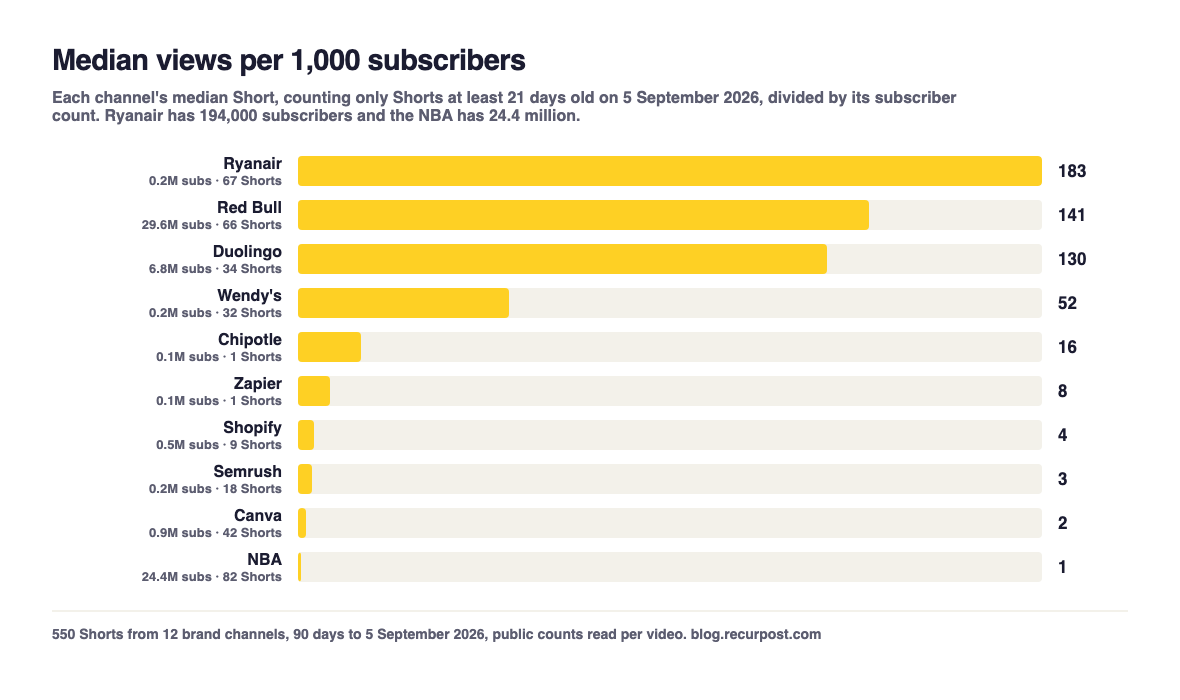
Ryanair’s median settled Short took 35,569 views. Red Bull’s took 4,164,970. So Red Bull wins on absolute reach by a mile, as you would expect. But per thousand subscribers, Ryanair’s median Short reaches 183 people and Red Bull’s reaches 141. Duolingo, with 6.79 million subscribers, sits at 130.
And then there is the NBA: 24.4 million subscribers, a median settled Short of 18,180 views. That is one view per thousand subscribers, from the largest audience in the set, publishing more than twice as often as anyone else.
I want to be careful about what that does and does not mean. Views per subscriber is a ratio of two public numbers. It is not a reach rate, it does not know how many views came from non-subscribers, and it does not know what any of these brands paid to promote anything. What it does show is that if you rank these twelve channels by subscribers and then by median views per subscriber, the two orders are almost unrelated. The audience number on the channel page is not the thing producing the views.
Every channel is carried by its outliers, and the busiest ones most of all
Read the spread column. Semrush’s best settled Short is twice its median. Canva’s is 3.5 times. Wendy’s is 5.4 times, Ryanair 6.3, Duolingo 6.9. Then Red Bull’s best is 37.8 times its median and the NBA’s is 44.4 times.
There is a real caveat here, and it cuts against the neat version of this finding: a channel with 200 Shorts has far more opportunities to produce an extreme value than a channel with 18. Some of that gap is arithmetic, not behaviour.
But the size of it is still worth sitting with. Red Bull’s top Short in this window, The Last Obstacle Is INSANE, took 157.5 million views. Its median settled Short took 4.2 million. One video in that 90 day window did more than thirty times what a typical one did, on a channel where a typical one already does four million.
If your reporting is built on the average, this is the shape of the thing that breaks it. The average Red Bull Short in this dataset is not a real object. Half the channel’s videos are within a factor of three of 4.2 million, and one of them is at 157 million.
Length: the one craft variable this data can speak to
Only two channels in the set published enough Shorts on both sides of the 30 second line to compare within themselves, which is the only comparison worth making because comparing durations across channels just compares the channels.
- NBA: 45 settled Shorts of 30 seconds or less took a median 25,416 views. 37 longer ones took a median 13,339. The shorter ones did 1.9 times better.
- Red Bull: 23 settled Shorts of 30 seconds or less took a median 6,442,358 views. 43 longer ones took 3,283,735. Again 2.0 times.
- Canva: 7 short and 35 long, and the difference is 1.07 times, which is nothing.
Two channels showing the same effect at the same size is suggestive and is not proof. It is also worth noticing what the channels have chosen: Ryanair’s median Short is 7 seconds, Duolingo’s is 10, Wendy’s is 11. Canva’s median is 52 seconds, Semrush’s 48, Zapier’s 179. The consumer brands with high views per subscriber are making things a third the length of the software brands’ videos.
The bottom of each channel is more informative than the top
The lowest settled performer on almost every channel in this set has an obvious explanation, and it is usually the same one: it is the video that was made for a different reason.
Ryanair’s weakest settled Short is a 157 second political statement about an aviation policy dispute, at 14,897 views against a channel median of 35,569. Its best is an 8 second joke about business class at 223,319. Wendy’s weakest is a 60 second corporate profile of an executive at 1,965 views; its best is a 22 second promotion for a film tie-in meal at 42,589. The NBA’s weakest is an 84 second Hall of Fame tribute to a referee at 3,821.
None of those are bad videos. They are videos that exist for a stakeholder rather than for the surface they were published on, and the numbers separate them from the rest of the channel cleanly enough that you could find them without reading the titles.
What this cannot tell you
- Twelve named channels on one platform, one 90 day window, one collection date. Not a sample of brands, and nothing here transfers to Instagram or TikTok.
- Public counts only. No impressions, no watch time, no traffic sources, no retention, no idea whether any of these views produced anything commercial.
- No way to detect paid promotion. Any of these videos could have money behind it.
- The NBA hit the 200 video extraction cap, so its count is a floor and its window is shorter than the others.
- Views keep moving. Every count here is as read on 5 September 2026, and the settled subset is a 21 day rule, not a guarantee that a count has stopped changing.
- Subscriber counts are as displayed on the collection date and say nothing about when those subscribers arrived.
Source ledger
- Video and channel data: the public YouTube pages for each channel’s Shorts tab and each video, extracted per video on 5 September 2026. 550 Shorts across 12 channels, of which 352 were at least 21 days old.
- Every Short referenced above is linked to its public URL and can be recounted. Counts will have moved since the collection date.
- The channel set, window, extraction cap and the 21 day settled rule were fixed before collection and analysis, and are described in full above.
- An earlier single account version of this method, covering one brand over 90 days, was published in Ninety days of Duolingo’s YouTube Shorts.