You open a post’s numbers and see a lot of saves next to very few likes. Is that a win, or an anomaly you need to explain before the client call? This piece cannot tell you why anyone did anything. It is a reading of Meta’s published documentation, read on 2026-09-25, and it involved no testing, no account data and no interviews. By the end you will know which claims about a save Meta has written down and which it has not.
The screen you are looking at
The question arrives the same way every time. A post has a save count that looks large beside its like count, and someone asks what it means. The honest first move is to separate two kinds of answer. One kind is what the platform’s own definitions state. The other is what people assume the numbers imply. Only the first can be checked against a page.
So that is the scope here. We will look at how Meta defines saves, shares, likes and comments, what the definitions say about how they relate, and what they leave out. Then we will use only those definitions to write a report line for a high-saves, low-likes post that you could defend if someone asked where it came from.
Which document this reads, and where it stops
The source is Meta’s Instagram Platform reference for the media insights endpoint, at developers.facebook.com/documentation/instagram-platform/reference/instagram-media/insights. It is a developer document, not the creator-facing Insights screen. I fetched it on 2026-09-25 and it returned HTTP 200. The page header reads “Updated : Sep 11, 2026”, so that is the only page date available, and every quote below is dated by my access date.
That host refuses some automated clients with an HTTP 400, so an archived copy of the same page, captured by the Internet Archive on 2026-08-01, is listed in Sources. I read that copy on 2026-09-25 as well. The rows quoted below carry the same wording and media types in both.
There is a limit on how far these quotes travel. The creator-facing Instagram Help Center pages load their text by script and could not be read as text in this research. Nothing here is quoted or paraphrased from them, and the wording on the app’s own Insights screen may differ from what is quoted here.
A developer reference is still useful for one reason: it is where Meta writes each metric down one line at a time, in a table, with the media types each one applies to.
The four definitions, side by side
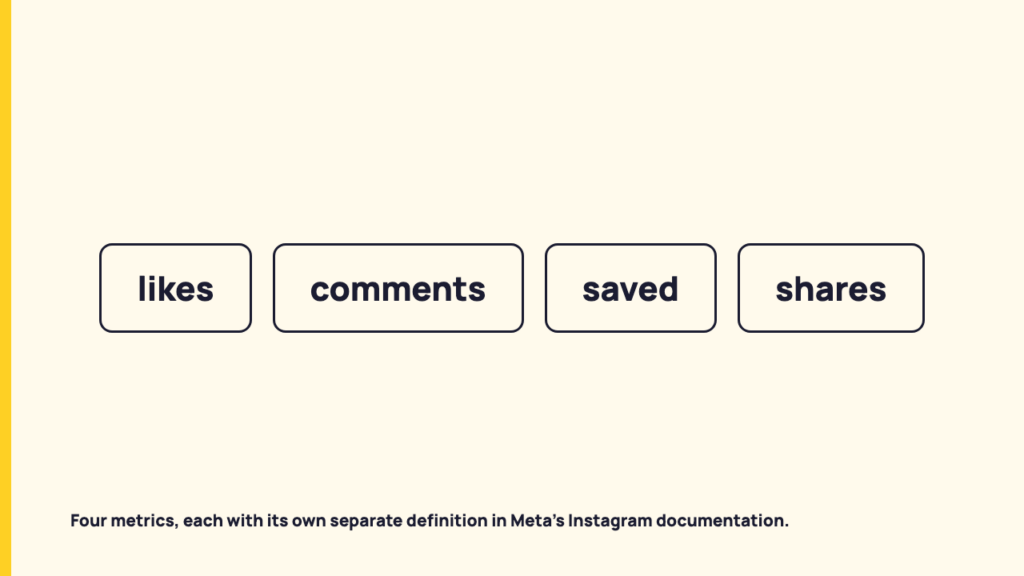
These are the four rows, quoted as they appear in the Metrics table on the access date.
| Metric as Meta writes it | Meta’s wording | Media types listed |
|---|---|---|
| likes | “Number of likes on the media object.” | FEED (posts), REELS |
| comments | “Number of comments on the media object.” | FEED (posts), REELS |
| saved | “Number of time your app user’s Instagram media was saved by an Instagram user.” (the word “time” is as written, [sic]) | FEED (posts), REELS |
| shares | “Number of shares of the reel.” | FEED (posts), REELS, STORY |
One more row sits nearby and is easy to confuse with shares. reposts is a separate metric in the same table: “The number of reposts on the IG media minus the number of deleted reposts.” It is not defined as shares.
What the definitions do separate, and what they do not
The finding that survives is narrow. saved and shares each have their own entry and their own definition, distinct from likes and comments. That is the only sense in which “a save is not a quieter like” is supported here, and it is a statement about how the metrics are listed, not about what any audience meant by tapping.
The total_interactions row is the one place the reference puts the actions together: “Number of likes, saves, comments, and shares on the reel, minus the number of unlikes, unsaves, and deleted comments.” The row carries a “Metric in development” note. Read it for what it says. It names four kinds of action and subtracts three kinds of reversal. It states no weighting between the four. It is a count definition, and nothing in the line tells you what happens to that count afterwards. If the ranking question is what you actually came with, the place to start is what Instagram has published about ranking signals.
It is worth saying once what none of the four definitions contain. There is no statement of the intent behind a save, no expected ratio between saves and likes, no benchmark and no ranking role. That is an absence in the document. It is not evidence for or against anything.
Wording gaps to check before you quote a number
A careful reporter would flag these before repeating any definition, and each can be checked on the page in a minute.
- The shares definition reads “Number of shares of the reel.” yet the same table lists shares for FEED (posts) and STORY as well as REELS. That is a wording fact. This piece does not decide which reading Meta intends. The total_interactions line has the same shape: it says “on the reel” while listing FEED (posts), REELS and STORY.
- The total_interactions line subtracts unsaves, so a save can be reversed by the person who made it. The saved line itself does not say whether its figure is net of unsaves. It is silent on this, and this piece stops there.
- The table has total_comments, total_likes and total_views, described as counts across all surfaces including promoted, boosted or ad media, available for Instagram API with Facebook Login only. No total_ variant is listed for saved or shares. The reference does not explain what that means for saves or shares on promoted media, and I will not guess. For the views side of the same table, see what a view counts as on each platform.
- The lookup that cost the least is the one to repeat: open the reference, find the row, read the exact sentence, before you put a definition in a client report.
Reading a high-saves, low-likes post using only the definitions
Start with what the definitions permit. The saved count and the likes count are defined independently, each as a number of a particular action. Neither definition makes one a function of the other. So a post can carry a high count of one and a low count of the other without contradicting either definition. That is a statement about what the documented definitions allow, not an observation about any real post.
Now what cannot be concluded. The documentation does not say why people saved. It does not say whether saving signals an intent to return, whether the post is a win, or whether it will be shown more. Filling that gap with a theory, a benchmark or a “good save rate” would be adding a claim Meta has not made. If you were hoping for a number to compare against, where industry averages come from explains why this piece offers none.
Here are two report-ready sentences. The first states the count as the metric is defined: “The post was saved N times, where saved is defined in Meta’s Instagram Platform reference as the number of times the media was saved by an Instagram user (read 2026-09-25).” The second states what is not known: “The reference does not state why users saved the post, what the count indicates about the audience, or how the count is used elsewhere on the platform.” Replace N with your figure and keep the second sentence.
The check that is yours to do is small. Open your own Insights screen, compare its label for saves with the definition quoted here, and note any difference in wording.
Before your next report
Put the source and the access date beside any metric definition you quote, and keep the sentence about what is not known. It costs one line and it is the line a client cannot argue with.
FAQ
What does a save mean in Instagram’s own documentation?
In Meta’s media insights reference, read on 2026-09-25, saved is defined as “Number of time your app user’s Instagram media was saved by an Instagram user.” and is listed for FEED (posts) and REELS. The definition is a count of an action. It states no intent behind a save and assigns it no value.
Is a save the same as a share?
Not on the documentation’s own terms. saved and shares are separate entries with separate wording, and reposts is a third. This says only that they are listed separately. Note that the shares line says “of the reel” even though the table lists it for other media types too.
Sources
- Meta, Instagram Platform: IG Media Insights reference, Internet Archive copy captured 2026-08-01, fetched 2026-09-25 (HTTP 200)
- Meta, Instagram Platform: IG Media Insights reference, live page, page header “Updated : Sep 11, 2026”, fetched 2026-09-25 (HTTP 200 to a plain “Mozilla/5.0” client, HTTP 400 to a full browser user agent)