Reach on your Instagram account has moved, your audience includes people under 18, and Meta’s teen content rules have been in the news. This piece sorts what Meta has actually said about its teen settings from what has not been said about brands.
The moment: reach moves and the audience includes under-18s
The method is plain. This is a reading of Meta’s published newsroom announcements. It is not a test, not a sample of accounts and not a set of interviews, and nothing here comes from any of those. The Instagram Help Center pages on teen accounts could not be retrieved as readable text in the research session, so every quotation below comes from Meta’s newsroom posts, and nothing is paraphrased from memory of the Help Center. Only Meta’s published wording counts as evidence about what the settings do.
What Meta announced, and when
Four announcements matter, and the wording belongs to different dates.
| Date | What Meta published |
|---|---|
| September 17, 2024 | Meta introduced Instagram Teen Accounts, saying it would “automatically place teens into Teen Accounts” and that teens under 16 need a parent’s permission to make settings less strict. The same page carries later updates dated April 10, 2025 and June 11, 2025, the latter saying Teen Accounts had been “rolled out to every country where Instagram is available”. This post is just over two years old, so it is cited here only for the dated origin and the sensitive content control wording, with no statistics taken from it. |
| October 14, 2025 | Meta announced that Teen Accounts would be inspired by 13+ movie ratings criteria and parent feedback. Teens under 18 are “automatically placed into an updated 13+ setting”, and “won’t be able to opt out without a parent’s permission”. Rollout began in the US, UK, Australia and Canada. |
| October 14, 2025 | The same post introduced a stricter setting called Limited Content, for parents who prefer it. Meta says it filters more content and “will also remove teens’ ability to see, leave, or receive comments under posts”. |
| April 29, 2026 | An update at the top of the October post says teens are being removed from the follower lists of accounts that regularly share age-inappropriate content. Affected accounts are told in Account Status. |
| May 2026 | Meta’s Asia Pacific newsroom post (listed as May 8, 2026 in Meta’s related-news block) announced the revamped settings rolling out across the region, with Facebook and Messenger Teen Accounts defaulting to the 13+ setting. |
For the September 2024 post, the sensitive content wording is that teens are placed “into the most restrictive setting of our sensitive content control”, which limits what they see “in places like Explore and Reels”.
The film rating is an inspiration, not a certification
The movie comparison is the part most likely to be repeated loosely, so read Meta’s own caveat. In the Asia Pacific post Meta writes: “We didn’t work with the MPA when updating our content settings, and they’re not rating any content on Instagram, and they’re not endorsing or approving our content settings in any way.” It says it “drew inspiration from the MPA’s public guidelines”, and adds: “Our content moderation systems are not the same as a movie ratings board, so the experience may not be exactly the same.”
The October post sets expectations in the same register. Just as you might hear strong language in a 13+ film, Meta says “teens may occasionally see something like that on Instagram”, and “we recognize no system is perfect”. The setting is a goal, not a guarantee.
For a manager, the consequence is narrow. A film-rating label tells you nothing about whether any given post of yours is filtered, because Meta says it is not rating posts like a film.
What the announcement says is restricted, and where
Meta names the categories first. Its “longstanding policies” already “hide or prohibit the recommendation of” sexually suggestive content, graphic or disturbing images, and adult content “like tobacco or alcohol sales”. The updated policies add “posts with strong language, certain risky stunts, and additional content that could encourage potentially harmful behaviors, such as posts showing marijuana paraphernalia”.
The surfaces Meta names, from the “Expanding Protections Across Teen Accounts” section of the October post:
- Recommendations: Explore, Reels and in-Feed.
- Feed and Stories: content that goes against the updated guidelines should not appear there “even when shared by someone they follow”.
- Comments: covered by the same sentence.
- Search: teens’ ability to see content results is blocked for “a wider range of mature search terms, such as ‘alcohol’ or ‘gore’”.
- DMs: if someone sends a teen a link to such content, “they won’t be able to open it”.
Two different levels are in play, and Meta words them differently. The account-level rule applies to accounts. Teens “will no longer be able to follow accounts that we’ve found regularly share age-inappropriate content, or if their name or bio suggests the account is inappropriate for teens”. Those accounts are not recommended to teens and are harder to find in Search, and the protections “work both ways”: those accounts cannot follow teens, send them DMs or comment on their posts. The content-level rule applies to individual pieces of content that go against the guidelines. Meta presents the first as turning on a pattern (“regularly”) or on a name or bio, and the second as turning on the content itself.
On scope, Meta says teens under 18 are placed in the 13+ setting automatically and cannot opt out without a parent’s permission.
How age is decided, which decides who is in scope
The settings cover teens, but Meta says teen status is not only what a user typed. In October 2025 it wrote: “We know teens may try to avoid these restrictions, which is why we’ll use age prediction technology to place teens into certain content protections, even if they claim to be adults.”
The earlier history is on the September 2024 page. A note dated March 27, 2025 says the requirement to verify age “didn’t work as well as we’d hoped”, and that Meta was removing it and testing “a new approach that will place suspected teens into Teen Account settings, regardless of the listed birthday”. And in the October post, under what it plans next, Meta says it will “apply more of the new protections to teens who claim to be adults”. That is a stated intention, not a completed change.
The reading consequence is that the covered group is defined by Meta’s classification, not only by the age a user entered. A brand cannot read that classification from its own analytics, and the pages read do not say that Insights reports it. Meta has not documented such a breakdown in those pages. This piece does not claim any Insights field exists or does not exist.
What the pages do not say about reach
In the Meta newsroom pages read (September 2024, October 2025, May 2026), Meta publishes no figure for how the settings change impressions, reach or follower counts for any account or any category of account.
The numbers Meta does publish are about parents:
- It received “over 3 million content ratings from parents” while refining its guidelines.
- In a September review in the US and UK of content recommended to teens, “fewer than 2% of the posts were considered inappropriate for teens by most parents”.
- In an Ipsos survey “commissioned by Meta”, 95% of US parents of teens said the updated settings would be helpful.
These measure parent opinion and review outcomes, not brand reach, and two of the three come from Meta-commissioned or Meta-run exercises.
The questions the pages leave open, each answered the same way, “the pages read do not state this”:
- How many accounts have been classed as regularly sharing age-inappropriate content.
- How an individual post is judged against the 13+ guidelines.
- Whether a post can be hidden from teens while shown to adults at normal distribution.
- What share of any brand’s audience is teen.
The April 29, 2026 update is the one place Meta describes a count effect. It removes teens from the follower lists of affected accounts “so their follower counts reflect only people who can actually see their content”. Meta describes it as applying to accounts that regularly share age-inappropriate content, not to ordinary brand accounts, and it should not be generalised.
Claims that circulate without a source
Some claims about teen settings travel without a citation. One kind says the settings “cut reach” for brands. Another says certain words are quietly limited for young audiences. No specifics are quoted here, because none are sourced.
For each kind, ask what published wording would have to exist. A reach-cut claim needs a Meta statement or figure about impressions or reach for an account category. The pages read contain none. A word-limiting claim needs a published list of words or topics tied to distribution. The pages name content categories and a few example search terms, and the search wording concerns teens’ content results, not distribution of your posts.
That is reading practice, not a verdict. Meta’s wording does not contradict these claims, so none is called a myth, but it does not support them either.
Before you blame the teen settings: a reading checklist
- Read the category list against your recent posts. Set Meta’s published list (strong language, certain risky stunts, adult content, content that could encourage harmful behaviours) beside your own recent posts. This is a reading exercise, not a prediction of filtering.
- Check Account Status. Meta says affected accounts are informed there of the follower-list change. If you find no notice, that is information, not proof of anything.
- Check what your analytics can and cannot show about audience age. Any age breakdown Instagram shows is a platform-reported figure, produced with whatever classification Instagram uses. This piece does not state what Insights does or does not show beyond what was verified.
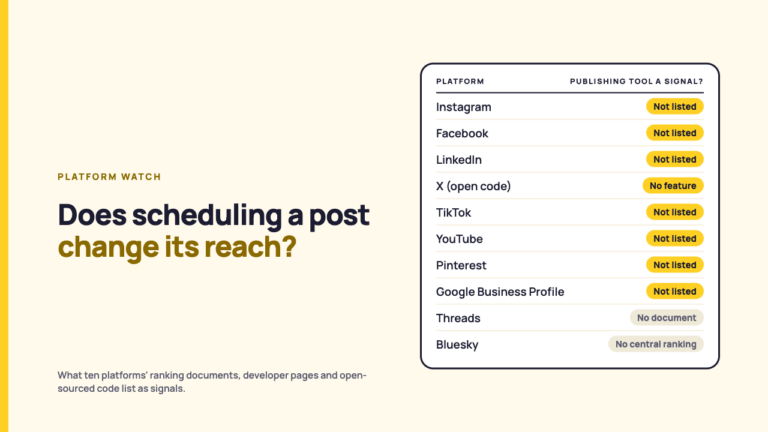
- Keep the conclusion small. Nothing here establishes the teen settings as the cause of any reach change. For the general question, see which Instagram ranking claims Meta has actually published. For a neighbouring control, see what the Hidden Words filter catches by default. More dated reads of platform statements live under Platform Watch.
FAQ
Do Instagram’s teen content settings reduce my reach?
Meta’s pages describe what content is hidden or not recommended to teens, but they publish no reach figures and no statement about the effect on any given account, so the effect on a particular account is not documented.
Does the 13+ setting mean Instagram rates every post like a film?
No. Meta’s Asia Pacific post says it did not work with the MPA, that the MPA is not rating any content on Instagram, and that “our content moderation systems are not the same as a movie ratings board”.
Sources
- Meta newsroom, Introducing Instagram Teen Accounts (September 17, 2024, with updates), fetched 2026-10-01
- Meta newsroom, Instagram Teen Accounts Will Be Inspired by Movie Ratings for Ages 13+ (October 14, 2025, updated April 29, 2026), fetched 2026-10-01
- Meta newsroom, Instagram Teen Accounts in APAC Will Be Inspired by 13+ Movie Ratings Criteria and Parent Feedback (May 2026), fetched 2026-10-01