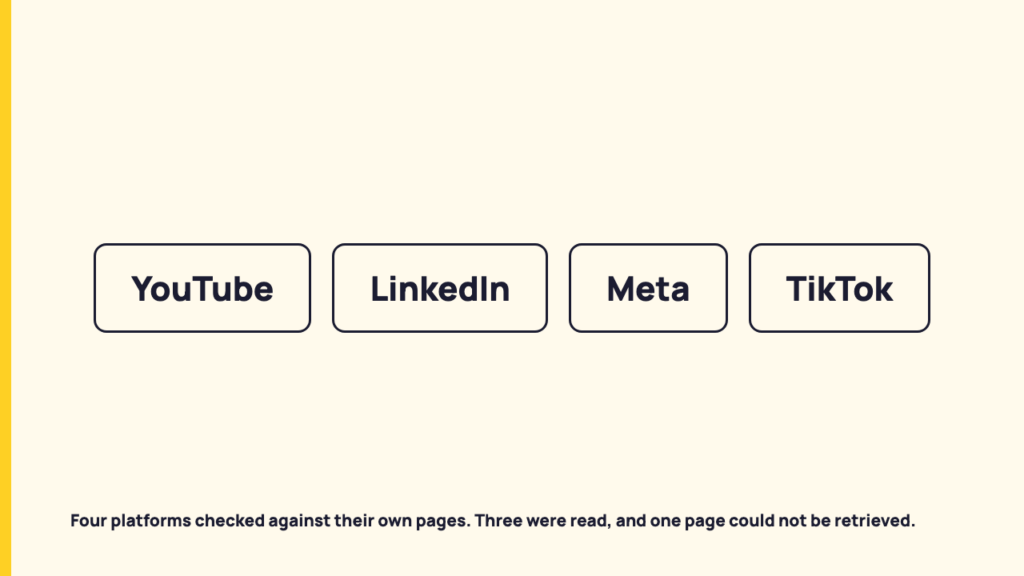
A client sends over a signed image or video and asks a plain question: will the Content Credentials still be there when it reaches the audience? The honest answer depends on a platform’s own words. This post sets each platform’s published statement against the C2PA specification and marks every silence. It reports what platforms say, not what they do to a file. No upload was run for it.
What the file carries, and what happens to it
This post read version 2.3 of the C2PA technical specification, the current version on spec.c2pa.org when retrieved on 2026-10-14. The page shows no publication date.
The spec defines a claim (section 2.3.2) as a digitally signed and tamper-evident data structure that references a set of assertions about an asset, along with the information needed to represent the content binding. A C2PA Manifest (2.3.4) is the combination of one or more assertions, a single claim and a claim signature. “Content Credential” (2.3.6) is the preferred non-technical term for a manifest. The C2PA explainer adds that Content Credentials make no value judgment about whether the provenance data is true.
Two kinds of binding tie a manifest to its file. A hard binding (2.3.12) is one or more cryptographic hashes that uniquely identify the whole asset or a portion of it. A soft binding (2.3.13) is a content identifier that is either not statistically unique, such as a fingerprint, or embedded as an invisible watermark in the content.
The spec also says, in its definition of a fingerprint (2.4.2), that an asset can become separated from its manifest “due to removal or corruption of asset metadata”, and that a fingerprint of the content could be used to search a database and recover the asset with an intact manifest. A Content Credential with soft bindings that let it be found in a manifest repository is what the spec calls a Durable Content Credential (2.4.1). That is the spec on files in general, not about any platform.
The comparison: read, show, strip, per platform
Every row below comes from a primary page that returned HTTP 200 on 2026-10-14 and whose text was read. “Has not said” means the pages named in the row were read and contain no statement on that point. Absence is a finding about those pages on that date, not about the platform’s systems. Rows run from most said to least.
| Platform | Says it reads | Says it shows viewers | Says about stripping or keeping metadata | Page date |
|---|---|---|---|---|
| YouTube (three Help pages) | Content Credentials (C2PA) 2.1 or higher; C2PA metadata | “Captured with a camera” disclosure; an AI label, which can appear in the player or the expanded description | Has not said whether it keeps or strips a file’s metadata on upload. Says a save to a photo album without C2PA 2.1 support “may break the chain of provenance” | Pages undated, retrieved 2026-10-14 |
| LinkedIn (Content credentials help page) | Image and video content with C2PA information attached | A C2PA icon; clicking shows the credential and available metadata | Has not said | “Last updated: 1 week ago”, retrieved 2026-10-14 |
| Meta (newsroom post) | Says it is building tools to identify the “AI generated” information in the C2PA and IPTC standards | Has not said how a credential is shown to viewers; the page describes labels on AI-generated images | Says people can strip out invisible markers | February 6, 2024, retrieved 2026-10-14 |
| TikTok | Page could not be retrieved on 2026-10-14 | Page could not be retrieved on 2026-10-14 | Page could not be retrieved on 2026-10-14 | Not applicable |
LinkedIn: the clearest statement of what viewers see
LinkedIn’s Content credentials help page says members can view the Content Credentials on all image and video content that has C2PA information attached. Signed content is noted with a C2PA icon, and clicking it displays the credential and available metadata. The page lists five fields: an assertion about the media (whether AI was used to generate or edit any part of the content, per the signer), app or device used, created by, issued by, and issued on.
LinkedIn writes that it is “gradually making this feature available” and that you might not have access to it at this time. And in select countries, when you upload media without valid authenticity information, you can self-attest that it was created using AI. If you do, LinkedIn says it will generate and securely store authenticity information for the original image or video, and that the original media itself is never modified.
The sponsored content note, as written: “for Sponsored Content single image and video ads, the C2PA icon will only appear on single image or video ads when the image or video is uploaded. This applies to content created in Campaign Manager, as well as content sponsored from your Company Page.”
The page has not said whether LinkedIn re-encodes uploads or preserves a manifest through processing. The page showed “Last updated: 1 week ago” on 2026-10-14, a relative date, so record the retrieval date.
YouTube: a disclosure that depends on an unbroken chain
The Help page “Building trust on YouTube: ‘Captured with a camera’ disclosure” covers one specific disclosure. For it to appear, creators must use tools with built-in C2PA support, version 2.1 or higher, to capture the video. The page says YouTube “will relay the information that the content was ‘Captured with a camera,’ and apply the disclosure when it detects this metadata.” It also says the content must not have edits to sound or visuals.
The page gives its own example of breaking the chain. If you capture an image with C2PA metadata and save it to your phone’s photo album that does not support C2PA v2.1 or higher, “that may break the chain of provenance.” That concerns a photo album, not YouTube’s own processing.
Its limitations are stated plainly. The disclosure only appears if a creator opts to use C2PA technology during filming, and if it is missing, “it doesn’t mean the content has modified audio or visuals.” It also names an “air-gapping” risk: someone could photograph a screen showing synthetic content.
The page says this feature is separate from YouTube’s altered and synthetic disclosures and does not describe Content Credentials feeding the AI label, so the two linked pages were fetched too (both 200).
“Disclosing use of GenAI content” says YouTube may automatically apply an AI label to content made with YouTube’s own GenAI tools, content that contains C2PA metadata, and content its internal systems detect as AI generated or altered. Creators cannot adjust a label triggered by C2PA metadata. “Understanding ‘How this content was made’ disclosures on YouTube” says YouTube will carry forward disclosures from tools and creators available with secure Content Credentials (C2PA) 2.1 or higher that indicate the entire video was made with AI, as a label on the player or in the description. None of the three pages says whether YouTube keeps or strips a file’s metadata on upload.
Meta and TikTok: what each has published, and one link out
Meta’s newsroom post “Labeling AI-Generated Images on Facebook, Instagram and Threads” is dated February 6, 2024. That is over two years old, and Meta may have said more since. It says Meta is building tools that can identify invisible markers at scale, specifically the “AI generated” information in the C2PA and IPTC standards, and that the invisible markers it uses for Meta AI images are IPTC metadata and invisible watermarks. It also says there are ways people can strip out invisible markers, so it is pursuing a range of options. For how the label itself works, see how Meta’s AI label decides what to flag.
TikTok is the gap. On 2026-10-14 the TikTok transparency URLs tried redirected to a generic tiktok.com/in/about page with no relevant statement, and the newsroom and support URLs tried returned 503. Nothing is reported here about TikTok.
Where nobody has said
Checked against the fetched text on 2026-10-14, none of these is answered:
- LinkedIn re-encoding or manifest preservation: not on its Content credentials page.
- YouTube keeping upload metadata or a manifest on re-encode: not on its three pages above.
- Meta preserving C2PA metadata after upload: not in the February 2024 post.
X, Pinterest, Snapchat and other platforms are not covered in this post, because no primary page for them was fetched. That is not the same as saying they have said nothing.
Where a platform is silent, the reader has the spec’s general statement that metadata removal or corruption can separate an asset from its manifest, and nothing platform-specific.
What a team can do with this on Monday
- Keep the original signed export separate from any re-saved copy. YouTube’s own example is that saving a C2PA-captured image into a photo album without C2PA 2.1 support may break the chain of provenance, so keep the signed original.
- Record which tool signed the file, and when, so it matches the signer and date a LinkedIn viewer could see.
- Expect the viewer-facing credential on LinkedIn only for content that carries valid C2PA data; self-attestation exists only in select countries.
- Answer “will it show?” with the platform’s own words and the date you read them, re-reading the page on the day you answer because these are living help documents.
When the platform has not said, say that. A worked wording for a client or compliance reviewer: “LinkedIn’s help page, read on 2026-10-14, says the C2PA icon appears on content with C2PA information attached. It does not say whether the file is re-encoded on upload. We have no published statement on that point, so we cannot confirm it.”
FAQ
Do social platforms strip Content Credentials on upload?
The pages read for this post do not say whether any platform strips or keeps them, so platform behaviour is “has not said”. The C2PA specification says removal or corruption of asset metadata can separate an asset from its manifest.
Does a missing label mean the content was edited or is AI-generated?
YouTube’s page says the “Captured with a camera” disclosure only appears if a creator opts to use C2PA technology during filming, and that if it is missing, it does not mean the content has modified audio or visuals.
Sources
- C2PA Technical Specification 2.3, fetched 2026-10-14 (HTTP 200)
- C2PA Explainer 2.3, fetched 2026-10-14 (HTTP 200)
- LinkedIn Help: Content credentials, fetched 2026-10-14 (HTTP 200)
- YouTube Help: Building trust on YouTube, Captured with a camera disclosure, fetched 2026-10-14 (HTTP 200)
- YouTube Help: Disclosing use of GenAI content, fetched 2026-10-14 (HTTP 200)
- YouTube Help: Understanding How this content was made disclosures on YouTube, fetched 2026-10-14 (HTTP 200)
- Meta Newsroom: Labeling AI-Generated Images on Facebook, Instagram and Threads, dated February 6, 2024, fetched 2026-10-14 (HTTP 200)