Meme marketing is a brand using internet memes, a familiar image, template or short clip re-captioned for a new joke, in its own social posts to get attention and engagement. On Facebook and Instagram, the question that decides whether it works is not whether the joke lands but what Meta’s rules do with a post the brand did not make.
A client saw a competitor’s account doing well with meme marketing and wants the same for their brand. Before the first post goes into the calendar, somebody has to be able to say what the exposure is. The scenario is hypothetical.
This piece is a reading of Meta’s Intellectual Property policy, its Content Distribution Guidelines change log, two of its enforcement pages, two Meta newsroom announcements, two Meta Business Help Centre pages on originality, Meta’s copyright help article, and three Instagram pages, read between 28 October and 13 November 2026. No posts were sampled, and no engagement was measured. Nothing here is legal advice.
Meta documents two separate exposures for an account posting content it did not make. The first is intellectual property: a rights holder can report the post, Meta says it will remove or restrict it, and accounts with repeated violations are removed. The second is distribution: Meta’s current enforcement page treats content “principally repurposed from other sources” as a reason to show a post to fewer people, even though Meta’s own change log records it dropping the equivalent demotion in October 2023, before announcing a fresh originality push in April 2025 and again in March 2026. Instagram publishes its own rules on top: it says it makes watermarked and already-posted reels less visible, and “accounts that repeatedly post content from other Instagram users that they didn’t create or enhance in a material way will not be shown in surfaces where we recommend content.”
The rights holder route, and what Meta says it does
Meta’s Intellectual Property Community Standard says Meta is “committed to protecting these rights while promoting expression, creativity, and innovation”, and prohibits posting content that violates another party’s intellectual property rights.
The policy allows content the rights holder has authorised, and content that “follows established fair use principles”. It does not define fair use beyond that phrase. After a report from a rights holder or an authorised representative, Meta says it will “remove or restrict content” involving copyright infringement, trademark infringement, counterfeit sales or false brand affiliation. It also removes content that “Shares, promotes, or facilitates suspected copyright infringement”, and it removes accounts with repeated violations.
What the policy does not do is treat reposting as a category of its own. It addresses infringement, and it addresses it on report. The trigger documented here is a complaint from the owner, not a scan by Meta, and the documented consequence is removal or restriction of the post, with the account at risk if it happens repeatedly. That is reasoning from the policy page, not a statement from Meta.
Meta’s help article on how copyright works answers the two beliefs that usually carry a meme onto a brand account. It says you can infringe someone’s copyright when you post their content even if you “Gave credit to the copyright owner”, “Found the content available on the Internet”, “Saw that others posted the same content as well” or “Think that the use is a fair use”. It also says that under the repeat infringer policy an account that keeps posting infringing content “may be disabled or your Page removed”.
Whether any particular image is infringing is a question for the client’s lawyer, and the US Copyright Office’s own wording is read in what the Copyright Office says about fair use and reposting a meme.
The distribution route, read in date order
Meta’s current enforcement page on reducing distribution lists “Limited originality content that is principally repurposed from other sources” among the things it shows to fewer people. The same list carries “Low-quality videos that abuse video or live video formats”, clickbait, engagement bait, and content from “creators that repeatedly violate our policies”. Meta frames the whole category as content that does not break the Community Standards but “might still be problematic or otherwise low-quality”, and says distribution may be reduced “consistent with user controls”.
Meta’s page on repeatedly posting low-quality content adds the account-level version. It says Meta will “implement new demotions for a set period of time” against publishers who keep posting unoriginal or repurposed content, and that it will “demote posts that repeatedly use engagement bait” to artificially gain reach in News Feed.
Meta also keeps a dated log of changes to these guidelines, and the log does not read like a settled policy.
| Date | What Meta’s change log records |
|---|---|
| 12/2021 | Added “Pages Posting Unoriginal Videos” to summarise new demotions acting on pages posting videos “that are not primarily filmed or produced by the Page”. |
| 10/2023 | Removed “Pages Posting Unoriginal Videos” because “we no longer reduce the distribution of these pages”. |
| 10/2023 | Removed “Low Quality Videos” because “we no longer reduce the distribution of these videos”. |
| 10/2023 | Removed “Content Borderline to the Community Standards” because “we take a personalized ranking approach to this type of content”. |
| 10/2024 | Recorded that a fake-account demotion had not been used since 2022, and that the change had been missing from the change log. |
| 7/2025 | Removed fourteen guidelines and updated one. |
Source: Meta Transparency Center, “CDG Corrections and adjustments”, read 2026-10-28. Dates and wording are Meta’s own.
The sequence is the finding. Meta added an unoriginal-video demotion in December 2021, removed it in October 2023 on the stated ground that it no longer reduced the distribution of those pages, and its live enforcement page still lists limited-originality content as a reduced-distribution category. Meta does not reconcile the two pages anywhere this piece could find, and this piece does not pick one on Meta’s behalf.
The October 2024 entry deserves its own sentence, because it records a change that had been missing from the log. A change log that admits to having missed a change is still the best dated record on offer, and it is the reason the date you read a rule matters as much as the rule.
What Meta now says counts as original
Meta’s announcement of 13 March 2026 supplies the definition that was missing from the guidelines. It says, “Content filmed or produced directly by a creator or owner of a Profile or Page is considered original content on Facebook.”
Reels built on third-party material can still count as original, Meta says, when they show “something genuinely new”. Content that is “duplicative or involves minor edits to another creator’s post will be considered unoriginal”. The announcement then names the edits it does not count: “watching along, reacting with facial expressions, stitching multiple clips together”, “adding borders, inserting captions”, and changing a reel’s speed.
The consequences are stated in the same announcement. “Creators who are not adding substantial creative value will see their content deprioritized”, and an account that continues to post primarily unoriginal content may find “their account deemed non-recommendable and demonetized”. Meta adds that “Creators always have the option to appeal decisions regarding originality.” It reports that views and watch time for original reels on Facebook “approximately doubled in the second half of 2025” against the same period in 2024, and that in 2025 it removed “more than 20 million accounts impersonating large content creators”, with impersonation reports related to large creators down 33%.
The earlier announcement, from April 2025, set the frame. Meta said “Too much spammy content is crowding out authentic creators and hurting the Facebook experience”, that “Some accounts try to game the Facebook algorithm to increase views”, and that “When other accounts reuse their content without their permission, it takes unfair advantage of their hard work.” It pointed creators to Rights Manager, its tool for protecting original content, and reported that “in 2024 we took down more than 100 Million fake Pages engaging in scripted follows abuse on Facebook” and “over 23 million profiles that were impersonating large content producers”.
The March 2026 announcement is written about creators and mostly about reels. For a brand account posting a still image, the more specific document is Meta’s help page on original content, covered next.
Photo memes: the edit Meta says makes a meme original
Meta’s Business Help Centre page “Original content guidelines on Facebook” opens with the rule that matters most for meme marketing: “Facebook prioritises original content in Feed and Reels recommendations.” It encourages Pages and profiles to post content “that they originally produced or have the rights to publish for the first time”.
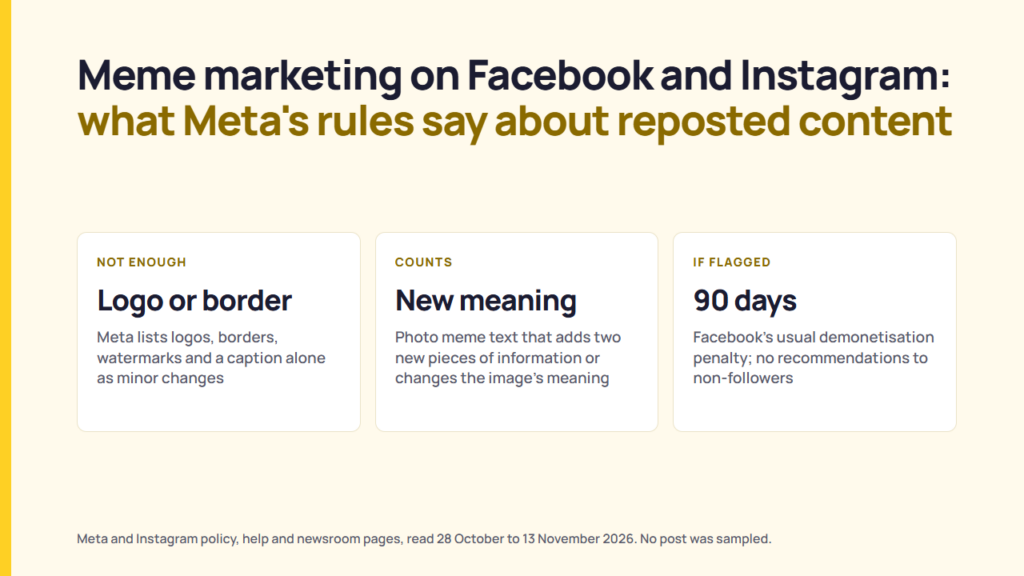
The page names photo memes directly. Among its examples of a meaningful enhancement of third-party material, it lists: “For photo memes, text edited onto the image that adds at least two new pieces of information or changes the interpretation of the original image.” It adds that “Describing the image with text or in the description alone does not qualify as a meaningful enhancement.”
The same page lists the “minor changes” that leave a post unoriginal. The ones a brand account is most likely to make to a meme are:
- Superimposing borders
- Inserting logos or graphics, including watermarks
- Adding only an on-screen text caption or title
- Simply describing what happens in a photo or video, in text, on screen, via voiceover or in the description, with no other meaningful additions
- Basic compilations that splice third-party clips or photos together without adding your own narrative or new information
On consequences, the page says “Third-party content that is posted without substantial changes is considered unoriginal and will receive reduced distribution”, that posting it “violates Meta’s terms and Partner Monetisation Policies”, and that it “may also lead to additional enforcement actions such as limited or loss of recommendations and monetisation abilities”. It also says the original content guidelines are separate from the intellectual property policies.
Instagram published the same distinction for its own app on 30 April 2026, when it extended its originality rules from reels to photos and carousels. Its creator blog says “material edits to third-party content (e.g. meme templates, popular clips, etc.) may be considered ‘original’ when your additions meaningfully enhance the content you’re using”, with examples such as “adding unique text on the content itself that provides more context than just describing what’s happening”. What does not qualify is “Re-uploading someone else’s work in a photo, carousel, or reel without adding meaningful creative input”, “such as just adding a border, watermark, subtitles, or a credit in the captions”.
Put together, the two pages set the line for a brand meme: the joke has to be the brand’s own addition. A logo, a border, a credit or a caption describing the picture is listed by Meta as not enough, and a meme with new text that changes what the image means is the case Meta names as original. Whether a given caption meets the “two new pieces of information” test is Meta’s call, not something this reading can settle.
Instagram’s separate rules for the same post
Instagram’s ranking explainer lists the reels it aims to make less visible, and most items on the list describe reused material directly. Instagram says it aims to make less visible “low-resolution or watermarked reels, reels that are muted or contain borders, reels that are majority text, or reels that have already been posted on Instagram”, and that it is experimenting with notifications to tell creators when a watermark has limited a reel’s reach.
Instagram’s creator blog post “Helping Creators Find New Audiences”, published 30 April 2024, says that when Instagram finds identical copies it will recommend only the original, but it “won’t replace content if it has been changed in a significant way, for instance if it’s materially edited to become a meme”. The same post says accounts that “repeatedly post content from other Instagram users that they didn’t create or enhance in a material way will not be shown in surfaces where we recommend content”, and that “these changes are separate from our intellectual property policies”.
Instagram’s creator blog post “Rewarding original creators on Instagram”, published 30 April 2026, says “accounts that primarily post unoriginal content in photos or carousel posts, in addition to reels, will no longer be shown in places where we recommend content”. It says the update “does not impact how we show people content from accounts they follow”, and it points accounts that want to share someone else’s work towards stories, reposts, collabs and remix, which credit the original creator.
A meme saved from another platform usually carries that platform’s watermark, and a meme that has circulated has by definition already been posted on Instagram. Both are named conditions on Instagram’s own page. That is a reading of the explainer, not a statement from Instagram. How these rules sit beside the rest of what Instagram has said about ranking is covered in what Instagram has published about its ranking signals.
At account level, Instagram says that if an account “repeatedly posts content that goes against our Recommendation Guidelines”, then “none of their posts will be eligible for recommendation for a period of time”.
If Facebook or Instagram flags the account for unoriginal content
Meta’s help page “Understanding limited originality of content violations” describes what a flagged Page sees: a message in Meta Business Suite, the professional dashboard or the Facebook app saying it “shared content that was unoriginal or repurposed content from other sources with limited added value”. The page says such content “cannot be monetised and will not be recommended to audiences that do not follow your Page or profile”, and that the policy “can still apply to copyrighted or licensed content”.
The page sets out the penalty and the way back:
| Question | What Meta’s page says |
|---|---|
| How long does it last? | “In most cases, the limited originality of content violation carries a 90-day demonetisation penalty.” More unoriginal content in that period “may result in the extension” of it. |
| What should the Page do? | Review its content, and post only content it “produced or meaningfully enhanced”. |
| Can it appeal? | Yes, if it believes it was “flagged incorrectly”. If the flag was correct, Meta recommends posting “a significant number of reels that are original or meaningfully enhanced before requesting an appeal”. |
| Should it delete old posts? | No. “You should not mass delete the existing content on your Page or profile in an attempt to expedite your access to monetisation.” |
| Where is the status shown? | Meta Business Suite > Monetisation > Policy Issues. |
On Instagram, the April 2026 post says an account that lost recommendations can become eligible again “when a significant percentage of their recently posted photos, carousels, and reels are considered original in a 30-day period”, calculated on a rolling basis. The standing is shown in Account Status, where the account can remove the content in question or appeal.
Most of this page is written about monetisation, which a brand account may not use. The part that applies to any Page is the loss of recommendations to people who do not already follow it (reasoning from the help page).
What a freelancer can tell a client about meme marketing
Six answers, each tied to a Meta document.
| What the client asks | What Meta’s documents support |
|---|---|
| 1. Can we post memes? | Meta’s Intellectual Property policy does not treat reposting as a category on its own. It acts on reports from rights holders, and Meta’s copyright help article says crediting the owner or finding the image online does not prevent infringement. |
| 2. What happens if the owner complains? | Meta says it will remove or restrict the content, and removes accounts with repeated violations. |
| 3. Will it hurt our reach? | Meta’s help page says third-party content posted without substantial changes “will receive reduced distribution”, and its enforcement page lists limited-originality content as a reduced-distribution category. Its change log records removing the unoriginal-video guideline in October 2023. No figure is published either way. |
| 4. Does adding our logo or a caption fix it? | No. Meta’s original content guidelines list “Inserting logos or graphics, including watermarks”, borders and “Adding only an on-screen text caption or title” as minor changes. For a photo meme, Meta names text that “adds at least two new pieces of information or changes the interpretation of the original image”. |
| 5. Is Instagram the same? | Instagram publishes its own rules. It names low-resolution, watermarked, bordered, majority-text and already-posted reels as less visible, and since April 2026 it applies its originality rules to photos and carousels too. |
| 6. What is the worst case? | An account “deemed non-recommendable and demonetized” per the March 2026 announcement, or removed for repeated intellectual property violations per the policy. |
Meta publishes a dated record of changing its position on reused content twice in five years, and its current pages do not agree with each other. The useful habit for an agency is to quote the date beside the rule, the way you would with a platform’s developer changelog. Whether the client posts memes is the client’s decision, and the copyright question belongs to their lawyer. Keep reading what the platform documents say about embedding, resharing and reuploading and YouTube’s inauthentic content policy for brand channels.
What could not be confirmed
This reading cannot settle seven points:
- Meta’s pages are not reconciled. A guideline removed in October 2023 and a live enforcement category describe the same behaviour, and nothing read here says which is operative.
- Meta’s change log records at least one change that was missing from it, by its own October 2024 entry.
- No reach figure is published for any originality demotion, so the size of any effect is unknown.
- Meta’s help page names the edit that makes a photo meme original, but it publishes no examples of captions that pass or fail the “two new pieces of information” test.
- Meta’s Partner Monetisation Policies were not read in full. The demonetisation consequences come from the March 2026 announcement and the limited originality help page.
- No posts were sampled, so nothing in the piece measures what happened to any real meme post.
- Nothing here is legal advice. Meta’s fair use line is quoted and not interpreted.
FAQ
What is meme marketing?
Meme marketing is a brand using internet memes, a familiar image, template or short clip with a new caption, in its own social posts. On Facebook and Instagram, Meta’s originality rules decide how far a meme post is shown when the brand did not make the underlying image.
Can a brand post memes it did not make?
Meta’s Intellectual Property policy does not answer that directly, because it does not treat reposting as a category on its own. It prohibits content that violates someone else’s rights, allows content the rights holder authorised or that “follows established fair use principles”, and acts after a report by removing or restricting the content. Accounts with repeated violations are removed.
Does meme marketing work on Facebook and Instagram?
Meta publishes no figure for meme posts. What it does publish points the other way for reposted memes: Facebook says it “prioritises original content in Feed and Reels recommendations”, Meta reports that views of original reels on Facebook “approximately doubled in the second half of 2025”, and Instagram says 75% of its US recommendations now come from original posts.
Does posting memes reduce reach?
Meta’s help page says third-party content posted without substantial changes “will receive reduced distribution”, and its enforcement page lists “Limited originality content that is principally repurposed from other sources” among the things it reduces distribution for. Its own change log records removing the equivalent unoriginal-video guideline in October 2023. No figure is published for how much reach is affected.
What does Meta count as original content?
Meta’s announcement on 13 March 2026 says original content is “Content filmed or produced directly by a creator or owner of a Profile or Page”. Content that is “duplicative or involves minor edits to another creator’s post” is treated as unoriginal, and the announcement names adding borders, inserting captions, stitching clips and changing speed as low-value changes.
Does a meme the brand makes itself count as original?
It can. Meta’s original content guidelines say a photo meme counts when the text edited onto the image “adds at least two new pieces of information or changes the interpretation of the original image”. Instagram says material edits to “meme templates” may be considered original when the additions “meaningfully enhance” the content. A border, logo, watermark or credit alone does not qualify on either app.
What happens if Facebook flags a Page for unoriginal content?
Meta’s help page says the content “cannot be monetised and will not be recommended to audiences that do not follow your Page or profile”, and that “In most cases” the violation “carries a 90-day demonetisation penalty”. The Page can appeal if it believes it was flagged incorrectly, and Meta says it should not mass delete old posts to speed things up.
Can a brand appeal an originality decision?
Facebook says, “Creators always have the option to appeal decisions regarding originality.” Instagram says ineligible accounts “can become eligible for recommendations again after enough time has passed since the last time they posted unoriginal content; this can be checked by using account status where they will also have the option to appeal.”
Is a watermarked meme a problem on Instagram?
Instagram says it aims to make “low-resolution or watermarked reels, reels that are muted or contain borders, reels that are majority text, or reels that have already been posted on Instagram” less visible. It also says an account that repeatedly posts content against its Recommendation Guidelines will have none of its posts eligible for recommendation for a period of time.
Does Instagram stop recommending accounts that repost memes?
Instagram’s 2024 creator blog post lists removing content aggregators from recommendations and says “accounts that repeatedly post content from other Instagram users that they didn’t create or enhance in a material way will not be shown in surfaces where we recommend content.” Its April 2026 post extends that to accounts that primarily post unoriginal photos or carousels. Neither change affects how the account’s posts reach people who already follow it.
Sources
Publisher, page title, link and the date read.
- Meta Transparency Center, Community Standards, “Intellectual Property“, read 2026-10-28.
- Meta Transparency Center, “CDG Corrections and adjustments“, read 2026-10-28.
- Meta Transparency Center, “Reducing the distribution of problematic content“, read 2026-10-28.
- Meta Transparency Center, “Repeatedly posting low-quality content“, read 2026-10-28.
- Meta Business Help Centre, “Original content guidelines on Facebook“, read 2026-11-05 and 2026-11-13.
- Meta Business Help Centre, “Understanding limited originality of content violations“, read 2026-11-13.
- Meta Help Centre, “How copyright works at Meta“, updated early October 2026, read 2026-11-05 and 2026-11-13.
- Meta Newsroom, “Rewarding Original Creators on Facebook“, 13 March 2026, read 2026-10-28 and 2026-11-13.
- Meta Newsroom, “Cracking Down on Spammy Content on Facebook“, April 2025, read 2026-10-28.
- Instagram, “Instagram Ranking Explained“, 31 May 2023, read 2026-10-28 and 2026-11-13.
- Instagram, “Helping Creators Find New Audiences“, 30 April 2024, read 2026-11-05 and 2026-11-13.
- Instagram, “Rewarding original creators on Instagram“, 30 April 2026, read 2026-11-05 and 2026-11-13.
- Meta Transparency Center, Community Standards, “Spam“, read 2026-10-28.