
This post covers US federal law only, the Fair Labor Standards Act (FLSA) and the Department of Labor’s regulations. It is a dated reading of published rules, not legal advice, and the answer for any real person depends on their actual duties, pay and state. The scenario, generic and not a finding about anyone: a salaried account manager is asked to cover a weekend when a brand has a public problem, and wants to know whether federal law says that time must be paid.
The duties side starts with what the work is, which is covered in what job postings say the job covers. This is a pay-law question, separate from how official occupation data classifies the job, and an occupation code does not decide whether anyone is exempt. More on the working life of the role sits under The Job.
The default rule: overtime unless an exemption applies
Section 7 of the FLSA (29 U.S.C. 207) says an employer may not employ a covered employee for a workweek longer than forty hours unless the employee receives pay for the extra hours at a rate not less than one and one-half times the regular rate. The Department of Labor’s May 15, 2026 Federal Register notice says the same: minimum wage for all hours worked, and overtime at not less than one and one-half times the regular rate for hours over 40 in a workweek.
Exemptions are the exception. Section 13(a)(1) (29 U.S.C. 213) exempts employees in a bona fide executive, administrative or professional capacity, as defined by the Secretary of Labor’s regulations in 29 CFR Part 541. The notice describes three tests that generally must all be met: a duties test, a salary basis test and a salary level test. All three, not one of them.
A title does not settle it. In the words of 29 CFR 541.2, “a job title alone is insufficient to establish the exempt status of an employee,” and status “must be determined on the basis of whether the employee’s salary and duties meet the requirements of the regulations in this part.”
Test one: the salary basis and salary level, and where the threshold stands today
Two of the three tests are about pay. Salary basis, defined in 29 CFR 541.602, means the employee regularly receives each pay period a predetermined amount that is not subject to reduction because of variations in the quality or quantity of the work performed. A salary that moves with hours or output is not a salary in this sense.
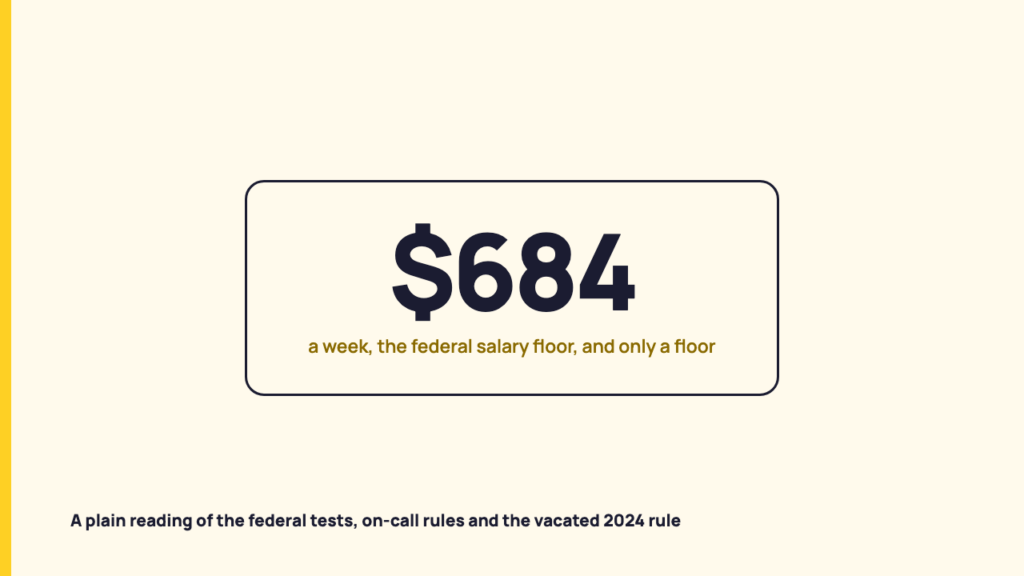
Salary level is the floor. Section 541.600, checked in the eCFR text on October 19, 2026, requires pay on a salary basis of not less than $684 per week for the standard level. The notice gives $35,568 per year for a full-year worker. The dates below are the Department’s account in the 2026 notice.
| Date | Event | Salary level per week |
|---|---|---|
| September 27, 2019 | Final rule, 84 FR 51230, raises the level; effective January 1, 2020 | $455 to $684 |
| April 26, 2024 | Final rule, 89 FR 32842, schedules two increases and triennial updates | $844 from July 1, 2024; $1,128 from January 1, 2025 |
| November 15, 2024 | E.D. Texas vacates the 2024 rule (Texas v. U.S. Dep’t of Labor) | 2024 rule vacated |
| December 30, 2024 | N.D. Texas likewise vacates it (Flint Avenue, LLC v. U.S. Dep’t of Labor) | 2024 rule vacated |
| May 5 and May 7, 2026 | Fifth Circuit appeals dismissed | Final judgments |
| May 15, 2026 | Technical amendment, 91 FR 27833, restores the earlier text | $684 |
The notice states: “the operative version of the Department’s part 541 regulations is the version of these regulations that was in place on June 30, 2024, prior to the effective date of the 2024 rule, and which the Department has been enforcing.” Thresholds have moved through rulemaking and court challenge before, so check the eCFR for 29 CFR 541.600 on the day you read this.
The level is only a floor. A person paid above it is not exempt for that reason, because the duties test still has to be met.
Test two: what the duties tests look at, and how account work lines up
The duties test asks about the real work, not the title or the job description. Three Part 541 exemptions are worth reading against account work.
The administrative exemption (29 CFR 541.200) requires a primary duty of office or non-manual work directly related to management or general business operations (541.201 names advertising, marketing and public relations), including discretion and independent judgment on matters of significance. Section 541.202 describes that as comparing and evaluating possible courses of conduct and then acting or deciding. Its factors include authority to commit the employer financially and to deviate from established policies without prior approval.
The creative professional exemption (29 CFR 541.300, with detail in 541.302) requires a primary duty of work requiring invention, imagination, originality or talent in a recognized field of artistic or creative endeavor. The text names writing and the graphic arts as fields and separates creative work from work that primarily depends on intelligence, diligence and accuracy.
The computer employee exemption (29 CFR 541.400) names systems analysis and the design, development, testing or modification of computer systems or programs. It is aimed at that kind of work, so it is unlikely to be the relevant test for account management, though that does not mean it never applies.
Each hinges on primary duty. Section 541.700 defines it as “the principal, main, major or most important duty that the employee performs,” judged on the character of the job as a whole. Its factors are the relative importance of exempt duties, time spent on exempt work, relative freedom from direct supervision, and the relationship between the employee’s salary and wages paid to others for the nonexempt work. One task, such as a weekend of crisis replies, does not decide it.
Three hypothetical duty examples
These are illustrations, not findings, and none is a conclusion about what is exempt. Each shows only the questions a test would ask.
- Someone who writes and publishes to a set calendar. Creative test: does the work require invention, imagination, originality or talent? Administrative test: who chose the calendar, and what discretion is left?
- Someone who sets an account’s strategy and budget. Administrative test: does the person plan objectives, commit spend, or deviate from policy without prior approval? Primary duty: is that the main duty or a small part of the job?
- Someone who answers inbound messages from a script. Administrative test: is there any comparison of courses of conduct, or has the script decided? Primary duty: what share of the job is this?
Where weekend and on-call time fits: hours worked
Whether time counts as work is separate from whether someone is exempt. The rules sit in 29 CFR Part 785 and matter for non-exempt employees. Section 785.11 says work not requested but suffered or permitted is work time. Section 785.15 treats waiting as work when the employee is engaged to wait. Section 785.16 says complete relief from duty, for long enough to use the time for one’s own purposes, is not hours worked.
On call, section 785.17 reads: “An employee who is required to remain on call on the employer’s premises or so close thereto that he cannot use the time effectively for his own purposes is working while ‘on call’. An employee who is not required to remain on the employer’s premises but is merely required to leave word at his home or with company officials where he may be reached is not working while on call.”
What follows depends on classification. If an employee is validly exempt, the exemption removes the overtime requirement, so weekend work and time on call are not paid by the hour under the FLSA. That is what the rule says, not a conclusion about the reader. If non-exempt, time that counts as hours worked goes into the weekly total, and hours over 40 are paid at not less than one and one-half times the regular rate.
So the order is classification first, then hours worked. The exemption tests alone do not answer the weekend question.
State law can be stricter
Section 18 of the FLSA (29 U.S.C. 218) says nothing in the chapter excuses noncompliance with a federal or state law or municipal ordinance establishing a higher minimum wage, or a lower maximum workweek, than the FLSA sets.
As one example only, the California Department of Industrial Relations publishes an overtime exemptions FAQ listing an exemption for work that is primarily intellectual, managerial or creative, requiring discretion and independent judgment, with pay not less than two times the monthly state minimum wage for full-time employment. That is a state test with a pay floor tied to the state minimum wage. It is not a summary of California law and not a list of states. Other states differ; check your own state labour department.
Questions to take to the Department of Labor or a lawyer
These are the facts the tests turn on, and only the reader can supply them:
- What is the weekly pay, and how is it calculated?
- Is pay ever reduced for hours worked or for the quality or quantity of output?
- What does the person spend most time doing, and who decides strategy and spend?
- Is the time on call restricted?
- Which state do they work in?
The Department’s Wage and Hour Division and an employment lawyer, not this site, can classify a real job. This is a dated reading of published federal rules, not legal advice.
FAQ
Is a salaried social media manager automatically exempt from overtime?
No. Under 29 CFR 541.2 a job title alone is insufficient, and being salaried speaks to only one of the three requirements in the Department’s 2026 notice. No conclusion is drawn about any reader.
What is the federal salary threshold for overtime exemption?
The text of 29 CFR 541.600 read $684 per week on October 19, 2026, after the 2024 increases were vacated and the text restored on May 15, 2026. Re-check the eCFR on the day you read this.
Sources
All fetched October 19, 2026.