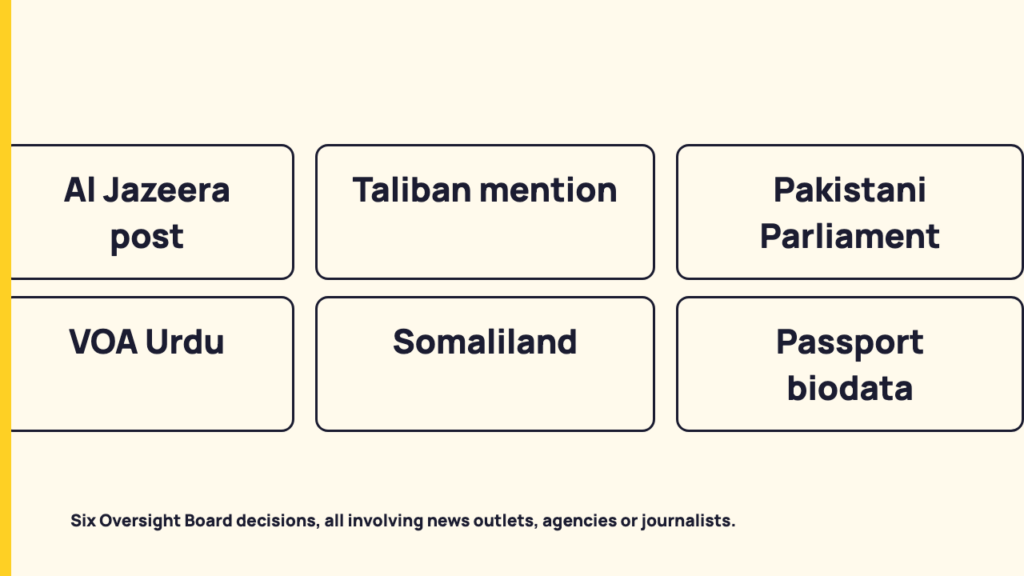
A post you manage has been removed under a policy name you recognise, the in-app explanation is a line or two long, and you are fairly sure the context was clear. The Oversight Board has published written reasoning on cases like this, and all of it concerns news outlets, a news agency or a journalist. This piece reads six of those decisions for what they say about context and newsworthiness, and for what they cannot bind.
What these decisions are, and what they are not
Start with the limit. In the “Authority and Scope” section of the Pakistani Parliament speech decision (2023-038-FB-MR), the Board writes that its decision “is binding on the company”, that Meta “must also assess the feasibility of applying its decision in respect to identical content with parallel context”, and that its decisions “may include non-binding recommendations that Meta must respond to”. So the ruling binds Meta for the content in that case. Everything else in a decision is reasoning you can learn from, not a rule you can invoke.
Summary decisions are weaker still. The Board’s page for the Oromo Liberation Front bundle (2026-022-FB-UA and 2026-023-FB-UA, February 24, 2026) says summary decisions “do not have precedential value for the Board”.
This is a secondary reading of published documents. It is not legal advice, not a forecast of any appeal, and it does not claim that a brand post would be treated like a news outlet’s. The Board does not say its reasons extend to brands. It also does not cover how to submit a case, who is eligible, or timeframes. For the statutory route in the EU, see the EU route for appealing a removal.
The reader moment: a one-line reason on a post you believe was quoted in context
Picture a manager whose post was taken down under a named policy, with a short notice that does not say why, and who believes the post quoted or reported something rather than endorsing it. The Board’s decisions give the reasoning that notice lacks, in a checkable shape: each names the exact Community Standard and explains why an exception applied or did not.
The policies in these decisions are Dangerous individuals and organizations, Violence and incitement, Child Sexual Exploitation, Abuse and Nudity, Privacy Violations, and Hateful conduct.
Six decisions, side by side
Each row comes from a decision page fetched and read on October 20, 2026.
| Decision | Case number | Date | Publisher as the decision describes it | Community Standard | Outcome |
|---|---|---|---|---|---|
| Shared Al Jazeera post | 2021-009-FB-UA | September 14, 2021 | A Facebook user sharing a news post | Dangerous Individuals and Organizations | Board agreed Facebook was correct to reverse its removal |
| Mention of the Taliban in news reporting | 2022-005-FB-UA | September 15, 2022 | News outlet page | Dangerous Individuals and Organizations | Overturned |
| Reporting on Pakistani Parliament Speech | 2023-038-FB-MR | April 4, 2024 | News outlet in Pakistan | Violence and Incitement | Upheld Meta’s decision to leave the post up |
| News Documentary on Child Abuse in Pakistan | 2024-001-FB-MR | May 14, 2024 | Voice of America Urdu page | Child Sexual Exploitation, Abuse and Nudity | Overturned, with the majority applying a newsworthiness allowance |
| Reporting on Somaliland Current Affairs | 2025-044-FB-UA to 2025-047-FB-UA | October 30, 2025 | A page describing itself as freelance journalism; bundle of four cases | Hateful Conduct | All overturned |
| Showing Passport Biodata in News Reporting | 2026-005-FB-MR | June 9, 2026 | A leading German news agency’s Facebook page | Privacy Violations | The Board “upholds Meta’s decision to leave up the content”, a majority finding the post violated the policy but newsworthiness applied |
Context: when the Board read the whole post rather than the sentence
In the Pakistani Parliament speech case, a local news outlet posted a video of a politician addressing parliament. His speech referred to officials being “sacrificed” and “hanged”. The Board found the post “does not violate the Violence and Incitement Community Standard because it was shared by a media outlet seeking to inform others and therefore falls under the exception for ‘awareness raising’”. It added that the references were “figurative (non-literal) when considering the whole speech”. The Board also weighed timing: the speech came ahead of national elections, and “in a period of turmoil, ahead of national elections, the Board considers safeguarding such speech as fundamental.”
The earlier Shared Al Jazeera post decision (September 14, 2021, so read it for reasoning only) turned on a user rather than an outlet. The user had shared Al Jazeera’s post with a one-word caption. The Board wrote that “the user in this case explained that their purpose was to update their followers on a matter of current importance, and their addition of the expression ‘Ooh’ appears to be neutral. As such, the Board finds that removing the user’s content did not materially reduce offline harm.”
These are findings about those posts. The second is five years old. Neither supports a rule such as “quoting in context is safe”. What they show is the Board’s method: look at the whole post, the caption, the stated purpose and who posted it.
Newsworthiness, and what the Board did when the post still broke the rule
In the Voice of America Urdu case, an 11-minute documentary showed the names and faces of child victims of crimes from the 1990s. The Board found the post “violated the Child Sexual Exploitation, Abuse and Nudity Community Standard”, yet a majority found a newsworthiness allowance should have been applied. They weighed ongoing public interest in reporting on child abuse against harm to victims who did not survive, from crimes “about 25 years ago”. A minority disagreed: they held that the public interest issues could be discussed “without showing the names and faces of the victims”, so removal was warranted. The Board also noted that no specific exceptions, such as raising awareness or reporting on, are available under that policy.
In the passport case, a German news agency posted an image of a torn passport whose biodata page was visible. Meta referred the case itself. Meta’s submission, as quoted in the decision, is that its Privacy Violations policy does not allow condemnation, discussion or awareness raising exceptions for personally identifiable information, because disclosure risks harm “regardless of the sharer’s intent”. A majority of the Board found the post violated the policy but that Meta acted correctly in keeping it up under the newsworthiness allowance. A minority disagreed. The Board recommended, among other things, that Meta clarify how the newsworthiness factors are weighted, and that once the technical capability exists it carve out an exception for PII “self-posted by an adult user in the exercise of political speech”. That is a recommendation, not a rule that exists.
The difference matters. “The post did not break the rule” and “the post broke the rule but an allowance applied” are different findings. The second depends on Meta’s own newsworthiness allowance, which the VOA Urdu decision describes as “rarely used” and “a general exception that can be applied only by Meta’s expert teams”. Nothing here says a brand can invoke it.
Where the Board says Meta got it wrong, and in what pattern
- The Taliban decision (2022-005-FB-UA, September 15, 2022, reasoning only): a news outlet page’s post reporting a Taliban announcement was removed. Meta also imposed “strikes” on the page administrator and limited their access to features such as going live. The Board overturned, noting the policy permits reporting on terrorist groups.
- The Somaliland bundle (October 30, 2025): the Board found “there was no justification under any of Meta’s content policies to take down the Facebook page and posts”, that “no elements of the page were violating and the removal was entirely arbitrary”.
- The journalist case (2024-016-FB-UA, April 4, 2024): a summary decision in which Meta reversed after the Board raised the appeal. The Board described “a recurring issue in the over-enforcement” of the policy “specifically regarding neutral posts”. That is the Board’s description, not a count.
What Meta did next, and what the Board cannot make it do
The Taliban decision gives one concrete example of the gap between a ruling and a change. In “Shared Al Jazeera post”, the Board recommended criteria and illustrative examples for what counts as news reporting. The Taliban decision records that Meta’s Q1 2022 implementation report said it was consulting several teams internally to develop such criteria, and expected to conclude by Q4 2022. This post does not claim Meta later shipped, or did not ship, anything, because no fetched page here says so.
The structure is the one quoted at the start. A decision binds Meta for the content in the case. Policy recommendations require a response, not adoption. The Board’s scope language adds that it may review appeals from users whose content Meta removed, appeals from users who reported content Meta left up, and decisions Meta refers to it.
Questions to take to your own removed post
None of the Board’s reasoning is a promise. It does, however, suggest questions that the Board itself asked in these cases:
- Which named policy was applied? Each decision names it, for example Dangerous Individuals and Organizations in the Taliban case.
- Does that policy have an exception for reporting, awareness raising or condemnation, and does the post sit inside it? The Pakistani Parliament speech decision rests on this; the VOA Urdu decision notes that some policies have no such exception.
- Was the whole post read, not one sentence? The Board read the full speech and the caption in 2023-038-FB-MR, and the purpose and caption in the Al Jazeera case.
- Is a separate allowance such as newsworthiness in play, and does the post actually break the rule underneath it? That was the structure of the VOA Urdu and passport cases.
- Did the removal cost the account strikes or feature limits? The Taliban and Somaliland cases both record them.
Nothing here predicts what Meta will do with a brand post. For the separate statutory route, see the EU route for appealing a removal.
Related reading
See also what platforms officially recommend in a crisis and what X documents about Community Notes on a brand post.
FAQ
Are Oversight Board decisions precedent for other accounts?
Only for the content in the case. The “Authority and Scope” wording is that the decision “is binding on the company”, and that Meta “must also assess the feasibility of applying its decision in respect to identical content with parallel context”. Summary decisions say they “do not have precedential value for the Board”. Nothing in them says a brand can rely on them.
Do these decisions cover brand accounts or only news outlets?
Every decision read here involves a news outlet, news agency, publisher or journalist, or in one case a user sharing a news post. The Board does not address brand accounts in them, so nothing should be extrapolated to brands.