A client asks about a follower boost, a new account arrives with an audience nobody can explain, or a giveaway starts to look like an engagement scheme. Someone says the FTC has a rule on this. Most of what circulates is a summary of a summary. This post goes to the text: one section of the rule, the Commission’s own explanation of it, and a plain marking of what neither says.
The rule, its dates, and the one section this post reads
The section is 16 CFR 465.8, “Misuse of fake indicators of social media influence.” It sits inside the Trade Regulation Rule on the Use of Consumer Reviews and Testimonials, which the Federal Trade Commission published in the Federal Register on 22 August 2024 (89 FR 68034). The rule took effect on 21 October 2024. Both dates come from the Federal Register record for document 2024-18519.
The rest of Part 465 covers fake reviews, insider reviews and review suppression; that is mentioned only to locate 465.8. Disclosure and endorsement are out of scope here. For those, the six ASA rulings on influencer posts are a better starting point.
This is a reading of a regulation and the Commission’s preamble. It is not legal advice, and no lawyer reviewed it. Text that is silent on a situation is not a ruling on it.
What 465.8 prohibits, in the Commission’s words
The section opens: “It is an unfair or deceptive act or practice and a violation of this part for anyone to:” and then splits into two halves. Verbatim from the eCFR text of Part 465:
(a) Sell or distribute fake indicators of social media influence that they knew or should have known to be fake and that can be used by individuals or businesses to materially misrepresent their influence or importance for a commercial purpose; or
(b) Purchase or procure fake indicators of social media influence that they knew or should have known to be fake and that materially misrepresent their influence or importance for a commercial purpose.
| Half | Who is bound | Act | Knowledge standard | Purpose and effect |
|---|---|---|---|---|
| 465.8(a) | “Anyone” | Sell or distribute fake indicators | Knew or should have known them to be fake | Indicators that “can be used” to materially misrepresent, for a commercial purpose |
| 465.8(b) | “Anyone” | Purchase or procure fake indicators | Knew or should have known them to be fake | Indicators that materially misrepresent, for a commercial purpose |
Note the difference in the last column. The seller half reaches indicators that can be used to misrepresent; the buyer half reaches indicators that do misrepresent. The preamble records that commenters asked for “are used” in the seller half, and the Commission declined.
The final text is narrower than what was proposed. The proposal had no knowledge language and no materiality word. In the preamble, the Commission says it is “narrowing the provision by adding ‘that they knew or should have known to be fake’ to both § 465.8(a) and (b),” in response to commenters who objected that someone could violate it by innocently buying a fake indicator. It also says it added “the concept of materiality” to both halves “so as to be consistent with other parts of the rule.”
The definitions do most of the work
465.8 is short because the definitions in 465.1 carry the weight. Three matter here.
Start with what counts as an indicator. 465.1(j) reads: “Indicators of social media influence means any metrics used by the public to make assessments of an individual’s or entity’s social media influence, such as followers, friends, connections, subscribers, views, plays, likes, saves, shares, reposts, and comments.” The words “such as” matter. In the preamble the Commission says it “intends the listed indicators to be examples and non-exhaustive.” So the list is illustrative.
Then what counts as fake. 465.1(h): “Fake indicators of social media influence means indicators of social media influence generated by bots, purported individual accounts not associated with a real individual, accounts created with a real individual’s personal information without their consent, or hijacked accounts, or that otherwise do not reflect a real individual’s or entity’s activities, opinions, findings, or experiences.” The last clause is the open one.
Finally, “commercial purpose.” The phrase appears in 465.8, and a search of the eCFR text of Part 465 finds it nowhere else, so it is not separately defined in 465.1. The preamble gives one boundary: “While some individuals may not be doing so for a commercial purpose, those individuals are excluded from the rule’s scope.”
What the preamble says is not fake, and not covered
Section IV.H of the Federal Register document explains 465.8 and comes nearest to the questions managers ask. These are the Commission’s statements, not rule text.
- On recommending a follow: “If a social media influencer were to recommend that their followers also follow another social media account, any resulting followers of the second account would not be ‘fake.’”
- On awarded indicators: “If a company awards legitimate indicators of influence to certain users upon satisfaction of objective criteria reflecting the influence of the users, the company would not be selling ‘fake’ indicators, even if bad actors were able to deceive the company.”
- On hiring influencers: the distribution provision was intended to mean distribution to those who could use the indicators to misrepresent their influence, “not causing the dissemination of social media by users of such fake indicators, e.g., by hiring influencers who happen to have fake followers.” The Commission added the definition in 465.1(g) to reflect that: “Distribute fake indicators of social media influence means the distribution of fake indicators of social media influence to individuals or businesses who could use the indicators to misrepresent their influence.”
- On incentivised engagement: a commenter wanted the rule to cover the purchase of engagement from real accounts as well as fake ones. The Commission answered: “The use of incentivized indicia of social media influence is not necessarily deceptive in all cases, and it is beyond the scope of this rulemaking.” That is an exclusion from this rulemaking. It is not permission, and it is not a prohibition.
- On bots themselves: “It is not the creation of the bot or fake account, itself, that the rule makes illegal, but the use of the bot or fake account to follow another user, watch another user’s videos, or create other fake indicia of social media influence.”
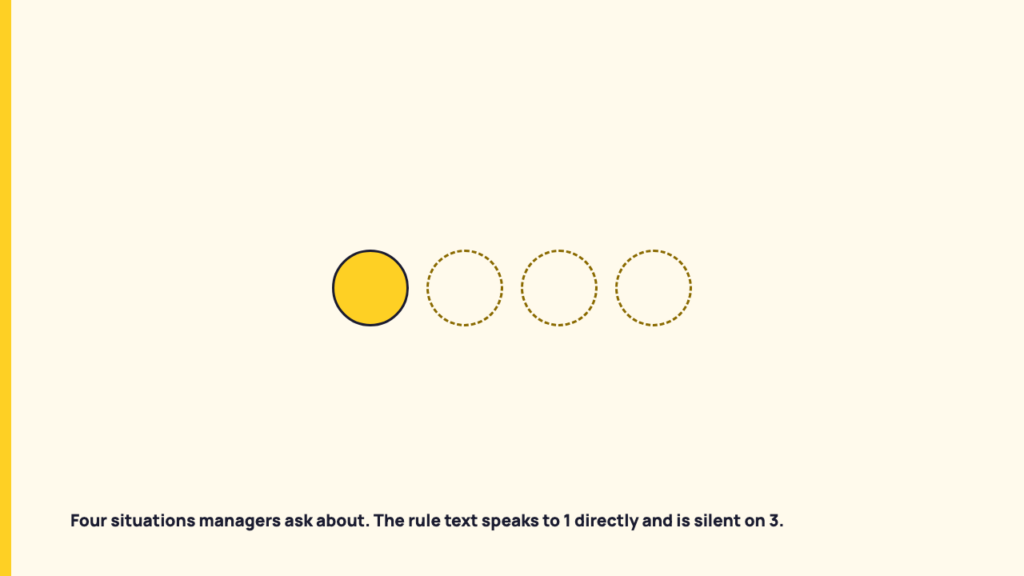
Four situations, sorted by what the text actually says
Each situation is checked against the fetched text. “Does not appear” means a search of the eCFR text of Part 465 and the Federal Register document for that word returned no matches. It does not mean allowed or banned.
| Situation | What the text says | What it leaves unaddressed |
|---|---|---|
| A client asks about buying a boost | 465.8(b) covers purchasing or procuring fake indicators the buyer knew or should have known to be fake. The preamble says “someone could think that they were paying for a promotional campaign to increase their followers but, unbeknownst to the purchaser, the entity offering the campaign was lying and just providing fake followers,” and gives that as the reason for adding the knowledge standard. | Does not say how “should have known” applies to any particular offer. This post does not say what is safe. |
| An inherited, inflated audience | Nothing directly. The word “inherit” does not appear in the rule or the Federal Register document. 465.8(b) is worded around purchasing or procuring. | Silent on what follows from simply holding, reporting or taking over such an audience. No inference either way. |
| A giveaway | The words “giveaway” and “contest” do not appear in 465.8 or the preamble discussion of it. Nearest passage: the incentivised-indicia exclusion above. “Contest entries” appears only in 465.1(m), the definition of purchasing a consumer review, a different provision. | Silent on giveaways as such, and on whether incentivised follows or entries are fake. |
| An engagement pod | The term “pod” does not appear in the rule or the Federal Register document. The definition of fake turns in part on whether indicators “otherwise do not reflect a real individual’s or entity’s activities, opinions, findings, or experiences.” | The text does not say whether pod activity falls inside that clause. |
Who the rule binds, and what the FTC can do about violations
465.8 applies to “anyone.” Individuals who are not acting for a commercial purpose are, in the preamble’s words, “excluded from the rule’s scope.” The rule text does not name platform operators as a class. The section binds sellers, distributors and purchasers of fake indicators, and nothing here should be read as saying platforms carry any duty under it.
On enforcement, the Federal Register document describes the path in general terms. In footnote 49 it cites section 5(m)(1)(A) of the FTC Act, 15 U.S.C. 45(m)(1)(A), under which violators of a trade regulation rule “with actual knowledge or knowledge fairly implied on the basis of objective circumstances that such act is unfair or deceptive and is prohibited by such rule” are liable for civil penalties for each violation. The Federal Register document also says the Commission can bring a federal court action to recover money for consumers. This post gives no dollar figure; the amount is adjusted periodically. It cites no enforcement action under 465.8, because none was fetched from an FTC source.
What to take from the text, and what it cannot tell you
The text fixes three things. There is a knowledge standard: knew or should have known to be fake. There is a commercial purpose limit, with non-commercial individuals excluded. And fake is defined by bots, fake or hijacked accounts, and indicators that do not reflect real activity.
It leaves open at least these questions:
- How “should have known” applies to a specific offer from a specific vendor.
- What follows from holding, reporting or taking over an audience someone else inflated. If that account situation is yours, the access side is covered in who owns the account when the manager leaves.
- Whether incentivised follows or entries, such as those in a giveaway, count as fake.
- Whether engagement pod activity counts as indicators that “do not reflect a real individual’s or entity’s activities.”
Put those to a lawyer, not to a blog.
FAQ
Does the rule say anything about engagement pods or giveaways?
Neither term appears in the rule or in the Federal Register document. The nearest passage is the Commission’s statement that “the use of incentivized indicia of social media influence is not necessarily deceptive in all cases, and it is beyond the scope of this rulemaking.” That is an exclusion from this rulemaking, and no conclusion about permission or prohibition follows from it.
Is this legal advice?
No. It is a reading of published text, written without review by a lawyer, and both enforcement and interpretation can change. For a specific situation, ask a lawyer.
Sources
- eCFR, 16 CFR Part 465 (full text via the eCFR versioner API), fetched 2026-10-24, HTTP 200
- Federal Register document 2024-18519, full text XML (89 FR 68034), fetched 2026-10-24, HTTP 200
- Federal Register API record for document 2024-18519 (publication date and effective date), fetched 2026-10-24, HTTP 200