Halfway through a quarterly review, a client turns a laptop round, points at a competitor’s Instagram grid and asks what that brand is doing that works. The honest answer is that a grid shows nothing the recommendation system reads. The scenario is hypothetical.
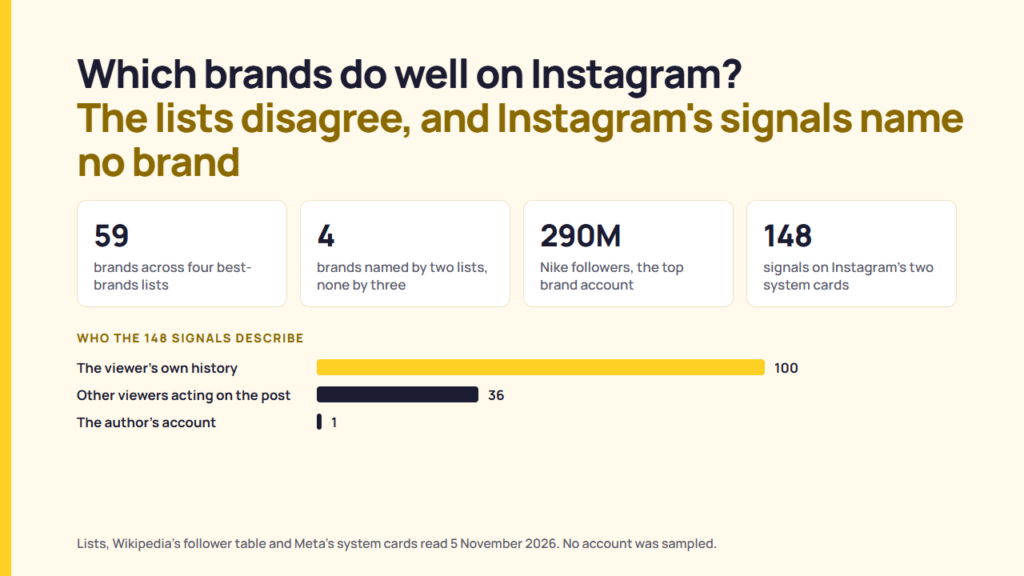
Which brands do well on Instagram depends on what “well” is measured by. On followers, Nike leads every brand account except Instagram’s own, at about 290 million. On published best-brands lists, Nike and McDonald’s are the only accounts named by two of the four lists read here. Instagram itself names no brand: it ranks posts on what it predicts each viewer will do.
This piece is a count. It counts the brands named on four published lists of the best brands on Instagram, sets them against the most followed brand accounts, and then counts what Meta publishes. It reads two of Meta’s AI system cards for Instagram, one for Feed recommendations and one for Explore. Each lists the outcomes the system predicts along with the input signals used for each prediction. Both cards, and Instagram’s ranking explainer (Adam Mosseri, 31 May 2023), were read on 2026-11-05. Every listed prediction and every listed signal was counted by hand, and each signal was classified by whose behaviour it describes. No brand account was sampled, and no engagement figure was measured. For a separate measured teardown, see twelve brand channels, 550 Shorts, side by side.
Instagram publishes a list, and the list is mostly about the audience. Across the two cards, 148 input signals sit under 46 predictions, and 100 of those signals describe the person scrolling rather than the account posting. Most of the signals that describe the post are counts of what other viewers have already done with it: visited the author’s profile, watched it through, liked it, or shared it off Instagram. Neither card lists follower count, posting frequency, hashtags or caption length. Instagram’s ranking explainer does name follower count, for Reels: it considers “popularity signals such as number of followers or level of engagement”.
The method, stated before the findings
A teardown is only worth reading if the method comes first, so here it is.
| Step | What was done |
|---|---|
| 1. Brand sources | Four published best-brands lists (Sprout Social, NoGood, Sked Social, HubSpot) and Wikipedia’s table of the most followed Instagram accounts, all read on 2026-11-05. A fifth list, from Kompozy, was left out because it says its figures come from the Sprout Social report. |
| 2. Instagram documents | The Instagram Feed Recommendations AI system card and the Instagram Explore AI system card on Meta’s Transparency Center, plus Instagram’s ranking explainer. The Feed Recommendations card was updated on 2026-06-29 and the Explore card on 2026-06-22. All three documents were read on 2026-11-05. |
| 3. Unit counted | Each card lists predictions, and under each prediction a set of input signals. Both were counted. The Explore card splits its list across four tabs, Recommender One to Recommender Four, and all four were opened and counted. A prediction or signal repeated across tabs was counted each time it is listed. |
| 4. Classification | Each signal was placed in one of seven classes by whose behaviour it describes: the viewer, other viewers acting on this post, another prediction used as an input, the viewer’s device, the post’s content, the author’s account, or the system’s own processing. One signal covers both the viewer’s external shares and other people’s, and it was counted under other viewers. |
| 5. Exclusions | The Feed Recommendations card excludes advertising and content from accounts the viewer follows. Meta publishes separate cards for Reels Chaining, Stories and Search, which were not counted. |
| 6. Limits | One reading, one date, one person classifying. Meta says these models and signals “change frequently”, so a later recount may differ. |
The exclusion in step 5 explains why this count is relevant to the client’s question. The Feed Recommendations card covers suggested content, and Instagram’s explainer describes what it recommends as content “from people you haven’t yet chosen to follow”. A competitor appearing in front of people who do not follow them is exactly what the client is asking about.
The best brands on Instagram, according to four published lists
Four lists of the best brands on Instagram name 63 entries between them, which comes to 59 different brands. Each one is reproduced here so the overlap can be checked.
| List | Date shown | Brands named | What the list credits |
|---|---|---|---|
| Sprout Social | 14 September 2026 | 9: Nike, Adidas, Levi’s, British Airways, Norwegian, WSDOT, Grillo’s Pickles, NASA, McDonald’s | Cultural relevance over product promotion |
| NoGood | 6 January 2026 | 18: SSENSE, Wendy’s, Sweetgreen, We’re Not Really Strangers, Netflix (Netflix2), Rhode, Yahoo!, Brita, Starface, Notion, ClickUp Comedy, Liquid Death, Oura, Loewe, Craighill, Jacquemus, Beli, Rains | Visual identity, personality, content that entertains or informs, interactive prompts |
| Sked Social | 2025 | 10: Nike, Gucci, Duolingo, GoPro, Airbnb, Sephora, McDonald’s, National Geographic, Rare Beauty, Apple | Customer content, creator partnerships, cause-based storytelling, memes and trends, community |
| HubSpot | Updated 05/01/25 | 26: The Every Mom, Bolden USA, The Broke Black Girl, Teleport Watches, Netflix (Strong Black Lead), Califia Farms, Anima Iris, Cooking With Constance, Lorna Jane, Letterfolk, Apartment Therapy, Sunday II Sunday, Tentsile, Desenio, Vans, Grass-Fields, Finfolk Productions, Shiseido, The Muted Home, Sephora Collections, Clare, HoneyBook, Design Essentials, Flodesk, Omsom, Chipotle | A distinct theme or personality, with no figures given for its “high engagement rates” |
Sources: the four lists, read 2026-11-05. Each list’s sub-brand or side account is shown as the list names it. The lists also mention other brands in passing, and those mentions were not counted.
The lists barely agree. No brand appears on three of them, and only four appear on two.
| Brand | Named by | What each list credits |
|---|---|---|
| Nike | Sprout Social, Sked Social | Star athletes in its World Cup campaign; emotional storytelling and athlete takeovers |
| McDonald’s | Sprout Social, Sked Social | Pop culture references; meme-driven, nostalgic visuals |
| Netflix | NoGood, HubSpot | Two different accounts: the private-feeling Netflix2, and Strong Black Lead’s clips of Netflix titles |
| Sephora | Sked Social, HubSpot | Two different accounts: Sephora’s tutorials and live sessions, and Sephora Collections’ playful personality |
Size does not explain the picks either. HubSpot’s list alone runs from Teleport Watches at 9.1k followers to Vans at 17 million, as HubSpot reports them, and Sprout Social puts a state transport department and a pickle brand beside Nike.
None of the four publishes a selection method a reader could rerun. Sprout Social says its list draws on its Social Futures Report and judges creative execution and brand impact. NoGood says it analysed accounts and “narrowed it down to 18 brands”. Sked Social says its picks are “consistently recognized by industry experts”. HubSpot says it polled 301 US users on what they enjoy about brands they follow and that every brand featured meets those needs, but it does not say how the 26 were chosen. These are editorial picks, which is a fair thing for a list to be, and they should be read as opinion rather than as measurement.
Culture, personality and memes do not appear as signals on either system card. A meme that works would show up there only as what people did with it, such as clicking, watching or sharing. That is a reading of the cards, not a statement from Instagram.
The best brands on Instagram by category
Grouping the 59 brands by what each company sells shows which sectors the lists favour. The grouping is this piece’s, not the lists’.
| Category | Brands | Brands named on the four lists |
|---|---|---|
| Fashion, apparel and accessories | 12 | Nike, Adidas, Levi’s, Gucci, Vans, SSENSE, Loewe, Jacquemus, Rains, Lorna Jane, Teleport Watches, Anima Iris |
| Tech, apps and software | 10 | Apple, GoPro, Oura, Notion, ClickUp, HoneyBook, Flodesk, Yahoo!, Beli, Duolingo |
| Food and drink | 8 | McDonald’s, Wendy’s, Sweetgreen, Chipotle, Grillo’s Pickles, Liquid Death, Califia Farms, Omsom |
| Beauty, skincare and hair care | 8 | Sephora, Rare Beauty, Rhode, Starface, Shiseido, Bolden USA, Design Essentials, Sunday II Sunday |
| Media and public sector | 5 | Netflix, National Geographic, NASA, WSDOT, Apartment Therapy |
| Home and decor | 4 | Letterfolk, Desenio, Clare, The Muted Home |
| Travel | 3 | British Airways, Norwegian, Airbnb |
| Other | 9 | The Every Mom, The Broke Black Girl, Cooking With Constance, We’re Not Really Strangers, Brita, Tentsile, Grass-Fields, Finfolk Productions, Craighill |
Fashion supplies the most picks, and Nike is the only fashion brand named twice. Tech comes second, and half of its ten come from NoGood’s list alone. Food and beauty tie for third, and the four brands that appear on two lists come from fashion, food, media and beauty. No sector dominates, which fits lists built on editorial judgement rather than a shared measure.
The most followed brands on Instagram
Follower count is the one public number every brand account has. Wikipedia’s table of the most followed Instagram accounts, dated November 2026, marks eight as brand accounts. Instagram’s own account leads with 686 million, and the other seven are below.
| Account | Followers (millions) | What it is | On a best-brands list above? |
|---|---|---|---|
| Nike (@nike) | 290 | Sportswear | Sprout Social, Sked Social |
| National Geographic (@natgeo) | 268 | Magazine | Sked Social |
| Real Madrid CF (@realmadrid) | 182 | Football club | None |
| FC Barcelona (@fcbarcelona) | 149 | Football club | None |
| UEFA Champions League (@championsleague) | 120 | Football competition | None |
| NASA (@nasa) | 104 | Space agency | Sprout Social |
| NBA (@nba) | 87.9 | Basketball league | None |
Source: Wikipedia, “List of most-followed Instagram accounts”, read 2026-11-05. Figures are Wikipedia’s rounded ones and were not read from each profile. The table covers only the most followed accounts overall, so it is not a full ranking of brands.
Four of the seven are sports clubs, leagues or competitions, and a fifth sells sportswear. Only three of the seven appear on a best-brands list, so a large following does not by itself earn a place on those lists. A follower count also records an audience built up over years, not how any recent post performed.
Which types of brands do well on Instagram
Rival IQ’s 2025 benchmark report gives the nearest thing to an answer by category. It sampled 150 companies in each of 14 industries and divided interactions by follower count. On that measure it calls higher education “the clear engagement winner on Instagram”, places sports teams second, and says health and beauty had the lowest engagement across platforms.
The result depends on the formula. Dividing by followers changes which account comes first and tends to favour smaller accounts, and figures from different reports cannot be averaged into one industry benchmark. Sports is the one category near the top of both the follower table above and Rival IQ’s report, which is a pattern across two sources and not a finding about why.
What Instagram says it is predicting
The Feed Recommendations card describes a system that gathers “a portion of the public content available on Instagram” and then ranks it by “predicting what you’re most likely to be interested in or engage with”. Both cards then publish predictions by name. The table shows the ten on the Feed Recommendations card and the ten under the first tab of the Explore card.
| Predicted outcome, in the card’s own wording | Card |
|---|---|
| How informative a post is | Feed |
| How likely you are to click ‘Interested’ | Feed |
| How long will the user spend in reels after clicking into a reels post in home feed | Feed |
| How likely will the user scroll through the feed for a certain time, after viewing the top position post | Feed |
| How likely you are to scroll to the next post | Feed |
| How likely you are to click on the profile of a post’s author | Feed |
| How likely you are to click to comment on a post | Feed |
| How likely you are to skip over the first post in feed | Feed |
| How likely you are to click a reel to view it in full screen | Feed |
| How likely you are to turn on the audio of a video post | Feed |
| How likely you are to follow the author of a post | Explore, Recommender One |
| How likely you are to spend more than five seconds viewing a post | Explore, Recommender One |
| How likely you are to watch more than 95% of a video | Explore, Recommender One |
| How likely you are to click “Not Interested” on a post | Explore, Recommender One |
| how likely you are to comment on a post | Explore, Recommender One |
| How likely you are to “like” a post | Explore, Recommender One |
| How likely you are to reshare a post | Explore, Recommender One |
| How likely you click and also engage with a post | Explore, Recommender One |
| How likely you are to save a post | Explore, Recommender One |
| How likely you are to click one of the short, squared post in Explore to view it in full screen | Explore, Recommender One |
Sources: Instagram Feed Recommendations and Instagram Explore AI system cards, Meta Transparency Center, read 2026-11-05. Wording, capitalisation and grammar are the cards’ own.
The other three Explore tabs add 26 more predictions, many of them about reels.
| Explore card tab | Predictions | Signals | One prediction, in the card’s wording |
|---|---|---|---|
| Recommender One | 10 | 38 | Listed in the table above |
| Recommender Two | 10 | 30 | “How likely you are to use the audio from a reel you’re viewing in one you create” |
| Recommender Three | 6 | 22 | “How likely you are to watch a reel for more than 11 seconds or watch a non-reel for more than 6 seconds” |
| Recommender Four | 10 | 25 | “How likely you are to watch the full length of a reel” |
The cards list 46 predicted outcomes. Forty-five are actions the viewer takes; the other, “How informative a post is”, is a judgement of the post. None is a property of the account that posted. The closest the cards come to judging the post itself is that Feed Recommendations signal, which the card describes as “purely generated by LLM to assess the post’s content quality”. That single line is the only place in either card where the content is assessed rather than counted or measured.
Who the signals are actually about
The two cards list 148 input signals between them, counted by hand on 2026-11-05, and 100 of those describe the viewer’s own history rather than anything about the post or the account.
| Class | Signals counted | A signal quoted from the card |
|---|---|---|
| The viewer’s own history | 100 | “How many times you’ve opened the app in the last 7 days”; “How much time spent a viewer on an author for the past 84 days” |
| Other viewers acting on this post | 36 | “The number of times other viewers went to the post author’s profile page after viewing the post”; “How many people have watched more than 95% of the video” |
| Another prediction, used as an input | 4 | The Explore card’s click-and-engage prediction takes four other predictions as its signals, among them “How likely you will spend X number of seconds viewing a post” |
| The viewer’s device | 3 | “What is the device platform e.g. ios, android” |
| The post’s content | 3 | The informativeness signal, “purely generated by LLM to assess the post’s content quality”; “The length of the reel”, listed twice |
| The author’s account | 1 | “How many times the author’s profile has been clicked by followers” |
| The system’s own processing | 1 | “How many posts have been processed in one batch” |
The Feed Recommendations card lists 33 signals and the Explore card lists 115 across its four tabs. Both cards introduce their lists as “some of the significant predictions”, and the explainer says of signals that “there are thousands of them”, so 148 is what Meta has chosen to publish and not the size of the system.
Only one of the 148 signals on the two cards describes the author’s account, and even that signal counts clicks made by other people. The explainer is broader: it lists information about the person who posted as a signal group on Feed, Explore and Reels, and for Explore it says popularity signals “matter much more in Explore than they do in Feed or in Stories”. The 36 post-level signals describe outcomes: somebody saw the post and then did something. A brand can decide what it publishes, but it cannot directly control any of those 36 actions.
Several things that usually come up in a quarterly review appear nowhere in either card: follower count, posting frequency, time of day, hashtags, caption length, account age, verification and whether the account is a business or a creator account. The nearest the Explore card comes to follower count is “The amount of followers the author received through the reel”, which counts followers gained from one reel and not the total. Saves are also narrower than usually assumed: the cards count a viewer’s own saves, and no signal on either card counts saves by other people, although the explainer does mention how quickly people are saving a post. What a save actually counts as is a separate reading.
Instagram’s ranking explainer does mention two of those missing items. It says Instagram considers “popularity signals such as number of followers or level of engagement” for Reels, in the last of four signal groups it lists “roughly in order of importance”. It also lists “when it was posted” among the Feed signals about a post. For more detail, read which Instagram ranking claims have a published source.
When compared with the competitor’s grid, the useful observation is that nothing about how a grid looks appears in either card. The signals instead describe what people do after seeing a post: visit the profile, finish the video, like it or share it. That is a reading of the two cards, not a statement from Instagram.
The account-level rules that sit above all of it
Instagram’s ranking explainer adds a layer that the signal lists cannot account for. It says posts that go against its Recommendation Guidelines “are allowed on Instagram”, but Instagram says it tries to “avoid showing that post where we recommend content”. Instagram has “rules for what we recommend in places like Explore, Reels, Search”.
Instagram also explains the account-level consequence. Instagram says that “If an account repeatedly posts content that goes against our Recommendation Guidelines or Community Standards, none of their posts will be eligible for recommendation for a period of time.” Instagram points accounts to one screen for checking this: “Account Status is the best way to understand if your account and content is eligible to be recommended on Instagram”.
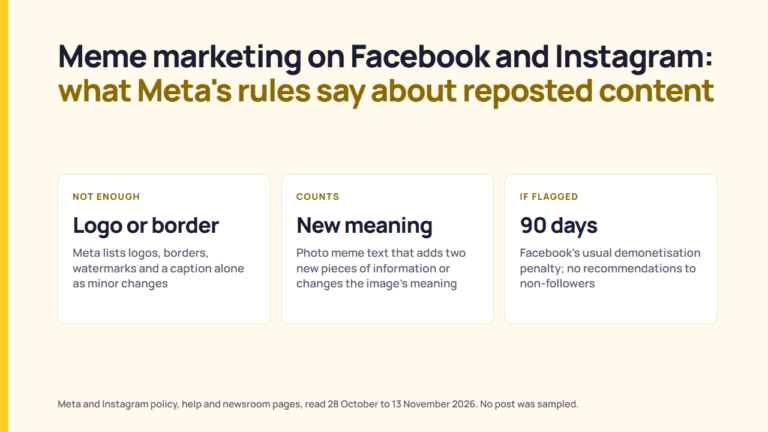
For video, Instagram names six reasons a reel may be made less visible. Its ranking explainer says: “We aim to make certain reels less visible for other reasons, such as low-resolution or watermarked reels, reels that are muted or contain borders, reels that are majority text, or reels that have already been posted on Instagram.” Instagram is also experimenting with notifications to tell creators when a watermark has limited a reel’s reach. Instagram explains its position on these measures: “it’s in our interest as a business to ensure that creators are able to reach their audiences and get discovered”, and “If anything makes your content less visible, you should know about it and be able to appeal.”
Meta’s Transparency Center lists categories of content whose distribution it reduces across Facebook and Instagram. Two of these categories are particularly relevant to business posting. One is “Limited originality content that is principally repurposed from other sources”. The other is “Low-quality videos that abuse video or live video formats”. Clickbait and engagement bait also appear in the same list. What Meta considers repurposed content and what it says happens to an account that continues posting it requires a separate reading.
What this leaves an account director able to say
Six questions that come up in a review map to the documents as follows.
| What the client asks | What the published sources support |
|---|---|
| Why does that brand do well? | Instagram’s documents describe no brand. They describe what the system predicts a viewer will do with a post. Published lists credit culture, personality and community, without a method a reader could rerun. |
| Should we post more often? | Posting frequency is not a listed signal on either card. |
| Do we need more followers first? | Follower count is not a listed signal on either card. The explainer names it for Reels only, in the last of four signal groups. One card signal counts how often the author’s profile has been clicked by followers. |
| Does the grid matter? | Nothing about how a grid looks appears in either card. |
| What is actually measurable here? | The 36 post-level signals, which are outcomes other viewers produced: profile visits after viewing, completion, likes, comments, external shares. |
| What can go wrong at account level? | Repeated breaches of Instagram’s Recommendation Guidelines or Community Standards make all of an account’s posts ineligible for recommendation for a period of time. Instagram also identifies six reasons a reel may be made less visible: low resolution, watermarks, muted audio, borders, majority text and content that has already been posted on Instagram. |
Instagram publishes more about its recommendation systems than most teams take the time to read. What it publishes is a list of audience actions, not a list of things the brand controls. Reading those documents the way you would read a platform’s published ranking code shows what the system says it predicts, which a competitor’s grid does not. What a client decides to do with that information remains the client’s decision.
What could not be confirmed
This count cannot settle eight points:
- Both system cards display update dates: the Feed Recommendations card was updated on 2026-06-29 and the Explore card on 2026-06-22. Neither says what changed on those dates.
- Neither card says its list of signals is complete, and both call their lists “some of the significant predictions”. A factor missing from the list is therefore not a factor disproved.
- Neither card publishes signal weightings, so this count cannot establish which signal matters most. The explainer gives only a rough order of signal groups, dated 2023.
- Meta’s index lists other Instagram system cards, including Instagram Feed (content from accounts the viewer follows), Reels Chaining, Stories and Search. Only Feed Recommendations and Explore were counted.
- No brand account was sampled and no engagement figure was measured, so this piece makes no claim about how any named account’s posts performed.
- Instagram’s documents publish no follower ranking or engagement benchmark. The follower figures here are Wikipedia’s rounded ones, which can lag the live profiles.
- The claims the four best-brands lists make about each brand were reported as published and were not tested.
- Account Status was not opened because it requires a logged-in professional account.
FAQ
Which brands do well on Instagram?
It depends on the measure. Nike leads brand accounts on followers, at about 290 million. Nike and McDonald’s are the only accounts named by two of the four best-brands lists read here. None of Instagram’s own documents read for this piece name or rank a brand. They list the outcomes its recommendation systems predict, most of them actions viewers take, such as visiting the author’s profile, watching a video, resharing, saving or commenting.
What are the best brands on Instagram?
There is no agreed list. Four published lists name 59 different brands, and only Nike, McDonald’s, Netflix and Sephora appear on two of them. Netflix and Sephora are each named through two different accounts. No brand appears on three lists, and none of the four publishes a selection method a reader could rerun.
What are the best fashion brands on Instagram?
Fashion is the largest group on the four lists read here, with 12 of the 59 brands: Nike, Adidas, Levi’s, Gucci, Vans, SSENSE, Loewe, Jacquemus, Rains, Lorna Jane, Teleport Watches and Anima Iris. Nike is the only one named twice, and it is also the most followed brand account on Instagram, at about 290 million followers.
Which brand has the most followers on Instagram?
Nike, with about 290 million followers according to Wikipedia’s table dated November 2026, not counting Instagram’s own account at 686 million. National Geographic follows at 268 million, then Real Madrid at 182 million.
What do the best brands on Instagram have in common?
The lists credit different things: cultural relevance, personality, creator partnerships, customer content and community. Those are editorial judgements. Instagram’s system cards list none of them as signals, and they describe what viewers do with a post instead. Instagram’s explainer describes “growing reach for those who create the most engaging content”.
Does follower count affect Instagram reach?
Follower count is not listed on the Feed Recommendations or Explore system cards. Instagram’s ranking explainer (31 May 2023) does name it for Reels, where Instagram says it considers “popularity signals such as number of followers or level of engagement”. Neither source publishes a weight, so neither says how much it counts.
What does Instagram’s algorithm actually look at?
Instagram says, “Instagram doesn’t have a singular algorithm that oversees what people do and don’t see on the app.” Its Feed Recommendations and Explore system cards list 46 predicted outcomes and 148 input signals. Of those signals, 100 describe the viewer’s own history. For a fuller breakdown, read which Instagram ranking claims have a published source.
Why is my brand’s reel getting less reach?
Instagram identifies six reasons a reel may be made less visible: low resolution, watermarks, muted audio, borders, majority text and content that has already been posted on Instagram. At the account level, Instagram says that “If an account repeatedly posts content that goes against our Recommendation Guidelines or Community Standards, none of their posts will be eligible for recommendation for a period of time.” It points accounts to Account Status to check their recommendation eligibility.
Sources
- Meta Transparency Center, “Instagram Feed Recommendations AI system card“, read 2026-11-05.
- Meta Transparency Center, “Instagram Explore AI system card“, read 2026-11-05.
- Instagram, “Instagram Ranking Explained“, read 2026-11-05.
- Meta Transparency Center, “Reducing the distribution of problematic content“, read 2026-11-05.
- Meta Transparency Center, “Our approach to explaining ranking“, read 2026-11-05.
- Sprout Social, “The Best Brands on Instagram in 2026“, read 2026-11-05.
- NoGood, “18 of the Best Brands on Instagram in 2026“, read 2026-11-05.
- Sked Social, “Best Brands on Instagram 2025“, read 2026-11-05.
- HubSpot, “26 of the Best Brands on Instagram Right Now“, read 2026-11-05.
- Wikipedia, “List of most-followed Instagram accounts“, read 2026-11-05.
- Rival IQ, “2025 Social Media Industry Benchmark Report“, read 2026-11-05.