You are editing a caption that carries a price and three conditions, and somewhere in the third pass it has gone stiff. Every sentence is correct. None of them sounds like a person talking. You want a published standard to judge whether the wording is too hard, and you want to know what it actually requires.
The caption that reads like a contract
Here is an illustrative caption, written for this post. It belongs to no brand and has no performance behind it:
Orders placed prior to the 15th of the month will be dispatched within that month, provided that verification of payment has been completed. Free shipping is applied to orders exceeding $50, excluding sale items. Refunds can be issued only where the initiation of a return occurs within 14 days of delivery, subject to the item not having been used.
Three habits are stacked in it. The verbs are passive (“will be dispatched”, “is applied”, “can be issued”), so nobody is doing anything. Verbs have been turned into nouns (“verification”, “initiation”). And the conditions arrive inside the sentence they modify, so a skimmer reaches the price after wading through exceptions.
This post reads two published sources: the W3C’s Understanding page for WCAG 2.2 Success Criterion 3.1.5, and the federal plain-language guide series on digital.gov. It says what each requires, and it says plainly that applying either one to a social caption is an interpretation. Nothing here was tested, and no readability score is reported for any text.
What WCAG 3.1.5 actually says
The criterion is titled Reading Level. The Understanding page words it this way: “When text requires reading ability more advanced than the lower secondary education level after removal of proper names and titles, supplemental content, or a version that does not require reading ability more advanced than the lower secondary education level, is available.”
It is marked Level AAA. The WCAG 2.2 document describes three conformance levels, A (lowest), AA, and AAA (highest). So this is a criterion at the top of the scale, not part of the lower levels. This post claims nothing about what a law or procurement rule demands of AAA.
The page borrows its definitions from the UNESCO International Standard Classification of Education. Lower secondary education is 7 to 9 years of school, after six years of primary. The page says supplemental content is required when text demands reading ability more advanced than that, meaning more than nine years of school.
The criterion does not require every sentence to be simple. The page says difficult text may be appropriate for most of the intended audience, and that the criterion helps people with reading disabilities “while also allowing authors to publish difficult or complex web content.” The author has two ways out: make the text more readable, or provide supplemental content or a lower secondary version.
On measurement, the page says qualified teachers can evaluate text against local education standards. It also lists, among its related resources, a Government of Canada article asking whether readability formulas work for plain language. A Note says why the criterion exists: the Accessibility Guidelines Working Group could not find a way to test whether the clearest, simplest language had been used, so reading level introduces testability. This post names no formula and reports no score.
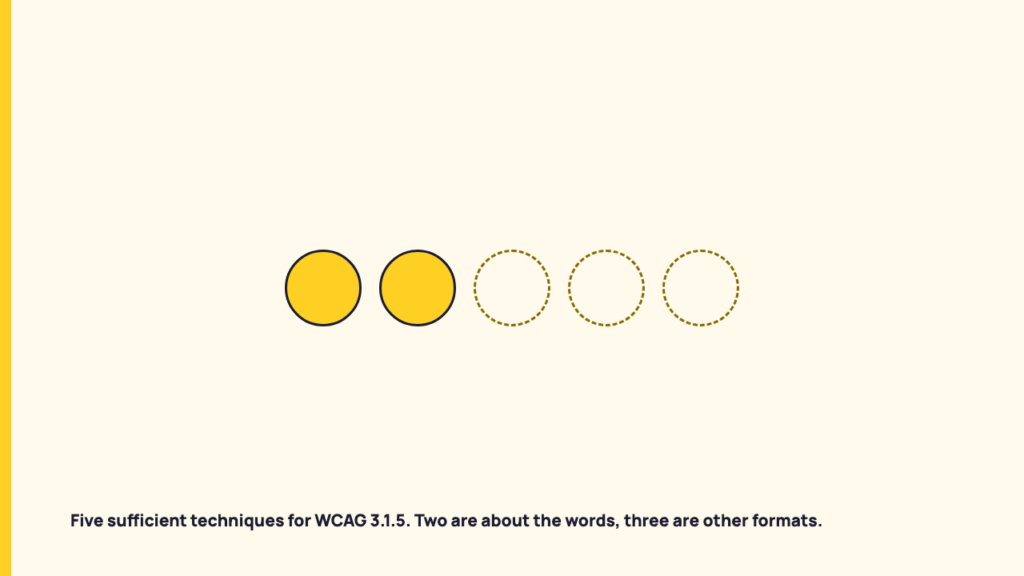
Five sufficient techniques, and only two touch the words
The page lists five sufficient techniques, says any one or any combination is considered sufficient, and says no single technique will help every user who has difficulty.
| Technique | What the page calls it | Lives in the wording? |
|---|---|---|
| G86 | Providing a text summary that can be understood by people with lower secondary education level reading ability | Yes |
| G103 | Providing visual illustrations, pictures, and symbols to help explain ideas, events, and processes | No, a different format |
| G79 | Providing a spoken version of the text | No, a different format |
| G153 | Making the text easier to read | Yes |
| G160 | Providing sign language versions of information, ideas, and processes that must be understood in order to use the content | No, a different format |
For a caption writer the honest reading is narrow. G86 and G153 are the two that live in the words: write a plainer summary, or make the text itself easier to read. The other three are other formats. A caption writer cannot attach a sign language version to a text post, and a spoken version or a picture is a production decision. Five techniques, two about the words, three not.
Where a short caption sits against a criterion written for text
The criterion is written for text content on web pages. The Understanding page does not mention social captions. Applying 3.1.5 to a caption is a reading, not a requirement the standard states.
A caption is often one short block, while the criterion says that when a page contains several languages, readability is judged for each language making up at least 5% of the content, used in full sentences or paragraphs. Together with the exemption for proper names and titles, that suggests the authors were picturing whole pages.
The level matters too. AAA is the top of the scale, and the WCAG document itself notes that even content conforming at the highest level will not be accessible to everyone, particularly in the cognitive, language and learning areas. No fetched source says a brand account becomes non-compliant because one caption is dense. Using 3.1.5 as a benchmark for a caption is a choice, not an answer to a demand.
What the federal plain-language guidance adds
The WCAG page tells you when extra help is needed. It does not tell you how to write. The US government’s plain-language guide series, now hosted on digital.gov (the old plainlanguage.gov address resolves there, and the series is adapted from that site’s content), supplies the craft layer.
Its principles page opens with a rule that sits awkwardly beside 3.1.5. The first rule of plain language is to write for your audience, and the page calls it a myth that you have to “dumb down” your content. It says to write for 8th graders only if your audience is an 8th-grade class. The WCAG criterion supplies one fixed benchmark. The federal guidance says calibrate to the people reading. They pull in different directions, and a caption editor has to choose.
The writing page gives the specific, checkable moves. On active voice it says: “Not ‘It must be done,’ but ‘You must do it.’” Its example pair sets “You must include the following information in your application.” against the passive “The following information must be included in the application for it to be considered complete.” It also says the more you use conditional or future tense, the harder your audience has to work. On hidden verbs, which it defines as a verb converted into a noun, its pair is “We analyze data.” against “We conduct an analysis of the data.”
The principles page adds practices that transfer without strain: have a topic sentence, organise the information so readers know what to expect, use tables where appropriate, and use lists to convey detailed information without overloading readers.
This guidance is written for federal communications. The digital.gov page on the Plain Writing Act says the law was signed in October 2010, defines plain writing as “writing that is clear, concise, well-organized, and follows other best practices appropriate to the subject or field and intended audience,” and requires all executive branch agencies to use plain writing. The Office of Management and Budget issued memo M-11-15 in April 2011. None of that binds a brand account. For how agency rules reach the people who run official accounts, see what government social media guidance asks of the account runner.
Rewriting the contract caption, as an illustration
This is an illustrative rewrite, written for this post. It is not a real brand’s caption and it was not tested with anyone.
The before version is the caption from the top of this post. The after version:
Free shipping on orders over $50. Sale items do not count toward the $50.
Order by the 15th and we ship this month, once your payment clears.
Returns: you have 14 days from delivery to start a return. We refund items that have not been used.
The moves, each beside the thing it fixes:
- Passive to active. “Will be dispatched” becomes “we ship”; “can be issued” becomes “we refund”. This is the writing page’s active-voice move, the “who should do what” point.
- Hidden verb back to a verb. “Verification of payment has been completed” becomes “your payment clears”, and “the initiation of a return occurs” becomes “start a return”. This is the “We analyze data” pair from the same page.
- Condition on its own line. The sale-items exclusion and the return rule each get their own sentence, following the principles page on organising information and using lists.
- Price before its exceptions. “Free shipping on orders over $50” now opens the caption, in the spirit of the topic-sentence advice, and the exception follows it.
The rewrite is not claimed to perform better, rank better or be understood better. No fetched source supports a performance claim, and this post states no grade level or score for either version.
Checking a caption without a formula
The WCAG page leaves measurement to qualified evaluators, and the federal series has its own test page. It describes paraphrase testing, individual interviews, as best for short web pages and short documents, and says the same techniques apply to social media among other formats. This post did not run one and reports none.
Without a test, you can ask these of any caption that carries a policy or a price, each drawn from a page cited above:
- Who is doing what? If a sentence has no actor, make it active (writing page).
- Is a noun doing a verb’s job? “Conduct an analysis” wants to be “analyze” (writing page).
- Does each condition sit on its own line, where a skimmer will see it (principles page, lists and organisation)?
- Does the first line state the price or the main fact (principles page, topic sentence)?
The criterion’s supplemental-content route has a plausible social analogue: a longer post, a pinned reply, or a linked page carrying the full terms, while the caption itself stays plain. That is an interpretation of the “supplemental content” wording, not something either page says about social media.
Where this sits with the rest of the accessibility reading
Contrast is a different criterion, covered in what WCAG says about contrast on a social graphic. A separate caption problem is covered in bold Unicode text in captions and screen readers. Another part of the same corridor is what the documentation says about capitalised hashtags, and this post covers the reading-level piece.
FAQ
Is WCAG 3.1.5 a requirement for social media captions?
No source says so. It is a Level AAA criterion about text content on web pages, so applying it to a caption is a reading, not a stated requirement.
Does the Plain Writing Act apply to a brand’s social posts?
No. The digital.gov page describes it as requiring executive branch agencies to use plain writing, so the guidance is a useful craft reference, not a rule for a private account.
Sources
- Understanding Success Criterion 3.1.5: Reading Level, W3C WAI, fetched 2026-11-12
- Web Content Accessibility Guidelines (WCAG) 2.2, W3C, fetched 2026-11-12
- Plain language guide series, digital.gov, fetched 2026-11-12
- Principles of plain language, digital.gov, fetched 2026-11-12
- Writing for understanding, digital.gov, fetched 2026-11-12
- Test for understanding, digital.gov, fetched 2026-11-12
- Plain Writing Act of 2010, digital.gov, fetched 2026-11-12