A quarterly deck shows one Instagram figure jumping or dropping, and nothing about the posting pattern explains it. Before anyone builds a story about content quality, the first question is whether the number itself changed meaning. This post reads one source set to answer that for a specific, documented case: Meta’s move from the impressions metric to a views metric in the Instagram API.
The method is narrow, and it is stated here so you can weigh it. Everything below comes from Meta’s Instagram Platform changelog and its media Insights reference, both read in full on the date shown in the Sources list. There is no testing, no account data and no interviews behind it. Where the documents say nothing, this post says they are silent.
The step change that is not in your posting
Picture a monthly report where one line moves sharply between two months while the content calendar looks the same. There are two questions that separate a real trend from a definition break. First, did the platform change what is counted? Second, from which date does the change apply, and what is that date attached to: the day the event happened, the day the post was created, or the day the data was requested?
Those questions are cheap to answer when the platform publishes a changelog, and expensive to answer after a stakeholder has already seen the chart. They also matter beyond Instagram, which is why the broader habit is covered in reading the developer changelog before it breaks a report.
What Meta’s changelog actually records, with dates
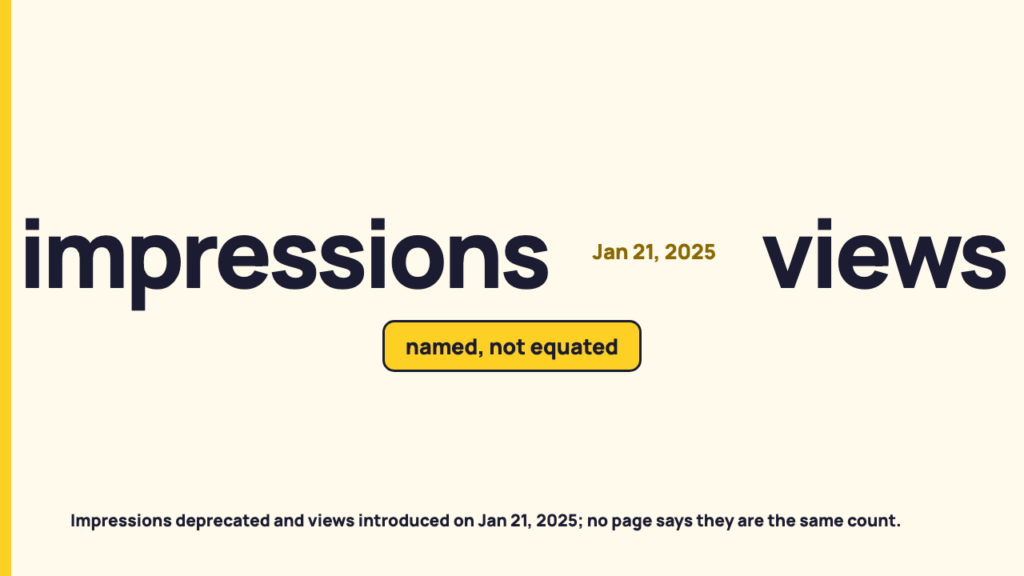
The Instagram Platform changelog has an entry dated Jan 21, 2025, headed “Insights APIs”. It says that Insights APIs for both media and user objects “are now available for apps that have implemented Instagram API with Instagram Login”, and that it is introducing a views metrics field for media and user insights. Under “Metric Deprecations” it lists four metrics. The Insights reference for media adds two further statements about the same metrics. Here they are side by side, each as written.
| Source | What it states |
|---|---|
| Changelog, Jan 21, 2025, introduced | views, as a new metrics field for media and user insights |
| Changelog, Jan 21, 2025, deprecated | clips_replays_count on media insights; ig_reels_aggregated_all_plays_count on media insights; impressions on media and user insights; plays on media insights |
| Changelog, applicability | “Applies to v22.0+. Will apply to all versions April 21, 2025.” |
| Changelog, note | “API requests with the impressions metric will continue to return data for media created on or before July 1, 2024 for v21.0 and older. API requests made after April 21, 2025 for media created on or after July 2, 2024 will return an error.” |
| Media Insights reference, impressions | “For media created after July 2, 2024, this metric is deprecated. For media created before July 2, 2024, this metric will still be available.” Described as the “Total number of times your app user’s Instagram Media object has been seen.” |
| Media Insights reference, views | “Total number of times IG Media has been played on Instagram.” Marked “Metric in development.” |
Note that the two pages phrase the cutoff differently: the changelog says on or before July 1, 2024 and on or after July 2, 2024, while the reference says after July 2, 2024 and before July 2, 2024. This post reproduces each as written and does not try to reconcile them. If the exact boundary matters to your series, that is a reason to check the live pages yourself.
One limit needs stating plainly. These are developer API documents. They describe what the API returns. They are not the same thing as the numbers shown in the Instagram app or in a third-party dashboard, and nothing here claims what any particular dashboard did or when.
Why a replaced metric is a break in the series, not a rename
Read the carve-out again. The cutoff for impressions is keyed to the media creation date, and the error is keyed to the request date. The following is a reading of that wording, not a Meta statement: a monthly report could contain some posts that can still be measured under the old metric and later posts that can only be measured under the new one, even when both sit in the same month. A single line that quietly switches its underlying quantity partway along is not one series.
The reference also shows that the two metrics were never the same kind of count. For reach it says: “Number of unique Instagram users that have seen the reel at least once. Reach is different from impressions, which can include multiple views of a reel by the same account.” So impressions and reach were already different counts, and views is described in terms of plays: “Total number of times IG Media has been played on Instagram.” That is a description of what each one is. It is not a conversion rule between them. The cross-platform version of that problem is laid out in what a view counts as on each platform, and the general pattern in why the same account reports different numbers.
Now the part the documentation does not say. On the changelog page and the two Insights pages fetched for this post, there is no statement that historical impressions were recomputed or backfilled as views, and no statement that views and impressions are numerically comparable. The pages are silent. Silence is not a yes or a no, so the honest report note records it as silence.
There are also practical limits on rebuilding history. The media Insights reference says: “Data used to calculate metrics can be delayed up to 48 hours.” and “Metrics data is stored for up to 2 years.” How short that window makes a series is the subject of how short your reporting history really is.
Three questions to put to any metric before it goes in the deck
These come from the author, not from Meta, but each is answered by the Instagram entry above.
- Which date does the change apply from, and what is that date keyed to? The Instagram entry uses two: the version and request date (v22.0 and later, all versions from April 21, 2025) and the media creation date (on or before July 1, 2024, on or after July 2, 2024). A report that uses only one of them can misplace the seam.
- Is the replacement described as the same quantity or a different one? The changelog only names views as introduced and impressions as deprecated. The reference describes views as plays and impressions as times seen. Neither page says they are the same quantity, so the answer is “named, not equated”.
- Does the platform say anything about history? Here, nothing was found. Write “documentation silent” in the notes rather than a guess.
How to annotate a monthly report so the break is visible
This section is recommended practice from the author. Meta does not prescribe it, no survey is behind it, and no template is offered here. It is a way of working, described in prose.
Start with the chart. Put a visible break marker at the month the definition changed, and split the series there, so the old metric and the new metric are two lines or two panels, not one continuous line. Do not compute a growth rate across the break, because the two ends of that calculation are not the same quantity as far as the documentation can say.
Then add a one-line footnote under the chart. It names the old and new metric exactly as Meta names them, impressions and views, and gives the source URL and the date of the changelog entry, Jan 21, 2025. No numbers are needed in the footnote and no one has to be named.
Finally, keep a running notes column in the report for platform definition changes. Each row carries the metric name, the date and a link. Review the platform changelog on a fixed cadence so that the row gets written when the change is published, not when someone asks why a line moved.
What to write when the documentation does not answer
Three wordings you can adapt, kept to what the pages support:
- “Per the Instagram Platform changelog entry of Jan 21, 2025, the impressions metric was deprecated and views was introduced.”
- “Impressions is documented as deprecated for media created after July 2, 2024. Comparability between impressions and views is not stated by the platform.”
- “The platform documentation reviewed does not state whether historical impressions were recomputed as views.”
What not to write: that the two metrics are equivalent, or that the change explains a movement in the numbers, unless the platform says so. A dated change is a reason to look closely at a movement. It is not, on its own, a cause.
Your next step
Open the changelog entry yourself, record the dates and the exact metric names in your report notes, and mark the seam on the chart before the next review.
FAQ
Did Meta replace impressions with views?
The Jan 21, 2025 changelog entry lists impressions on media and user insights among the metric deprecations and introduces views as a new metrics field. That is the scope documented for the Instagram API, applying to v22.0 and later and to all versions from April 21, 2025.
Are impressions and views the same count?
The fetched pages describe impressions as the total number of times media has been seen and views as the total number of times media has been played. They do not state that the two are equivalent, so this post does not infer it.
Sources
- Instagram Platform changelog, entry of Jan 21, 2025, fetched 2026-11-13
- Instagram Media Insights reference, fetched 2026-11-13
- Instagram Platform Insights guide, fetched 2026-11-13 (read for backfill or comparability statements; none found)