A freelancer takes over a client’s Instagram account and the follower count does not match anything else on the profile. Someone may have been buying Instagram followers before the handover. Before deciding what to do, it helps to know which document addresses the problem. This scene is hypothetical.
This piece is a reading of Instagram’s Terms of Use, three of Meta’s Community Standards, Meta’s Community Standards Enforcement Report, three Meta announcements, four Instagram Help Center articles, and Instagram’s Feed Recommendations and Explore AI system cards, read between 28 October and 17 November 2026. No account was checked and nothing was tested. No seller is named or linked, and no purchasing method is described anywhere in it.
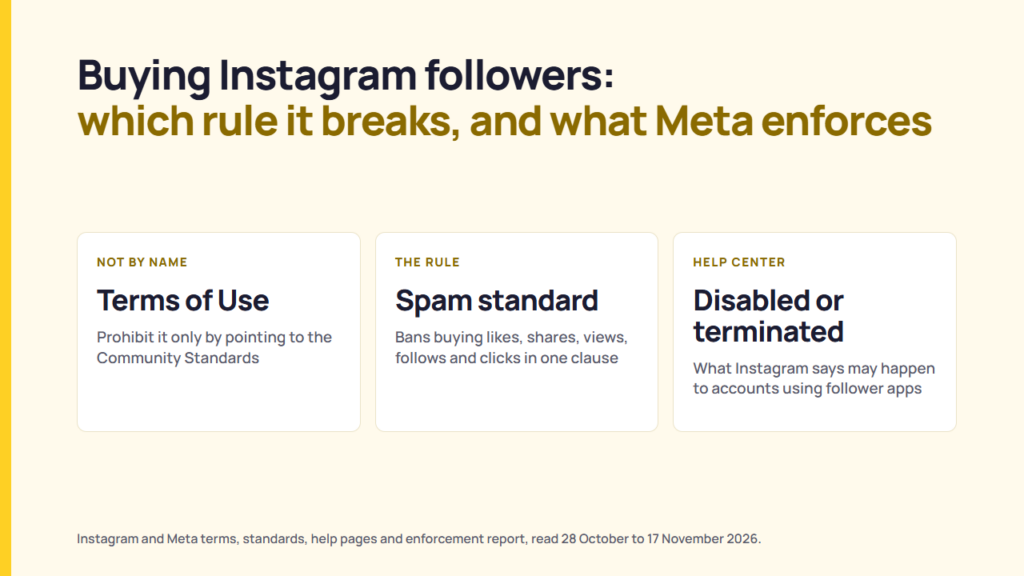
The rule most people expect to find in Instagram’s Terms of Use is not stated there. The Terms prohibit creating accounts in unauthorised automated ways and buying, selling or transferring any aspect of an account. The prohibition on paying for engagement appears in Meta’s Spam Community Standard, which bans “Attempting to or successfully selling, buying, or exchanging for engagement, such as likes, shares, views, follows, clicks, use of specific hashtags, etc.” Instagram’s Help Center is blunter: “You shouldn’t use apps that offer likes and followers”, and an account that uses one to gain likes or followers “may be disabled or terminated”. Meta publishes no figure for purchased followers, and publishes very large figures for accounts it has actioned.
What Instagram’s Terms of Use actually say
Instagram’s Terms of Use set out the account holder’s commitments in section 4.2, headed “How You Can’t Use Instagram”. None of those commitments name buying followers.
Four clauses are relevant. The first is general: “You can’t do anything unlawful, misleading, or fraudulent or for an illegal or unauthorized purpose.” The second covers account creation: “You can’t attempt to create accounts or access or collect information in unauthorized ways”, which the Terms say “includes creating accounts or accessing or collecting information in an automated way without our express permission”.
The third is the closest the Terms come to the subject. “You can’t sell, license, or purchase any account or data obtained from us or our Service”, and that “includes attempts to buy, sell, or transfer any aspect of your account (including your username); solicit, collect, or use login credentials or badges of other users”.
The fourth clause links the Terms to the Community Standards: “You can’t violate (or help or encourage others to violate) these Terms or our policies, including in particular the Community Standards”. The Terms do not prohibit buying followers by name. They prohibit violating the Community Standards, which contain the relevant rule.
Section 6 sets out what Meta says it can do. It “can remove any content or information you share on the Service” if it believes the Terms or policies have been violated and it can “refuse to provide or stop providing all or part of the Service to you (including terminating or disabling your access to the Meta Products and Meta Company Products) immediately”.
The Meta standard that prohibits buying Instagram followers
Meta’s Spam Community Standard contains the relevant rule. Its stated rationale is that “We do not allow content that is designed to deceive, mislead, or overwhelm users in order to artificially increase viewership.”
| Prohibited behaviour | What Meta’s Spam standard says |
|---|---|
| Paying for engagement | “Attempting to or successfully selling, buying, or exchanging for engagement, such as likes, shares, views, follows, clicks, use of specific hashtags, etc.” |
| High-frequency activity | Posting, sharing, engaging, or creating accounts and other assets “at very high frequencies”, whether done manually or automatically |
| Engagement gating | Requiring people to like or share before they can view promised content |
| Trading platform assets | Buying, selling or exchanging accounts, groups or pages, or site privileges such as admin or moderator roles |
Source: Meta Transparency Center, Community Standards, “Spam”, read 2026-10-28 and rechecked 2026-11-17. The standard lists exceptions including clearly identified branded content, and cross-promotion that is not triggered by payment to a third party.
The first row covers more than followers. Meta’s clause names likes, shares, views, follows and clicks together, so buying views or impressions falls under exactly the same rule as buying followers, and is not a separate case.
Two other standards sit alongside it. Meta’s Inauthentic Behavior policy covers networks of inauthentic assets used to “Deceive Meta or our users about the identity, or origin of an audience or the entity that they represent”. It also says that when Meta finds such a network, it will “remove the fake accounts, Pages, Groups, or other Meta assets directly involved in the operation”. Meta’s Account Integrity policy says it may restrict or disable accounts showing “close linkage with a network of accounts or other entities that violate or evade our policies”.
The familiar wording about artificially collecting likes and followers used to appear on Instagram’s own Community Guidelines page. That address redirected to Meta’s Community Standards when it was checked on 28 October 2026 and again on 17 November 2026, so this piece quotes the standards rather than a page that no longer answers at that address.
What Instagram’s Help Center says about apps that sell likes and followers
Instagram’s Help Center has an article titled “Why you should not use apps that offer likes and followers on Instagram”, and it is the most direct statement Instagram makes on the subject.
The article opens: “You shouldn’t use apps that offer likes and followers.” It says some of these apps ask for an account’s login details, that “None of these services are affiliated with or endorsed by Instagram”, and that an app given a username and password, or an access token, “can gain complete access to your account”, including personal messages.
It then sets out three consequences in rising order. “If it looks like you’ve shared your login details with one of these apps, we may remove any likes or other engagement that they generated.” Accounts that keep using such apps “may notice that certain parts of their Instagram account are limited”. And “If you use one of these apps to gain likes or followers, your account may be disabled or terminated.” The fix it gives for shared login details is to change the Instagram password.
A second Help Center article explains why a follower count can drop on its own. It says some non-Instagram apps create automated likes, comments and follows “to make an account appear more popular than it is”, that “When these accounts are discovered, their activity is removed from Instagram”, and that because Instagram routinely removes disabled accounts, an account’s follower total “may change, even within a short time”.
Can Instagram detect bought followers?
Instagram has said it uses automated tools to find this activity, and it has not published how accurate those tools are.
In November 2018, Instagram announced it would begin “removing inauthentic likes, follows and comments from accounts that use third-party apps to boost their popularity”. It said: “We’ve built machine learning tools to help identify accounts that use these services and remove the inauthentic activity.” Accounts it identified “will receive an in-app message alerting them” that the inauthentic activity had been removed, and would be asked to change their password.
The current Help Center adds a feature for the account holder’s side. Instagram “may flag accounts if they’re potentially spam, bots or irrelevant”, and a public account that has flagged followers sees a “Flagged for review” notice in its Followers list, with a “Remove all” option. Instagram says removed flagged followers are taken out of the follower count and follower list and “won’t be notified that they’ve been removed”. New follows from flagged accounts arrive as requests, even on a public account, and requests not approved within 30 days are automatically declined.
None of this is a detection rate. Instagram describes tools and features, and the enforcement figures below describe totals. Neither says what share of bought followers is found, or how quickly.
What Meta publishes about enforcement
Meta’s Community Standards Enforcement Report publishes a quarterly fake-accounts figure for Facebook. Meta publishes no figure for purchased followers.
On prevalence, the report says: “In Q1 and Q2 2026, we estimated that less than 5% of our worldwide daily active people (DAP) measured across our family of apps consisted solely of violating accounts.”
| Quarter | Fake accounts actioned on Facebook |
|---|---|
| April to June 2026 | 822M |
| January to March 2026 | 1.2B |
| October to December 2025 | 1.1B |
| July to September 2025 | 698M |
| April to June 2025 | 687M |
| January to March 2025 | 1B |
Source: Meta Transparency Center, Community Standards Enforcement Report, Fake Accounts, Facebook, rechecked 2026-11-09. These are Facebook figures, not Instagram’s, and Meta states that blocked creation attempts are excluded from them.
Meta attaches its own caveats to those numbers. It says “We expect the number of accounts we action to vary over time due to the unpredictable nature of adversarial account creation”, that “Our detection technology helps us block millions of attempts to create fake accounts every day and detect millions more, often within minutes after creation”, and that “We do not include blocked attempts in the metrics we report here.”
Two announcements add figures of their own. In April 2025, Meta said that “in 2024 we took down more than 100 million fake Pages engaging in scripted follow abuse on Facebook”, and “over 23 million profiles that were impersonating large content producers”. In March 2026, it said it had removed more than 20 million accounts impersonating large content creators during 2025, and that impersonation reports about large creators had fallen by 33%.
Three qualifications apply to these figures. The quarterly table reports Facebook figures. The prevalence statement is a ceiling across the whole family of apps, not an estimate of bought followers. Meta excludes blocked attempts from its reported metrics, so the totals describe accounts it actioned rather than every attempt its systems stopped. The general method for reading numbers like these is set out in how to read a platform transparency report.
Eight questions about buying Instagram followers on an inherited account
Each question is tied to a document.
| The question | What the documents support |
|---|---|
| 1. Is buying followers against the rules? | Yes. Meta’s Spam Community Standard prohibits “selling, buying, or exchanging for engagement, such as likes, shares, views, follows”. Instagram’s Terms of Use prohibit it by cross-reference to the Community Standards, not by name, and the Help Center says not to use apps that offer likes and followers. |
| 2. What about buying views? | The same clause names views and clicks alongside follows. |
| 3. What can Meta do about it? | Remove the engagement, limit parts of the account, or disable or terminate it, per the Help Center. Remove content and “stop providing all or part of the Service”, per the Terms. Restrict or disable accounts linked to violating networks, per Account Integrity. The documented appeal routes are covered in what the platforms document about business account restrictions. |
| 4. Will the followers be removed? | Possibly. Meta says it removes the fake accounts involved in an inauthentic operation, the Help Center says activity from discovered accounts is removed, and in November 2018 Instagram said it would begin “removing inauthentic likes, follows and comments from accounts that use third-party apps to boost their popularity”. |
| 5. How likely is enforcement? | Not answerable from anything Meta publishes. The report gives totals, not rates, and excludes blocked attempts. |
| 6. Does the follower count help the account anyway? | Follower count is not listed as an input signal on Instagram’s Feed Recommendations system card (updated 29 June 2026) or Instagram’s Explore system card (updated 22 June 2026); both were read on 28 October 2026. For a fuller explanation, see what Instagram has published about ranking signals. |
| 7. What do bought followers do to the engagement rate? | The classic engagement rate divides interactions by followers, so followers who never interact raise the denominator and lower the rate. That is arithmetic, not a Meta statement, and the five common engagement rate formulas do not all divide by followers. |
| 8. What can be checked on the account itself? | Account Status, which Instagram says shows removed content, features the account can no longer use, and whether it may face restrictions. The Followers list, for a “Flagged for review” notice. And the password, which the Help Center says to change if login details were shared with a follower app. |
The rule exists, but it is not where most people look for it. The enforcement data Meta publishes describes the scale of its actions rather than anyone’s odds. Whether buying followers is lawful is a separate question, read in the FTC’s fake social media indicators rule, read line by line. What a client does next is the client’s decision.
What could not be confirmed
This reading cannot settle seven points:
- Meta publishes no figure for purchased followers or purchased views.
- The quarterly accounts-actioned table read here is Facebook’s. The report has a separate Instagram view that was not read.
- Meta states that blocked account-creation attempts are excluded from the fake-account metrics reported here.
- The Help Center’s consequences are written about apps that offer likes and followers. Nothing read separates a service that takes login details from one that does not.
- Instagram has not published how accurate its detection tools are, or how long detection takes.
- The prevalence statement is a ceiling across the family of apps and says nothing specific about inauthentic followers.
- No seller was examined, so nothing here describes what any such service actually delivers.
FAQ
Is buying Instagram followers against Instagram’s rules?
Yes, under Meta’s Spam Community Standard rather than Instagram’s Terms of Use. The Spam standard prohibits “Attempting to or successfully selling, buying, or exchanging for engagement, such as likes, shares, views, follows, clicks, use of specific hashtags, etc.” Instagram’s Terms of Use reach the same place by requiring that you not “violate (or help or encourage others to violate) these Terms or our policies, including in particular the Community Standards”.
Is buying Instagram followers illegal?
Platform rules and the law are separate questions. In the US, the FTC’s rule at 16 CFR 465.8(b) treats buying fake indicators of social media influence as a violation when the buyer knew or should have known they were fake and they materially misrepresent influence for a commercial purpose; individuals not acting for a commercial purpose are excluded. The text is read in full in what the FTC rule says about bought followers. This is not legal advice.
Can Instagram tell if you bought followers?
Instagram says it uses machine learning tools to identify accounts that use third-party apps for likes and follows and to remove the inauthentic activity, and its Help Center describes flagging followers that are “potentially spam, bots or irrelevant”. It has not published a detection rate.
Can you get banned for buying Instagram followers?
Instagram’s Help Center says that if you use an app to gain likes or followers, “your account may be disabled or terminated”, and that accounts that keep using such apps may find parts of the account limited. The Terms of Use also allow Meta to stop providing the service, including disabling access.
Is buying Instagram views treated differently from followers?
No. Meta’s Spam standard names likes, shares, views, follows and clicks in the same clause. The same standard also prohibits offering cash giveaways or other rewards in exchange for engagement, and requiring people to like or share before they can see promised content.
How do you remove fake followers from an Instagram account?
On a public account, Instagram’s Help Center says flagged followers appear under a “Flagged for review” notice in the Followers list, with “Remove all” or a Remove button per account. Removed flagged followers come off the follower count and are not notified. Any follower can also be removed individually.
How many fake accounts does Meta remove?
Meta reported 822 million fake accounts actioned on Facebook between April and June 2026, and 1.2 billion in the quarter before. These are Facebook figures, they exclude blocked creation attempts under Meta’s stated reporting method, and Meta publishes no figure for purchased followers.
Sources
Publisher, page title, link and the date read.
- Instagram, “Terms of Use“, read 2026-10-28.
- Meta Transparency Center, Community Standards, “Spam“, read 2026-10-28, rechecked 2026-11-17.
- Meta Transparency Center, Community Standards, “Inauthentic Behavior“, read 2026-10-28.
- Meta Transparency Center, Community Standards, “Account Integrity“, read 2026-10-28.
- Meta Transparency Center, Community Standards Enforcement Report, “Fake Accounts“, Facebook, read 2026-11-09.
- Instagram Help Center, “Why you should not use apps that offer likes and followers on Instagram“, read 2026-11-17.
- Instagram Help Center, “Changes to your likes, follows or comments on Instagram“, read 2026-11-17.
- Instagram Help Center, “Manage unwanted followers on Instagram“, read 2026-11-17.
- Instagram Help Center, “Check your Account Status on Instagram“, read 2026-11-17.
- Meta, “Reducing Inauthentic Activity on Instagram“, 19 November 2018, read 2026-11-17.
- Meta Newsroom, “Cracking Down on Spammy Content on Facebook“, April 2025, read 2026-10-28.
- Meta Newsroom, “Rewarding Original Creators on Facebook“, 13 March 2026, read 2026-10-28.
- Meta Transparency Center, “Instagram Feed Recommendations“, read 2026-11-09.
- Meta Transparency Center, “Instagram Explore“, read 2026-11-09.