You have spent a week reading hostile replies under a brand’s posts because a controversy landed on the account you run. Nobody told you to stop, nobody asked how it was going, and the unspoken assumption is that this is simply the job. Whether it is also a workplace risk that an employer is supposed to manage is a fair question, and two regulators publish material that bears on it.
This post is a reading of that published material. It is not original testing and it is not based on interviews. Neither the UK Health and Safety Executive (HSE) nor the European Agency for Safety and Health at Work (EU-OSHA) writes about social media or comment moderation in the pages read for this piece. Where this post connects their words to a reply queue, it says so. The guidance is UK and EU guidance that binds employers in those jurisdictions. It does not cover readers elsewhere, including the United States, and this post makes no claim about US law.
The question after a bad week of replies
The useful move is to separate what the regulators wrote, which can be quoted and dated, from what follows if you lay those words over a social media role, which is interpretation.
For other parts of the account runner’s working conditions, see what the law says about the 2am post alert and what government social media guidance asks of the account runner. For how the role is described, there is what live job postings say the job covers.
What HSE counts as work-related violence, and where it puts verbal abuse
HSE’s employer guidance on violence and aggression (page marked Updated 2024-11-19) defines work-related violence as: “Any incident in which a person is abused, threatened or assaulted in circumstances relating to their work.” The page goes on to say this “can include” verbal abuse or threats, “including face to face, online and via telephone”, and that it might include violence from “members of the public, customers, clients, patients, service users and students towards a person at work.”
It also describes the effect. The page says there can be physical harm, “but serious or persistent verbal abuse or threats can also have a serious effect on a worker’s mental health.”
Now the limits. The page does not mention social media, replies or comment sections. “Online” is the page’s word. Applying it to replies under a brand post is this post’s reading. The page also says that for violence to be work-related it “must be in connection with the work activity”, so the connection to the job matters. And HSE states plainly that it “is not the primary authority for cases of bullying, harassment or domestic abuse in the workplace.” The page should not be stretched past that.
The six Management Standards, read against a reply queue
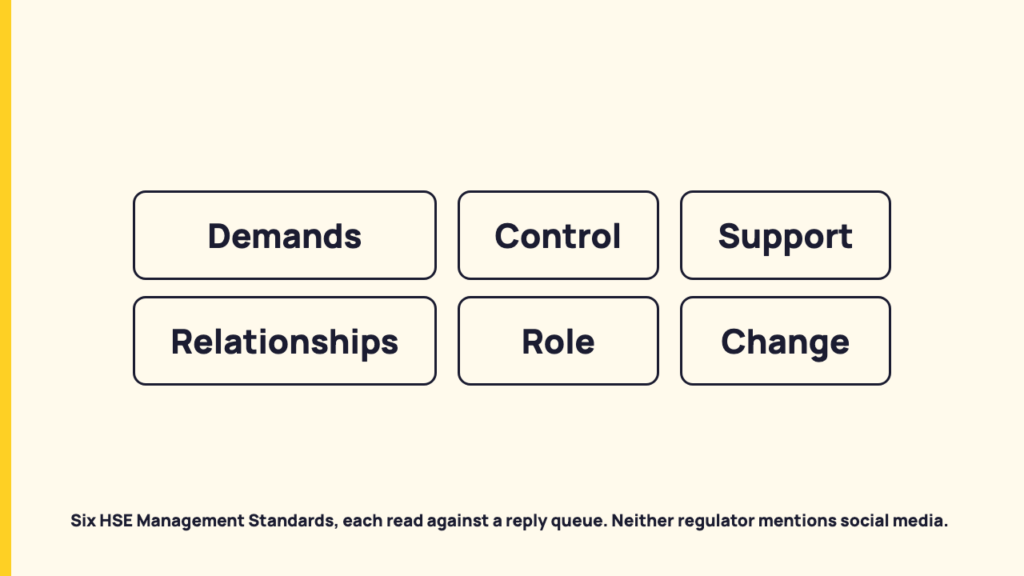
HSE’s page “What are the Management Standards?” (Updated 2025-01-14) says they cover “six key areas of work design that, if not properly managed, are associated with poor health, lower productivity and increased accident and sickness absence rates.” The second column below is HSE’s wording. The third column is a question raised by this post’s reading, not a claim HSE makes.
One caution comes first. HSE’s Step 1 page (Updated 2021-05-11) says “by necessity, the standards are high level and aspirational” and that “HSE does not expect an employer to meet all the standards.” They are not a checklist an employer passes or fails, and nothing in the table should be read that way.
| Standard | HSE’s wording | A question this post’s reading raises |
|---|---|---|
| Demands | “issues such as workload, work patterns and the work environment” | Does the reading of hostile replies count as workload, and does anyone plan for how much of it one person does in a stretch? |
| Control | “how much say the person has in the way they do their work” | Who decides whether the account runner can hide, report or escalate, and does the runner have a say in that? |
| Support | “the encouragement, sponsorship and resources provided by the organisation, line management and colleagues” | When a controversy lands, does anyone check in with the person reading the replies? |
| Relationships | “promoting positive working to avoid conflict and dealing with unacceptable behaviour” | Is abuse from the public treated as unacceptable behaviour that the organisation deals with, or is it left with the individual? |
| Role | “whether people understand their role within the organisation and whether the organisation ensures that they do not have conflicting roles” | Is absorbing abuse written into the role anywhere, and does it sit alongside a brief to stay friendly in public? |
| Change | “how organisational change (large or small) is managed and communicated in the organisation” | When the brand’s stance or the platform’s rules shift, is the person facing the replies told in advance? |
What EU-OSHA adds: difficult customers and the organisational frame
EU-OSHA’s page on psychosocial risks and mental health shows no last-updated date, so this post cites it as fetched on 2026-11-18. It says psychosocial risks “arise from poor work design, organisation and management, as well as from poor social context of work.” Among its examples of working conditions leading to psychosocial risks is the phrase “psychological and sexual harassment; and difficult customers, patients, pupils, etc.” The same list includes lack of influence over the way the job is done and lack of support from management or colleagues.
The page also answers a worry many people carry quietly, that struggling with this is a personal failing. It says that “when viewed as an organisational issue rather than an individual fault, psychosocial risks can be tackled in the same structured and organised way as other OSH risks.” It is a statement about how risks are framed, not a clinical claim.
On the legal side, the page says managing these risks “is not just a moral obligation and a good investment for employers, it is a legal imperative set out in Framework Directive 89/391/EEC.” It adds: “Employers have a legal responsibility to ensure that workplace risks are properly assessed and controlled,” and that involving workers in the process “is essential.” These are EU-OSHA’s statements, reported as such. They are not a legal conclusion of this post.
As with HSE, the EU-OSHA page does not name social media or comment moderation.
What the documents do not say
Reading the pages closely matters as much for what is absent. In the pages fetched for this post:
- There is no social media guidance from either body. A text search of each cited page for “social media” and “moderat” found no matches, and the only use of “comment” is an unrelated one on the Step 2 page, about comments made in team meetings.
- There is no threshold for how many hostile replies is too many, or how long a stretch is too long.
- There is no rule about exposure to graphic or distressing content in the pages read.
- There is no statement about an employee versus freelancer split beyond what HSE’s worker page says, covered next.
On that worker page, HSE says: “Your employer has specific duties to protect you from work-related violence and aggression. This includes verbal abuse as well as physical attacks. This also applies if you’re working for them as a contractor, a freelancer or are self-employed.” The same page also says “find out if health and safety law applies to you if you’re self-employed”, pointing self-employed people to a separate check. Read the two lines together. The page carries no last-updated date, so it is cited here as fetched on 2026-11-18.
Nothing in this post is legal advice, and it does not say any employer is in breach of anything.
What the guidance asks an employer to do with a risk like this
Knowing what “managed” looks like on paper makes the documents easier to use. HSE lays out a five-step process on its Management Standards pages. In its own terms: identify the risk factors, work out who can be harmed and how, evaluate the risks, record the findings, then monitor and review.
Step 1 tells employers where to start. It says to “first focus on organisational level issues that potentially impact on a group,” and gives the reason: “It is more effective to remove a stressor or significantly reduce its impact than it is to manage lots of individual cases.”
Step 2 (marked Updated 2022-05-17) lists the data an organisation typically already holds, naming sickness absence and staff turnover among the inputs. Step 3 (Updated 2025-01-14) says: “If you want to know what is affecting employees, you have to ask them.” For the discussion groups it describes, it says “groups of between 6 and 10 people work best.” All of this is HSE describing a process for employers. None of it is advice to the reader.
On violence specifically, HSE’s employer guidance says it covers “what you should do if an incident does occur, what to report and how to support any workers who may be physically or mentally affected”, and links to separate information on providing support after an incident. This post adds no detail beyond that.
Taking it to a manager: what the reader can do with this
The documents support questions better than they support demands. Some forms that stay within what was quoted above:
- Does our risk assessment cover abusive replies from the public, and if so, where is it written down?
- Who has the say over hiding, reporting or escalating abusive replies?
- If a stretch of hostile replies continues for days, who is asked how the person reading them is doing?
Those are questions, not accusations and not legal claims. HSE’s worker page advises that if you have experienced violence in connection with your work you should report it to your employer, and that if you are concerned you can talk to your employer, a manager or supervisor, or your trade union or health and safety representative. If you are still concerned after that, it says you can contact HSE. That advice is for UK readers.
Outside the UK and EU you would need to check local rules. This post does not assert any US requirement, or any requirement elsewhere.
FAQ
Does HSE say online abuse from the public counts as work-related violence?
HSE’s definition is “any incident in which a person is abused, threatened or assaulted in circumstances relating to their work,” and it says this can include verbal abuse or threats “online” and from members of the public. The page does not name social media, so applying it to replies under a brand post is this post’s reading, not HSE’s statement.
Are the HSE Management Standards a legal requirement?
HSE says employers have a legal duty to protect employees from stress at work by doing a risk assessment and acting on it, and that following the Management Standards approach correctly is considered suitable and sufficient. It also says it does not expect an employer to meet all the standards. This is not legal advice. It is UK guidance and does not apply in the US.
Sources
- HSE, How employers can protect workers from violence and aggression at work, page dated Updated 2024-11-19, fetched 2026-11-18.
- HSE, Advice for workers on violence in the workplace, no last-updated date shown, fetched 2026-11-18.
- HSE, What are the Management Standards?, Updated 2025-01-14, fetched 2026-11-18.
- HSE, Step 1: Identify the risk factors, Updated 2021-05-11, fetched 2026-11-18.
- HSE, Step 2: Who can be harmed and how, Updated 2022-05-17, fetched 2026-11-18.
- HSE, Step 3: Evaluate the risks, Updated 2025-01-14, fetched 2026-11-18.
- HSE, Work-related stress and how to manage it, Updated 2024-06-04, fetched 2026-11-18.
- EU-OSHA, Psychosocial risks and mental health at work, no last-updated date shown, fetched 2026-11-18.