The platform dashboard says a post drove a few thousand link clicks. GA4 says far fewer sessions arrived from that platform. A client asks where the rest went, and “consent” is one of the answers someone will offer. This post reads what Google’s help pages say, and where they stop.
The gap a manager is asked to explain
Consent is one possible cause of the gap, among several. This post covers only the consent and modelling layer. How GA4 decides a visit is social is a separate question, and we cover it in how GA4 decides a visit is social. The definitional gap between a click and a visit is covered in the difference between a click, a landing page view and a session.
You will not find a figure here for how many sessions consent loses. Google’s pages do not publish a typical loss rate, and any number offered would be invented. The sources are Google Analytics Help (“Consent mode on websites and mobile apps”, “Behavioral modeling for consent mode” and “Reporting identity”), retrieved on 2026-10-14. The pages showed no last-updated date, so the retrieval date is the only date given. This is a documentation read. It is not a test of any property.
What consent mode actually does when a visitor says no
Consent mode communicates users’ consent status to Google so tags adjust their behaviour. Consent mode does not provide a banner or widget; it interacts with one. It receives the visitor’s choice from whatever consent tool the site uses.
The page states that when visitors deny consent, instead of storing cookies, tags send pings to Google, and that for Google Analytics the gaps are filled with conversion modelling and behavioral modelling. With analytics_storage denied, the tag does not read or write first-party analytics cookies.
The same page lists what those cookieless pings can include. Functional information: timestamp, user agent (web only) and referrer. Coarse information: whether ad-click information such as a GCLID was in the URL, a boolean for the consent state, a random number per page load, and information about the consent platform.
Referrer appears in that list, and it is tempting to conclude that a denied visit from a social link can be traced back to its platform. The page does not say that. It lists what a ping can include. It does not say how, or whether, a modelled session is assigned a source. Google does not make that inference on that page.
Basic versus advanced: the difference decides whether anything is estimated
Google’s page compares two ways of wiring consent mode. In the advanced implementation, Google tags load before the consent dialog appears and send cookieless pings when consent is declined. In the basic implementation, Google tags are blocked until consent is granted. Google’s table, for the Google Analytics rows:
| Row on Google’s table | Advanced implementation | Basic implementation |
|---|---|---|
| Tag behavior | Tags are loaded before the consent dialog appears. Tags send cookieless pings when cookie consent is declined. | Google tags are blocked until consent is granted. |
| Behavioral modeling in Google Analytics | Marked yes. | Left blank. |
| Conversion modeling in Google Analytics | Marked yes. | Marked yes, with an asterisk; the footnote says that when tags are blocked “no data is collected”, and its modelling discussion concerns Ads. |
The consequence is stated in plain words on the page: if you block Google tags until the consent dialog and users consent, “you will not get modeled data in your Google Analytics property to fill in the gaps for the missing observed data when users decline consent.”
The page adds a note on the IAB Europe Transparency and Consent Framework. When a consent solution that uses it is in place and users deny consent, Google Analytics properties are not able to model data to fill in the missing information.
The bar for modelling: what Google says a property needs
Behavioral modelling estimates users who decline analytics cookies from similar users who accept them, trained on the property’s own observed data. To be eligible, Google lists these prerequisites:
- Consent mode is enabled across all pages of the sites and all app screens of the apps.
- For web pages, consent mode is implemented so that tags load before the consent dialog appears and Google tags load in all cases, not only if the user consents (the advanced implementation).
- The property collects at least 1,000 events per day with analytics_storage=’denied’ for at least 7 days.
- The property has at least 1,000 daily users sending events with analytics_storage=’granted’ for at least 7 of the previous 28 days.
The page says training may take more than 7 days of meeting the threshold, and extra data may still not be enough. It adds a caveat: meeting these external prerequisites “doesn’t guarantee eligibility” because the underlying model follows its own eligibility criteria, and it names the ratio of new to returning users and user to session counts as factors.
The page also says behavioral modelling is only included when there is high confidence of model quality. Its example: if there is not enough consented traffic to inform the model, events triggered by users who decline consent are not reported. In plain terms, for a smaller property those sessions are not estimated. They are simply absent from the report.
Note what the thresholds are measured against. They apply to the property as a whole. The page does not say a channel needs its own volume, and it does not mention channels at all, so no channel-level rule should be asserted either way.
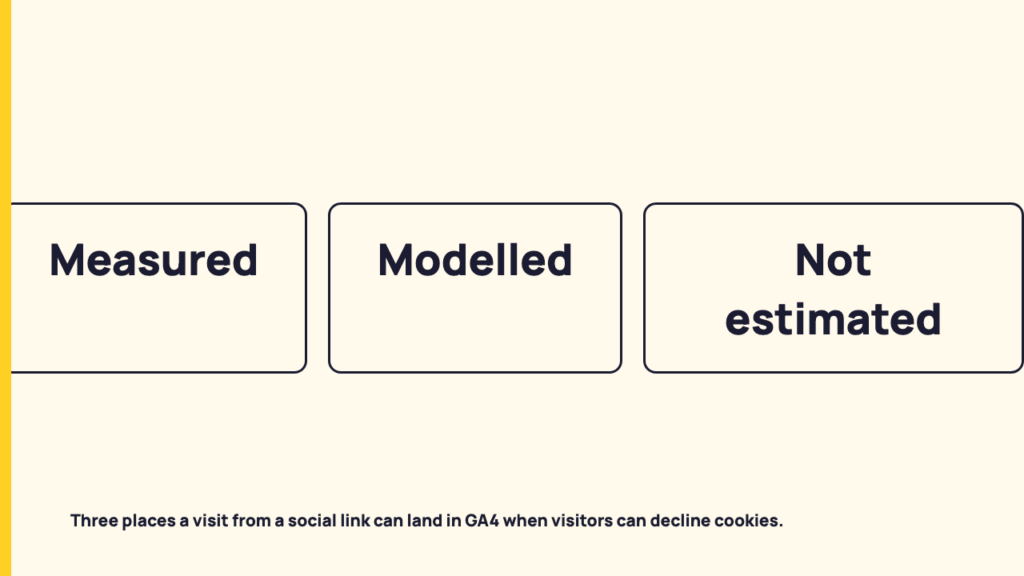
Measured, modelled, dropped: sorting a social visit into one of three buckets
What follows is reasoning from Google’s text, applied to a hypothetical visit from a social link. It is not an observation of any property.
- Measured. The visitor accepts analytics cookies. Analytics associates the behaviour with identifiers, which Google calls observed data.
- Modelled. The visitor declines, the tags loaded anyway (advanced), and the property clears the prerequisites above and the model’s further criteria. The behaviour is estimated from similar consenting users. Per the reporting identity page, it is visible in reports only under the Blended reporting identity.
- Not estimated. The visitor declines and tags were blocked until consent (basic), so no data was collected. Or tags loaded but the property is not eligible, or lacks enough consented traffic. Per the page, events from those users are not reported.
Two points matter for anyone comparing numbers. First, modelling in reports is applied to metrics like users, sessions and new users. It is not applied to event counts such as page_view, first_visit and session_start. The page says that without a persistent identifier the same visitor cannot be recognised across page loads, which results in a higher number of first_visit and session_start events for those users, because the event is sent each time they load a page. So two numbers inside one GA4 property can disagree about what a visit count means.
Second, the question the whole post is circling is not answered. The pages read do not say how a modelled session is assigned a source, medium or channel, and they do not mention social at all. I re-scanned all three pages for “social”, “channel”, “medium” and “source”. The only hit in the consent pages’ own text was “referrer” in the ping list. Google does not document this on the pages read.
Where modelled data shows up, and where it does not
Modelled data appears in reports only when the Blended reporting identity is selected, under Admin, Data display, Reporting identity. The reporting identity page describes Blended as: user ID if it is collected, then device ID, then modelling when no identifier is available. Observed (user ID, then device ID) and Device based (device ID only) are the options that exclude it. The page states the option does not affect data collection or processing.
Before sending a number to a client, look at the data-quality icon. The behavioral modelling page lists statuses including “Including estimated user data” and “Excluding estimated user data”, the latter explained as the reporting identity setting not allowing estimation, so reports include only data from users who consented. The page also notes that when modelled data is included, you will probably see differences compared with observed-only reports, for example higher user counts.
The page lists features that do not support modelled behavioral data: audiences; user explorer, cohort and user lifetime explorations; segments with a sequence; retention reports; Predictive Metrics; and data export, for example BigQuery export. So a BigQuery export and a standard report can show different numbers for the same period, and the page is the citation for each item.
Explorations differ too. Modelling in path and funnel explorations is applied to the first_visit and session_start events, so their counts are lower there than in reports.
What to say to the client, and what to leave out
Statements the documentation supports:
- If the property qualifies, Google estimates those visitors and shows them in reports under Blended reporting identity (behavioral modelling and reporting identity pages).
- If the property does not qualify, or tags were blocked until consent, those visits are not estimated (consent mode and behavioral modelling pages).
- A report with modelling will probably show higher user counts than one with observed data only (behavioral modelling page).
Statements it does not support: any percentage of social sessions lost to consent, and any claim that modelled sessions are attributed to social.
Three things to check in your own property, rather than guess:
- Is consent mode on, and implemented the advanced way?
- Which reporting identity is selected?
- What does the data-quality icon say for the date range in question?
Consent is one documented reason a GA4 number can be lower than a platform number. Google’s pages do not allow sizing it. The honest line for a client is that it is a known contributor of unknown size.
FAQ
Does consent mode explain why GA4 sessions are lower than platform clicks?
It is one documented contributor. Visitors who decline analytics cookies are not tracked with identifiers, and they are only estimated if the property qualifies for modelling. Google’s pages give no size for the effect, and other causes exist that are covered in the two sibling posts linked above.
What does GA4 need before it will model visitors who decline cookies?
Consent mode on all pages, the advanced implementation, at least 1,000 events per day with analytics_storage denied for at least 7 days, and at least 1,000 daily users sending events with analytics_storage granted for at least 7 of the previous 28 days. Meeting them does not guarantee eligibility. Source: the behavioral modelling page, 2026-10-14.
Sources
- Consent mode on websites and mobile apps, Google Analytics Help, fetched 2026-10-14
- Behavioral modeling for consent mode, Google Analytics Help, fetched 2026-10-14
- Reporting identity, Google Analytics Help, fetched 2026-10-14