What LinkedIn has published about how the feed ranks posts
Three statuses run through the table below. Stated means a LinkedIn primary source says it, and the source is named with its date. Inferred means a LinkedIn primary source implies it without saying it, and the row names what the inference adds. Not stated by LinkedIn means the claim circulates widely and no LinkedIn primary source read for this page states it.
An agency lead auditing why a B2B client’s LinkedIn posts flattened has to sort an inherited posting checklist into rules LinkedIn has documented and rules nobody at LinkedIn has ever written down. The table is that sort, run against LinkedIn’s own material.
| Claim as practitioners state it | What LinkedIn actually said | Source | Date | Status |
|---|---|---|---|---|
| There is one LinkedIn algorithm | LinkedIn describes two distinct systems: a “unified retrieval system” built on LLM-generated embeddings, and a separate “Generative Recommender” ranking model | Engineering the next generation of LinkedIn’s Feed, Hristo Danchev, LinkedIn Engineering Blog | 2026-03-12 | stated |
| The feed weighs a lot of inputs | LinkedIn’s AI systems and algorithms “consider hundreds of signals to determine what content appears in each member’s Feed” | How the Feed ranks content, LinkedIn Help | labeled by LinkedIn as last updated 9 months earlier; read 2026-08-24 | stated |
| LinkedIn groups its inputs | LinkedIn names three signal types: Identity, Content and Activity, each with a published item list | LinkedIn relevance: Optimizing the member experience, LinkedIn Help | labeled last updated 4 months earlier; read 2026-08-24 | stated |
| Your own profile affects your reach | The system that ranks and surfaces content “factors in the author’s professional identity, such as experience, content shared on their profile, and skills” | How Does the LinkedIn Feed Work?, Tim Jurka | 2025-08-11 | stated |
| Recency is an input | “How recent the content is” appears in LinkedIn’s published Content signal list. Separately, LinkedIn states the feed retrieval layer indexes “data from the past 30 days” | LinkedIn Help relevance article; FishDB, Kenneth Li and co-authors | read 2026-08-24; 2025-11-17 | stated |
| Dwell time is an input | LinkedIn defines two kinds of dwell time and added a skip-prediction model to the ranking function. Its member-facing wording is “Content you spend the most time viewing” | Understanding dwell time to improve LinkedIn feed ranking, Siddharth Dangi and co-authors; LinkedIn Help relevance article | 2020-05-12; read 2026-08-24 | stated |
| Early engagement counts | “Engagement others have with your posts and how recent it is” appears in LinkedIn’s published Activity signal list | LinkedIn Help relevance article | read 2026-08-24 | stated |
| Tagging affects distribution | “Tagged people, companies, or topics” appears in LinkedIn’s published Content signal list. No direction or size of effect is given | LinkedIn Help relevance article | read 2026-08-24 | stated as a signal only |
| Engagement pods work | LinkedIn states its goal “is to make engagement pods ineffective”, that it flags posts that look artificially boosted and limits their reach, and that detected inauthentic engagement around a person’s or company’s own posts “can affect how that content is distributed across the platform” | LinkedIn: Where Real Conversations Matter, Oscar Rodriguez | 2025-09-05 | stated, and contradicted |
| Engagement bait gets demoted | LinkedIn states it is reducing “repetitive, click-driven posts” and engagement bait, and that a video unrelated to its text post “should no longer gain additional reach” | Updates to The LinkedIn Feed, Tim Jurka; LinkedIn Pressroom | 2026-03-12 | stated |
| Low-quality posts get suppressed | LinkedIn’s algorithms “filter out or taper distribution of low-quality and unsafe content”, and its Feed systems “help reduce the visibility of low-quality or unsafe content” | LinkedIn Help relevance article | read 2026-08-24 | stated |
| Gender or other demographics change reach | LinkedIn states demographic information is not used as a signal for content visibility, and that its teams tested member-run comparisons and found distribution “was not influenced by gender, pronouns, or any other demographic information” | Putting members first, Sakshi Jain, LinkedIn Engineering Blog | 2025-11-20 | stated as a denial |
| Out-of-network reach is real | LinkedIn states that for suggested content from outside a member’s network, “2000 candidates are retrieved from a pool of hundreds of millions” | Large Scale Retrieval for the LinkedIn Feed using Causal Language Models, Sudarshan Srinivasa Ramanujam and co-authors, arXiv:2510.14223 | 2025-10-16 | stated |
| The model reads your history | The Generative Recommender “processes more than a thousand of your historical interactions” | Danchev, LinkedIn Engineering Blog | 2026-03-12 | stated |
| You can turn personalization off | Selecting Recent shows “posts in reverse chronological order from people you follow, without personalization” | Sort your feed by Top or Recent posts, LinkedIn Help | labeled last updated 9 months earlier; read 2026-08-24 | stated |
| The ranking model optimizes for engagement | LinkedIn names the modeled tasks: “passive tasks (click, skip, long-dwell) and active tasks (like, comment, share)”. The inference is that these are the objectives. LinkedIn publishes no weighting between them | Danchev, LinkedIn Engineering Blog; An Industrial-Scale Sequential Recommender for LinkedIn Feed Ranking, Lars Hertel and co-authors, arXiv:2602.12354 | 2026-03-12; 2026-02-12 | inferred |
| Getting skipped hurts a post | LinkedIn stated in 2020 that it reduced each update’s score “by an amount proportional to the predicted P(skip) value”. Skip is still a named modeled task in 2026. Whether the 2020 penalty mechanism survives into the current system is not stated | Dangi and co-authors; Danchev | 2020-05-12; 2026-03-12 | inferred |
| A fixed early window decides total reach | LinkedIn names engagement recency as a signal and publishes no window length, no comment count and no threshold | Search trail recorded below | read 2026-08-24 | not stated by LinkedIn |
| A link in the post cuts reach by a set percentage | No LinkedIn primary source read for this page states any link-based distribution rule | Search trail recorded below | read 2026-08-24 | not stated by LinkedIn |
| Company Page posts and member posts are ranked the same way | LinkedIn lists posts from companies you follow among the feed’s sources without stating whether the criteria are shared or separate | LinkedIn Help relevance article | read 2026-08-24 | not stated by LinkedIn |
This sort applies to anyone deciding which received rules about LinkedIn to keep. It does not apply to explaining or predicting the performance of one specific post, for the reasons set out further down.
The feed as LinkedIn’s engineers describe it: retrieval, filtering, ranking
LinkedIn’s engineers do not describe the feed as one algorithm. They describe named stages that run in order, each with its own system, its own budget and its own criteria. FishDB, the Rust retrieval engine LinkedIn published on 2025-11-17, names three of them directly: “candidate retrieval, filtering, and scoring.”
A solo social media manager at a small B2B software company, watching Page posts hold steady while employee posts move around, is looking at a pipeline with several decision points, not a single verdict. Which stage a post falls out of matters, and LinkedIn’s own material distinguishes them.
Retrieval. LinkedIn narrows the candidate pool before anything is ranked. Hristo Danchev writes that LinkedIn replaced a heterogeneous set of retrieval sources, including “a chronological index of your network’s activities, trending posts in your geography, collaborative filtering based on similar members’ interests, industry-specific trending content, and several embedding-based retrieval systems”, with one unified system built on LLM-generated embeddings (LinkedIn Engineering Blog, 2026-03-12). LinkedIn’s retrieval paper puts a number on the out-of-network side: 2,000 candidates from a pool of hundreds of millions, “with a latency budget of a few milliseconds” (arXiv:2510.14223, 2025-10-16). FishDB adds the in-network figures: a single feed query “can contain 300+ inverted terms, selects ~3K candidates, and performs ~150K data accesses for filtering and ranking” (2025-11-17).
The 30-day figure sits at this stage. LinkedIn states that “the feed use case only retrieves data from the past 30 days, which can entirely fit in memory across our 48 partitions” (FishDB, 2025-11-17). That is a published property of the retrieval index. LinkedIn does not present it as guidance about when to post, and this page does not read it that way.
Filtering. LinkedIn describes filtering as a separate step with its own rules. The FishDB migration “preserved all existing business rules (such as hiding content from unfollowed entities or filtering out spam)”, and LinkedIn states it stores “spam classification features as sparse filtering attributes” alongside document embeddings (2025-11-17). LinkedIn’s Help Center describes the member-facing effect of the same layer: its algorithms “filter out or taper distribution of low-quality and unsafe content” (LinkedIn relevance article, read 2026-08-24).
Ranking. LinkedIn calls its current ranking model a Generative Recommender. Danchev describes it as treating “your feed interaction history as a sequence”, processing more than a thousand past interactions through “transformer layers with causal attention”, then routing predictions through a Multi-gate Mixture-of-Experts head that gates passive tasks (click, skip, long-dwell) separately from active tasks (like, comment, share). Danchev also states what the ranking model does not use: it “relies on professional signals and engagement patterns, never demographic attributes” (2026-03-12).
Two of these descriptions are aimed at engineers, and one carries a production claim worth reading precisely. LinkedIn’s Feed SR paper states the model “has been serving the majority of LinkedIn’s Feed traffic for over three months” and reports online A/B results of +2.10% time spent and +3.52% like, comments or reshares against the previous production model (arXiv:2602.12354, submitted 2026-02-12, revised 2026-05-29). That is a statement about aggregate metric movement in a controlled test. It is not a statement about what any individual post will do.
Older LinkedIn material used different names for the same shape, and those names are now superseded. LinkedIn’s 2019 post describes “first pass rankers (FPR)” creating a preliminary candidate selection and “a second pass ranker (SPR)” combining and scoring their output (Community-focused Feed optimization, 2019-06-25). It names FollowFeed as the dominant first pass ranker. FishDB then states that LinkedIn replaced FollowFeed (2025-11-17). Anyone quoting the FPR and SPR vocabulary in 2026 is quoting a retired architecture.
What dwell time means in LinkedIn’s terms
LinkedIn defines dwell time in two parts, and the definition is narrower than the way the term gets used. Siddharth Dangi and co-authors write that each update viewed on the feed generates two types. Dwell time “on the feed” is the one with a measurement rule attached: it “starts measuring when at least half of a feed update is visible” as a member scrolls. Dwell time “after the click” is “the time spent on content after clicking on an update in the feed” (LinkedIn Engineering Blog, 2020-05-12).
LinkedIn’s member-facing wording for the same idea appears in its Help Center as a single line in the Activity signal list: “Content you spend the most time viewing” (LinkedIn relevance article, read 2026-08-24). Danchev’s 2026 post lists “long dwells” among the member actions that get embedded into the ranking sequence, alongside likes, comments and shares (2026-03-12).
Now the divergence. The practitioner shorthand treats dwell time as a reward: hold attention longer, earn more distribution. LinkedIn’s own published mechanism runs the other way round. Dangi and co-authors describe a threshold below which an update counts as “skipped”, then a model that predicts skipping, then a scoring change: LinkedIn “incorporated the new model into our final ranking function by reducing the score of all updates by an amount proportional to the predicted P(skip) value” (2020-05-12). The published objective is a penalty for being skipped, not a bonus for being read.
Three things the shorthand assumes are not in LinkedIn’s published record. LinkedIn does not publish the value of the skip threshold, only that one exists and that a single value “was a good choice of threshold for all of the heterogenous types of feed updates” (2020-05-12). LinkedIn does not publish the weight dwell time carries relative to likes, comments or shares. LinkedIn does not state whether the 2020 P(skip) mechanism still operates inside the 2026 Generative Recommender, and the 2026 post names skip only as one of several modeled tasks.
A two-person in-house team told by a consultant to “maximize dwell time” is being handed a target LinkedIn has defined, measured and then largely stopped writing about. The 2020 post is the most quotable LinkedIn statement on dwell time and it is more than six years old.
What LinkedIn says a person posting can influence, and what they cannot
LinkedIn’s published signal lists split cleanly into two groups. The split matters because roughly half of what LinkedIn says it evaluates belongs to the person scrolling, not the person posting.
A freelancer running LinkedIn for several B2B clients, working through a checklist inherited from a previous consultant, can put every line of it on one side or the other of this split, or discover it belongs on neither. A freelancer running LinkedIn for several B2B clients, working through a checklist inherited from a previous consultant, can put every line of it on one side or the other of this split, or discover it belongs on neither. The same applies to the practical side of producing video content for LinkedIn, where unlimited video editing services for businesses can help turn raw material into publishable content.
Group one: inputs LinkedIn describes that the person posting controls.
- What the post is about. LinkedIn lists “What the post is about and whether it provides knowledge or advice” as a Content signal (LinkedIn Help relevance article, read 2026-08-24).
- The language of the post. LinkedIn lists “The language of the post” as a Content signal (same source).
- Who and what is tagged. LinkedIn lists “Tagged people, companies, or topics” as a Content signal (same source).
- How the conversation reads. LinkedIn lists “How constructive or professional the conversation is” as a Content signal (same source).
- Whether the post is engagement bait. LinkedIn states it is reducing engagement bait and names examples, including “comment to agree” prompts and videos that do not match the text (Tim Jurka, 2026-03-12; LinkedIn Pressroom, 2026-03-12).
- Whether the engagement is authentic. LinkedIn states that when it detects patterns suggesting inauthentic engagement around a person’s or company’s own posts, “it can affect how that content is distributed”, and that third-party tools and browser extensions enabling this are not allowed (Oscar Rodriguez, 2025-09-05).
- The author’s own profile. LinkedIn states the ranking system factors in the author’s professional identity, naming experience, profile content and skills (Tim Jurka, 2025-08-11), and its 2026 announcement names industry, skills, experience and geography (2026-03-12).
- The visibility setting chosen at publish. LinkedIn states the visibility of a post varies with the option the author selected, and that “You can’t change the visibility option after you’ve shared your post” (Visibility of shared posts, LinkedIn Help, labeled last updated 2 years earlier; read 2026-08-24).
Group two: inputs LinkedIn describes that sit with the viewer or the system.
- The viewer’s profile. LinkedIn lists the viewer’s location, workplace and skills under Identity signals (LinkedIn Help relevance article, read 2026-08-24).
- The viewer’s past behavior. LinkedIn lists what the viewer reacted to, commented on or shared, who they interact with frequently, “Content you spend the most time viewing”, and topics they have shown interest in (same source).
- The viewer’s graph position. LinkedIn lists “Whether the content comes from someone you follow or are connected to” as a Content signal (same source).
- The viewer’s explicit controls. LinkedIn documents unfollow, mute, hide and Not interested, and states that after a member selects Not interested, “your feedback may be used to improve future Feed recommendations” (Hide content in your feed, LinkedIn Help, labeled last updated 1 month earlier; read 2026-08-24).
- The viewer’s sort choice. LinkedIn documents a Recent view that shows posts chronologically “without personalization” (Sort your feed article, read 2026-08-24).
- Other people’s engagement, and how recent it is. LinkedIn lists it as an Activity signal (LinkedIn Help relevance article, read 2026-08-24). The poster does not control other members’ behavior.
- How recent the content is. LinkedIn lists it as a Content signal (same source). Time passes on its own.
- The retrieval budget and window. LinkedIn states the feed retrieval layer covers the past 30 days, selects roughly 3,000 candidates per query in-network (FishDB, 2025-11-17), and retrieves 2,000 out-of-network candidates from hundreds of millions (arXiv:2510.14223, 2025-10-16).
- The models and their objectives. LinkedIn describes the retrieval embeddings, the sequential ranking model and the modeled task set, and publishes no way for a member to change any of them (Danchev, 2026-03-12).
- Demographic attributes. LinkedIn states these are not used as ranking signals at all (Sakshi Jain, 2025-11-20; How the Feed ranks content, read 2026-08-24).
Every item above is an input LinkedIn named. None of them is a promise about an outcome. LinkedIn describes inputs to a ranking system, and nowhere in the material read for this page does LinkedIn state what any input will do to a specific post.
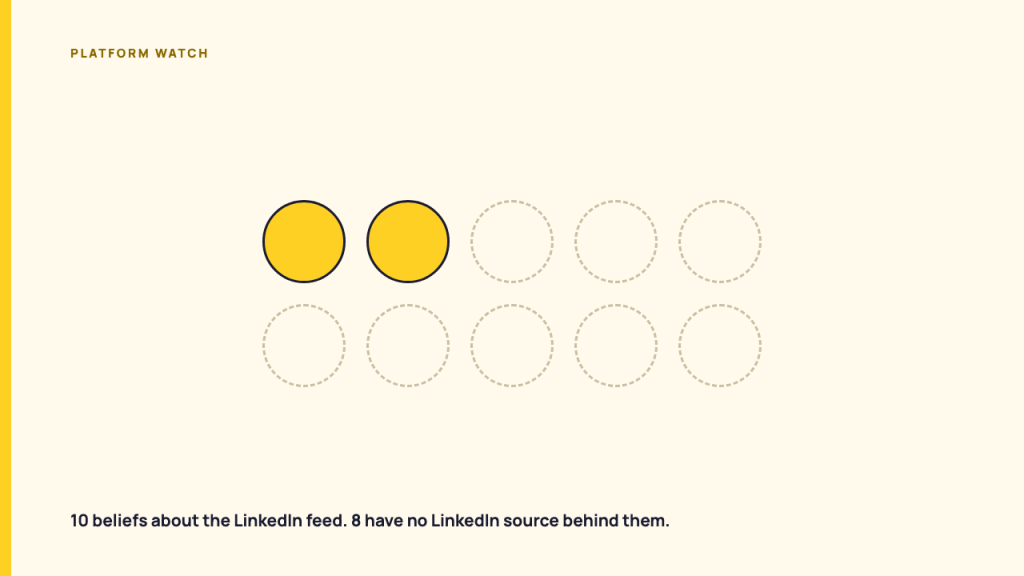
Ten beliefs about the LinkedIn feed, checked against LinkedIn’s own material
Each belief below is stated the way practitioners state it, followed by what was searched and what the search found. The finding is always about LinkedIn’s published record. “No LinkedIn primary source states it” is not the same as “it is false”, and this section never makes that jump.
An agency lead handed an incoming client’s LinkedIn playbook can mark each rule in it against this list: documented, partly documented, or unsourced.
- A link in the post cuts reach, often quoted at around 60%. This circulates in mainstream business press, including Forbes columns dated 2026-07-23 and 2026-07-30, and across vendor blogs. No LinkedIn primary source read for this page states a link-based distribution rule. LinkedIn’s published Content signal list contains no link attribute. LinkedIn’s only published distribution-reduction grounds are low-quality and unsafe content, spam, inauthentic engagement and engagement bait. LinkedIn also publishes “Visits to links in this post” as a normal post analytics metric, and states data is unavailable only for links “detected as spam, malicious, or that violate LinkedIn’s professional community policies” (Post analytics for your content, labeled last updated 2 months earlier; read 2026-08-24). One page on linkedin.com does assert the penalty: a Top Content page titled “Do Links Lower LinkedIn Post Reach” opens with the claim that the feed “penalizes posts with outbound links”. LinkedIn labels that page’s summary “Summarized by AI based on LinkedIn member posts” (read 2026-08-24). It is member content on LinkedIn’s domain, not LinkedIn stating a rule.
- Editing a post after publishing reduces its distribution. This circulates on vendor blogs and in member posts on LinkedIn itself. No LinkedIn primary source read for this page attaches any distribution consequence to editing. LinkedIn’s help material on posting and on sharing content does not mention editing and reach together. The denial is equally unsourced: a widely shared member post dated 2025-10 reports that LinkedIn’s product team called the belief false, which is a secondhand account of a conversation, not a LinkedIn publication.
- Deleting a post harms the account. No LinkedIn primary source read for this page attaches a ranking consequence to deletion. LinkedIn’s Troubleshoot missing posts article lists deletion of the original content among the reasons a post cannot be viewed, and states that a removal notification appears when LinkedIn removes a post for a violation (labeled last updated 8 months earlier; read 2026-08-24). That is a display and moderation statement, not a ranking one.
- A comment count reached inside a fixed early window determines total reach. LinkedIn states that engagement others have with a post, and how recent that engagement is, is a signal it evaluates. LinkedIn publishes no window length, no comment count and no threshold anywhere in the material read for this page. The one threshold LinkedIn does document is the skip threshold in the 2020 dwell time post, and LinkedIn withholds its value.
- A specific posting cadence is required for distribution. No LinkedIn primary source read for this page connects posting cadence to feed distribution. LinkedIn publishes two cadence-adjacent figures, and neither is a distribution statement. Its Build your voice by sharing content FAQ states that members who post twice per week see up to five times more profile views, which is a profile-view claim (labeled last updated 1 year earlier; read 2026-08-24). Its LinkedIn Pages Best Practices page claims a 2x engagement lift for companies that post weekly, and that page carries no publication date at all, so this piece does not treat its figures as current numbers (read 2026-08-24). Neither states a ranking rule, and neither is a recommendation this page makes.
- Tagging people or companies increases reach. Half documented. LinkedIn lists “Tagged people, companies, or topics” among the Content signals it evaluates (LinkedIn Help relevance article, read 2026-08-24). LinkedIn states no direction and no magnitude. “Tagging is an input LinkedIn evaluates” is documented. “Tagging increases reach” is not.
- Document and carousel posts get more distribution. No LinkedIn primary source read for this page states a format-based ranking advantage. LinkedIn lists PDF slideshows among available formats and “Add a document” among composer options, and its published Content signal list contains no format attribute. The only format-related distribution statement LinkedIn makes runs the other way: a video that does not match its text post “should no longer gain additional reach” (Tim Jurka, 2026-03-12).
- A paid subscription changes ranking. No LinkedIn primary source read for this page states that a Premium subscription affects feed ranking. The nearest LinkedIn statement is narrower than the belief: “Feed distribution isn’t influenced by payments from third parties to LinkedIn, except for promoted (paid) content, which is clearly labeled” (LinkedIn Help relevance article, read 2026-08-24). That addresses third-party payments and labeled paid promotion. It does not address member subscriptions, and LinkedIn’s Premium help material read for this page does not mention feed ranking.
- The feed suppresses accounts that post too often. No LinkedIn primary source read for this page states a frequency-based suppression rule. LinkedIn does publish distribution reduction on four other grounds, each sourced above: low-quality and unsafe content, spam, inauthentic engagement including engagement pods and comment automation, and engagement bait or recycled low-substance posts. Whether an individual account has actually been restricted, and how a restriction is appealed, is a different question with its own evidence, and it is not answered here.
- Company Page posts and member posts are ranked by the same criteria. LinkedIn’s published feed description lists posts from connections, from people and companies you follow, from groups, and from outside your network, without stating whether the criteria differ by author type (LinkedIn Help relevance article, read 2026-08-24). Danchev’s 2026 post describes one unified retrieval system without addressing Pages separately. LinkedIn’s 2019 post describes multiple first pass rankers with separate inventories, including sponsored updates, but that architecture is superseded. The record is silent on the current answer.
What the documented record does and does not mean for the person posting
The record supports paying attention to a short list, and every item on it traces to a specific stated input rather than to a stated result.
What LinkedIn’s published material supports attending to:
- The subject of the post and whether it carries knowledge or advice, because LinkedIn lists that as a Content signal (read 2026-08-24).
- Whether the post’s framing is one LinkedIn has publicly named as bait, because LinkedIn named “comment to agree” prompts and mismatched videos specifically (2026-03-12).
- Whether the engagement a post attracts is real, because LinkedIn states detected inauthentic engagement can affect distribution and that pod-enabling tools are not allowed (2025-09-05).
- The author’s own profile fields, because LinkedIn states the ranking system factors in the author’s professional identity (2025-08-11).
- The visibility option selected at publish, because LinkedIn states it cannot be changed afterward (read 2026-08-24).
What the record does not support is longer, and it is the more useful half.
LinkedIn’s published material cannot explain why one post underperformed. LinkedIn describes systems, stages and modeled objectives, never per-post outcomes, and LinkedIn’s own analytics carry a caveat: “the numbers in your post analytics are estimates and may not be precise” (Post analytics article, read 2026-08-24). LinkedIn publishes no weighting between its modeled tasks, so no stated input can be ranked against another. LinkedIn publishes no threshold values, so no stated signal converts into a target. And LinkedIn’s published record cannot substitute for observation on the specific account in question, because none of it is account-level.
Parts of the record have also aged past the systems they describe. The dwell time definition dates from 2020-05-12 and predates the Generative Recommender by nearly six years. The first pass and second pass ranker vocabulary dates from 2019-06-25 and names FollowFeed, which LinkedIn states it has since replaced (2025-11-17). LinkedIn’s oldest relevant help article, Visibility and impact of your social activity on the LinkedIn feed, is labeled as last updated three years before it was read on 2026-08-24. Even LinkedIn’s own headline numbers differ by source and date: Danchev writes of 1.3 billion professionals on 2026-03-12, while the Feed SR paper describes deployment “at a scale of 1.2 billion members” on 2026-02-12.
The agency lead from the top of this page ends with a shorter list than they started with. Five inputs above are documented and attributable. Four of the ten beliefs audited have no LinkedIn source behind them at all, two are only half documented, and one resolves to a stated LinkedIn denial rather than a rule.
LinkedIn’s published sources, and how old each one is
Four lanes of LinkedIn material were read for this page, all on 2026-08-24.
The LinkedIn Engineering blog’s Feed category contains twelve posts in total. Four are directly about feed ranking or feed retrieval: Danchev on the current system (2026-03-12), Jain on testing and measurement (2025-11-20), the FishDB retrieval engine (2025-11-17) and Dangi and co-authors on dwell time (2020-05-12). One more, Community-focused Feed optimization (2019-06-25), describes the superseded architecture.
LinkedIn’s product and newsroom material contributed three dated items: Tim Jurka’s two articles (2025-08-11 and 2026-03-12), Oscar Rodriguez on feed authenticity (2025-09-05) and the LinkedIn Pressroom announcement (2026-03-12).
LinkedIn’s Help Center contributed eleven articles, listed in the source ledger below. LinkedIn publishes only relative “last updated” labels on these pages rather than dates, so each citation records both LinkedIn’s label and the date the page was read.
Two LinkedIn-authored research papers were read for what the systems optimize for rather than for their headline results: arXiv:2510.14223 on retrieval (2025-10-16) and arXiv:2602.12354 on sequential ranking (submitted 2026-02-12, revised 2026-05-29).
A “not stated by LinkedIn” verdict required three things: absence from the LinkedIn Engineering Feed category, absence from the eleven Help Center articles and four LinkedIn product and newsroom items read, and a targeted search that surfaced no LinkedIn primary source. Where a search surfaced a page on linkedin.com that turned out to be member content or an AI summary of member posts, that is recorded as member content, not as a LinkedIn statement. LinkedIn hosts a great deal of writing it did not author.
What LinkedIn has not published
LinkedIn has published the shape of its feed systems and withheld the settings. Across everything read for this page, LinkedIn names its stages, its signal categories, its modeled tasks and its retrieval budgets, and publishes no weight, no threshold value, no per-post explanation and no commitment to announce the next change before it ships. LinkedIn’s most detailed current description, Danchev’s 2026-03-12 post, closes on what comes next without saying what will change.
That is the honest boundary of a documented reading. It also means the record dates fast, and the parts of it people quote most confidently are the parts that have aged worst.
Instagram’s published record gets read the same way in the same audit run on Instagram’s published signals, which carries none of the findings above: one platform per post, no claim moved across. More dated, sourced reads of what the platforms have actually said sit in Platform Watch.
Questions about the LinkedIn feed
What does LinkedIn say decides which posts appear in the feed?
LinkedIn states that its AI systems and algorithms “consider hundreds of signals to determine what content appears in each member’s Feed”, including the context of a post and signals from the viewer’s profile, network and activity (How the Feed ranks content, LinkedIn Help, read 2026-08-24). LinkedIn groups those signals into Identity, Content and Activity and publishes an item list under each (LinkedIn relevance article, read 2026-08-24). LinkedIn Engineering adds the system layer: a unified retrieval stage built on LLM-generated embeddings, then a Generative Recommender ranking model (Hristo Danchev, 2026-03-12).
What is dwell time on LinkedIn?
LinkedIn defines dwell time in two parts. Dwell time “on the feed” “starts measuring when at least half of a feed update is visible” as a member scrolls, and dwell time “after the click” is “the time spent on content after clicking on an update in the feed” (Siddharth Dangi and co-authors, LinkedIn Engineering Blog, 2020-05-12). LinkedIn’s member-facing wording for the same signal is “Content you spend the most time viewing” (LinkedIn relevance article, read 2026-08-24). The published mechanism built on it predicts skipping and lowers the score of updates predicted to be skipped, which is the opposite shape from the reward the popular paraphrase describes.
Does LinkedIn reduce the reach of posts with external links?
No LinkedIn primary source read for this page states that LinkedIn reduces the distribution of posts containing external links. LinkedIn’s published Content signal list contains no link attribute, and its published grounds for tapering distribution are low-quality and unsafe content, spam, inauthentic engagement and engagement bait (LinkedIn relevance article, read 2026-08-24; Oscar Rodriguez, 2025-09-05; Tim Jurka, 2026-03-12). The page on linkedin.com that asserts a link penalty is labeled by LinkedIn as an AI summary of member posts (read 2026-08-24). The absence of a LinkedIn statement is not evidence that no effect exists. It is evidence that the widely quoted figures have no LinkedIn source.
Does editing a LinkedIn post after publishing affect its distribution?
No LinkedIn primary source read for this page states any distribution consequence for editing a published post. LinkedIn’s help material on posting and on sharing content does not connect the two. You will also find no LinkedIn publication denying it: the widely shared denial traces to a member post reporting what LinkedIn’s product team said, which is a secondhand account rather than a LinkedIn statement.
Is recency a stated input to LinkedIn feed ranking?
Yes. LinkedIn lists “How recent the content is” among its published Content signals, and “Engagement others have with your posts and how recent it is” among its Activity signals (LinkedIn relevance article, read 2026-08-24). LinkedIn separately states that its feed retrieval layer indexes data from the past 30 days (FishDB, 2025-11-17). LinkedIn publishes no window length, no threshold and nothing about clock time, and this page makes no claim about when to post.
Does LinkedIn rank Company Page posts and member posts by the same stated criteria?
LinkedIn does not say. Its published feed description lists posts from connections, from people and companies a member follows, from groups, and from outside the network, without stating whether the ranking criteria differ by author type (LinkedIn relevance article, read 2026-08-24). Danchev’s description of the unified retrieval system does not address Pages separately (2026-03-12). LinkedIn’s 2019 post describes separate first pass rankers per inventory, but LinkedIn has since replaced that architecture (FishDB, 2025-11-17). The current answer is not in the published record.
Does LinkedIn suppress accounts that post too often?
No LinkedIn primary source read for this page states a frequency-based suppression rule. LinkedIn does publish four other grounds on which it reduces distribution: low-quality and unsafe content, spam, inauthentic engagement including engagement pods and comment automation, and engagement bait or recycled low-substance posts (LinkedIn relevance article, read 2026-08-24; Oscar Rodriguez, 2025-09-05; Tim Jurka and LinkedIn Pressroom, 2026-03-12). Whether a specific account has been restricted, and how that is appealed, is a separate question with its own evidence and is not answered here.
Can I tell from LinkedIn’s engineering posts why one of my posts underperformed?
You cannot. LinkedIn’s engineering posts describe systems, stages, signal categories and modeled objectives, and they report aggregate A/B results such as +2.10% time spent for the Feed SR model (arXiv:2602.12354, 2026-02-12). None of that resolves to a single post. LinkedIn publishes no weighting between its modeled tasks and no threshold values, and LinkedIn’s own post analytics state that “the numbers in your post analytics are estimates and may not be precise” (read 2026-08-24).