A title and thumbnail test has finished in YouTube Studio and it has named a winner. Before you swap the losing version out for good, it helps to know what the word “winner” is attached to. Many people assume it means the version that got the most clicks. That assumption is worth checking against the documentation.
This piece is a reading of YouTube’s own help page, “A/B test titles & thumbnails”, accessed on 2026-09-30. No test was run for this piece, and nothing here is an observation from a test. It covers only YouTube’s native title and thumbnail A/B test in YouTube Studio. Other platforms’ testing tools are not covered, because their documentation was not read.
The result you are deciding whether to trust
The test is over, one option has a label next to it, and you have to decide whether to act on it. The help page says plainly what the label measures. It says little about what the label leaves out, so this piece separates what the page states from what a careful reader can infer.
What the help page says the test optimizes for
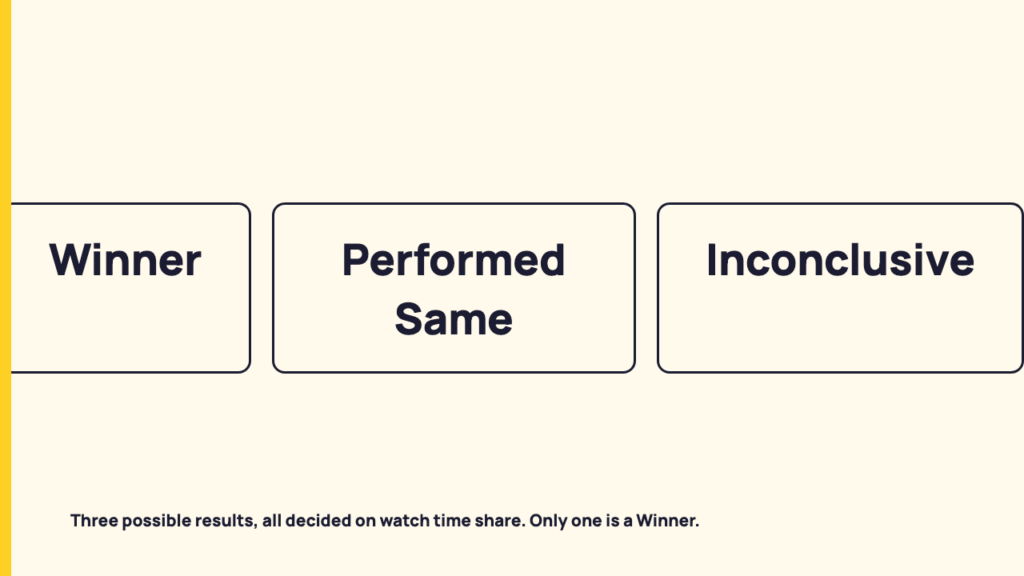
The opening summary of the page says creators can test and compare up to 3 different titles and thumbnails, and that “at the end of the test, the title or combination of title and thumbnail with the highest watch time will be shown to all viewers.” The results section repeats the point: you will see one of three results “based on watch time share.”
The page also explains the choice under the question “Why is the watch time used to determine the winner?” Its answer begins: “Great titles and thumbnails serve an important purpose beyond getting viewers to click. They help a viewer understand what the video is about so that they don’t waste their time clicking on the wrong videos.” It continues: “To help your video get high quality engagement, we optimize tests for overall watch time over other metrics, like click-through-rate.”
That inverts the common assumption. The native tool is documented as not choosing on click-through rate. The page goes further in its comparison with outside tools: “Many third-party tools run A/B tests sequentially and may generate different results. These tools often only optimize for click-through rate, which may determine a different ‘winner’ than measuring by watch time share.” That is YouTube’s statement about the category, and this piece does not name or evaluate any tool.
One limit on what can be said about the metric itself: the page uses the phrase “watch time share” but does not define how the share is computed. It does not say what the share is a share of, or over what window. Any formula would be supplied by the reader, not by the page, so none is offered here. If you want the other metric that tends to get mixed up in these conversations, there is a separate piece on five ways to say engagement rate.
The three results, and the two that are not a win
The page defines three outcomes. The table below quotes or closely follows each definition and records what the page says happens to the video.
| Result | The page’s definition | What happens to the video |
|---|---|---|
| Winner | “This option clearly outperformed the others based on watch time share, and we’re sure that these results are statistically significant based on data from viewers.” | The option with the highest watch time is shown to all viewers. |
| Performed Same | “The test ran and all your options performed about the same. While there may be small differences, there isn’t a clear winner, so pick the option you prefer.” | The page tells you to pick the option you prefer. It also says that if there was no clear winner, the first title or combination you uploaded is shown to all viewers. |
| Inconclusive | “There was no strong statistical difference in engagement between your options.” | “The first title and thumbnail you upload will be the default.” You can change to the title and thumbnail of your choice manually at any time. |
The page is explicit that not winning is ordinary: “It’s normal not to receive a ‘Winner’ test result.” It gives two reasons. The first is a minimal difference in titles or thumbnails, meaning the difference “did not have a measurable impact on video performance.” The second is not enough impressions, and the page adds that “if your video receives a higher number of views, then the more likely a ‘Winner’ will be declared.”
A related tip on the same page: testing titles and thumbnails that are too similar to each other can cause tests to run for longer, because there may not be enough of a difference to decide on a winner.
How the test is run, and the limits that shape a result
- Options. Up to 3 titles and/or thumbnails. You choose Title only, Thumbnail only, or Title and thumbnail.
- Duration. The page says “your test should be completed within two weeks”, and separately that it “can take a few days or up to 2 weeks to complete due to differences in impressions, how recently your video was published, and other factors.”
- Editing stops the test. “If a video’s title or thumbnail is changed during the test, the test will automatically stop.” You then need to restart it.
- Control group. YouTube “may maintain a small percentage of traffic as a control group of viewers that are excluded from the experiment.” That group sees only the default title and thumbnail, and its performance “is excluded from the experiment calculations.” The page gives no percentage.
- Eligibility. The feature is desktop only, through YouTube Studio, and you need advanced features enabled. Shorts, Scheduled Lives and Premieres cannot be tested, though Live Archives can, and a Premiere becomes eligible after it ends and converts to a long-form video. Videos that are made for kids, mature audiences or private cannot be tested.
- Variance. Results for the same video “may vary due to the statistical variation that exists in any real-world experiment, similar to flipping a coin”. They may also vary because of “natural changes in a video’s audience composition over time”, since early impressions are more likely to come from viewers already familiar with the channel.
What a watch time winner still does not tell you
This section is reasoning from the documented metric. It is not a finding from any test, and nothing here says a winner was worse on any measure.
The test compares options on one stated quantity, watch time share. The results description on the help page names no other outcome as an input to the winner. It does not list saves, shares, subscribers or comments. That is a statement about what the page says, not about what YouTube does internally. The Inconclusive definition does use the word “engagement” in general terms, and the page does not spell out what it includes, so the safe reading is that the page does not say.
The page also gives its reason for the choice: “we believe that deciding a ‘winner’ by watch time will best support creators’ growth.” That is YouTube’s stated belief. The page cites no data for it, so treat it as the design rationale and not as a demonstrated result.
Here is a worked example built only from the definitions, with no numbers. The page says a Winner “clearly outperformed the others based on watch time share.” Read literally, a Winner tells you which option earned the larger share of watch time among test viewers. It does not tell you why. The reason could be the wording, the image, the promise the pairing makes, or something about who was shown which version. The definition does not separate those.
That last point deserves a caution. A title and thumbnail can change who clicks as well as how they click, so a winner reflects a mix of audience and packaging. The page does not measure this. It does note that audience composition shifts over a video’s life, which is the reason to hold the result loosely.
Reading a result before it becomes a strategy
Three questions can be answered from the page for any result you are looking at.
- What did the test measure? Watch time share. In the page’s words, the tests are optimized “for overall watch time over other metrics, like click-through-rate.”
- What did it call the result? Winner, Performed Same or Inconclusive, each with the definition quoted above. A Winner is described as clearly outperforming the others with results “statistically significant based on data from viewers.”
- How much traffic could it have seen? The page says more impressions make a Winner more likely, and that a control group of unstated size saw only the default. A low-traffic video has less to go on before you even reach the options.
The page’s own advice on where to start is to test older videos first, “to reduce the impact to your channel’s overall views”, and then choose videos “most helpful to test for your channel’s content strategy.” It also recommends running diverse tests, since options that are too similar can make tests run longer.
Treat Performed Same and Inconclusive as information about your options, not as a failed test. The page’s own response to Performed Same is “pick the option you prefer”, and to Inconclusive is that you can change the title and thumbnail to whatever you choose.
Finally, one result is one video’s answer for the period it ran. The page itself says results for a given video can vary, and does not present a rule for all content. If you want to look at what viewers did after the click once a version is live, that is a separate job, covered in how to read an audience retention graph.
Next time a test finishes
Open the help page alongside the report and check the result against the three questions above. Write down which metric was used, which of the three results you got, and how much traffic the video had. Then decide, for this one video, whether to keep the outcome.
FAQ
Does YouTube’s A/B test choose by click-through rate?
No, according to the help page. Results are based on watch time share, and the page says “we optimize tests for overall watch time over other metrics, like click-through-rate.”
Why is there sometimes no winner?
The page says it is normal and gives two reasons: minimal difference between the titles or thumbnails, and not enough impressions. In those cases the result is Performed Same or Inconclusive, and if there was no clear winner the first title and thumbnail you uploaded are shown to all viewers, which you can change manually.
Sources
- YouTube Help, “A/B test titles & thumbnails”, fetched 2026-09-30.