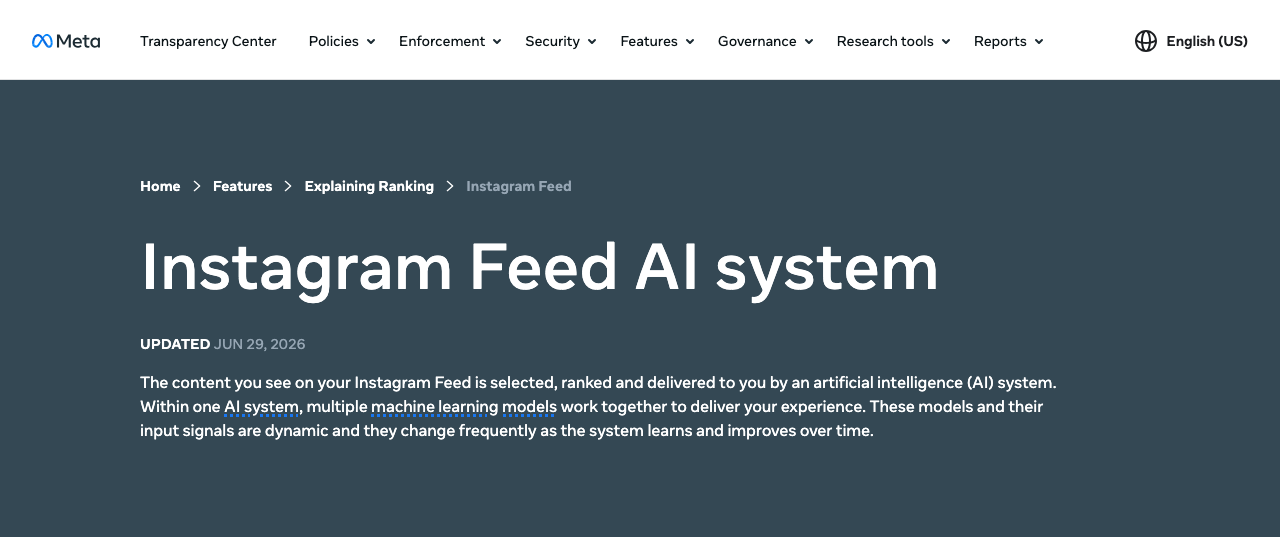
Instagram’s published ranking record is much smaller than the advice built on top of it. Meta’s explaining-ranking index lists ten Instagram-prefixed system cards, nine of them for Instagram surfaces and one for the Threads feed (Meta Transparency Center, Explaining Ranking index, read 2026-08-24). Instagram’s fullest written explanation of ranking is still Adam Mosseri’s post from May 31, 2023 (Instagram Ranking Explained). The Recommendations Guidelines on the Instagram Help Center carry no version date at all.
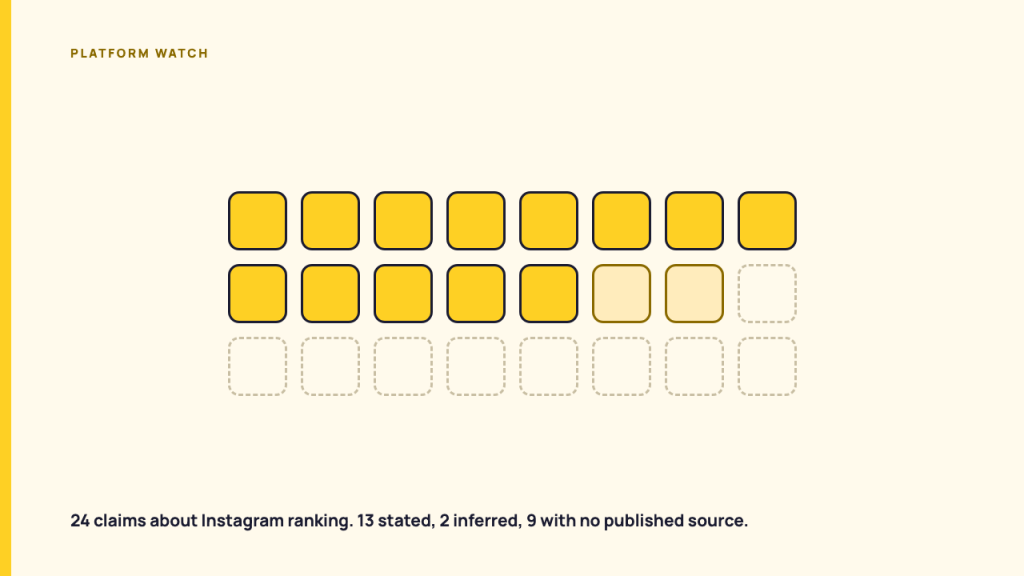
Those documents say a lot less than the guidance circulating around them. This page sorts the claims into three groups: the ones Instagram or Meta states, the ones a primary source implies without saying, and the ones with no published source behind them.
What Instagram and Meta have actually published about ranking
Three statuses run through the table below.
Stated means Instagram or Meta says it in a primary source, and the source, its author and its date are named. Inferred means a primary source implies it without saying it, and the row names the statement the inference rests on. No source found means the belief circulates widely and no Instagram or Meta primary source read for this page states it.
Every source in the table was fetched on 2026-08-24. Where a document is older than two years, the date is on the row and the statement is a record of what Instagram said then, not a claim about current behavior.
| Claim as practitioners state it | What Instagram or Meta actually said | Source | Date | Status |
|---|---|---|---|---|
| Instagram has one algorithm | “Instagram doesn’t have a singular algorithm that oversees what people do and don’t see on the app” | Instagram Ranking Explained, Adam Mosseri, about.instagram.com | 2023-05-31 | Stated, and it says the opposite of the claim |
| Feed and suggested posts are ranked by the same system | Meta publishes two separate cards: Instagram Feed for connected content, Instagram Feed Recommendations for suggested content | Instagram Feed and Instagram Feed Recommendations, Meta Transparency Center | both updated 2026-06-29 | Stated |
| Recency is a ranking signal | “How recently the post was created (within 90 days)” is listed as an input signal to one Feed prediction (note 1) | Instagram Feed, Meta Transparency Center | updated 2026-06-29 | Stated, narrowly |
| DM shares are a ranking input | Meta lists “How likely you are to share a post with someone in a direct message” among the significant Feed predictions | Instagram Feed, Meta Transparency Center | updated 2026-06-29 | Stated |
| Sends per reach is the single most important Instagram ranking signal | No primary Instagram or Meta document read for this page ranks sends above other signals (note 2) | search trail in the method note | n/a | No source found |
| Engagement speed matters more in Explore than in Feed | “These signals matter much more in Explore than they do in Feed or in Stories” | Instagram Ranking Explained, Adam Mosseri | 2023-05-31 | Stated, as of that date |
| Reels are ranked by watch completion | Meta lists “How likely you are to watch less than three seconds of a reel” among the significant Reels Chaining predictions | Instagram Reels Chaining, Meta Transparency Center | updated 2025-11-11 | Stated |
| Reposted and aggregated content gets less reach | Accounts that primarily post unoriginal photos, carousels or reels “will no longer be shown in places where we recommend content” | Rewarding original creators on Instagram, Instagram for Creators | 2026-04-30 | Stated |
| Watermarks and borders reduce reach | Instagram aims to make “low-resolution or watermarked reels, reels that are muted or contain borders, reels that are majority text” less visible | Instagram Ranking Explained, Adam Mosseri | 2023-05-31 | Stated, as of that date |
| Engagement pods hurt your account | The Recommendations Guidelines list “coordinated comment networks intended to artificially drive engagement and distribution” as low-quality content that may not be eligible for recommendations | Instagram Recommendations Guidelines, Instagram Help Center | no version date shown, read 2026-08-24 | Stated, as recommendation ineligibility |
| Instagram throttles reach to sell ads | “we don’t suppress content to encourage people to buy ads” | Instagram Ranking Explained, Adam Mosseri | 2023-05-31 | Stated, and it denies the claim |
| Private accounts can still get recommended | “We only recommend content from public accounts” | What Creators Need To Know About Instagram Recommendations, Instagram for Creators | 2022-08-30, updated 2023-04-25 | Stated, as of that date |
| Political content is never recommended | Meta says it will “begin to treat it more like other types of content on our platforms” and may recommend it in Instagram Reels, Explore and In-Feed Recommendations | Our Approach to Political Content, Meta Transparency Center | updated 2025-09-18 | Stated, and it supersedes the 2024-04-30 list (note 3) |
| Hashtags change what gets ranked | Instagram says keywords and hashtags belong in the caption for Search discovery, and Meta’s Search card names hashtags as a result type and a prediction target | Tips for Improving Your Reach (2023-05-31) and Instagram Search (updated 2026-06-23) | 2023-05-31 and 2026-06-23 | Stated for Search discovery only |
| Hashtag count changes reach | No primary Instagram or Meta document read for this page states that the number of hashtags affects ranking or reach | search trail in the method note | n/a | No source found |
| Reposts are penalized in Feed ranking | Meta lists “Whether the post is a repost or organic repost” as an input signal without saying which direction it pushes | Instagram Feed, Meta Transparency Center | updated 2026-06-29 | Inferred |
| Reels get more reach than photos | Meta lists whether a post is a photo, video or carousel as a signal, and Mosseri describes format as a per-viewer preference rather than a global boost | Instagram Feed (updated 2026-06-29) and Instagram Ranking Explained (2023-05-31) | 2026-06-29 and 2023-05-31 | Inferred, and the inference runs against the claim |
| Editing a caption after posting suppresses reach | No primary Instagram or Meta document read for this page mentions caption edits in a ranking or reach context | search trail in the method note | n/a | No source found |
| Deleting a post harms the account | No primary Instagram or Meta document read for this page states that deleting a post carries a ranking or reach consequence | search trail in the method note | n/a | No source found |
| Engagement in the first hour determines total reach | No primary Instagram or Meta document read for this page names a first-hour window | search trail in the method note | n/a | No source found |
| A fixed posting cadence is required for reach | No primary Instagram or Meta document read for this page states a required posting frequency | search trail in the method note | n/a | No source found |
| Switching to a business or creator account reduces reach | No primary Instagram or Meta document read for this page states a reach consequence for account type | search trail in the method note | n/a | No source found |
| Replying to your own comments changes ranking | No primary Instagram or Meta document read for this page mentions author replies as a ranking input | search trail in the method note | n/a | No source found |
| Links in captions suppress reach | No primary Instagram or Meta document read for this page states that a link in a caption affects ranking or reach | search trail in the method note | n/a | No source found |
Note 1. Meta lists “How recently the post was created (within 90 days)” under the prediction “How likely you are to share a post with someone in a direct message” on the Instagram Feed card, not as a standalone freshness boost.
Note 2. The “sends per reach is the most important signal” claim is widely attributed to Adam Mosseri speaking in an Instagram video. No Instagram-owned or Meta-owned page read for this page carries that statement in text, and a video statement is not a document that can be dated and quoted from a URL. See the evidence gaps at the foot of this page.
Note 3. Instagram’s April 30, 2024 originality post listed political content among the categories that may not be eligible for recommendations (Helping Creators Find New Audiences, 2024-04-30). Meta’s political content page, updated 2025-09-18, states the newer position. Both dates are on the record.
An agency lead auditing a stalled client account can use this table for one specific job: separating the rules that came from Instagram from the rules that came from someone’s blog. Six items on a handed-down best-practices list will typically split into two or three stated rows and three or four rows with no source. That split is what the table is for.
Applies to anyone deciding what to change on an account. Does not apply to predicting the outcome of a specific post, because none of these documents describe per-post behavior.
Instagram Feed, Reels, Explore and Search each have their own published system
Adam Mosseri said in 2023 that each part of the app uses its own algorithm (Instagram Ranking Explained, 2023-05-31). Meta’s system cards now show what that means in practice, with a different pipeline and a different signal list per surface. Five of the nine Instagram cards were read for this page. The other four (Stories, Comments, Notifications and Suggested Accounts) were not, and nothing here should be read as covering them.
Instagram Feed covers content from accounts a person follows. Meta describes a lightweight model that selects roughly 700 posts, then a relevance score calculated for about 500 of them (Instagram Feed, updated 2026-06-29). The card lists ten significant predictions, including carousel swipe-through, skip likelihood, DM share likelihood and sound-on likelihood.
Instagram Feed Recommendations covers suggested content from accounts a person does not follow. It is a separate card with its own predictions, including one Meta describes as an assessment of how informative a post is, generated by a large language model (Instagram Feed Recommendations, updated 2026-06-29). Reading the Feed card and assuming it governs suggested reach is the most common way to get this wrong.
Instagram Explore runs three named stages. Meta describes retrieval that fetches up to 1500 media, early-stage ranking with a two-tower neural network that narrows to the top 100, then late-stage ranking that produces the Explore grid (Instagram Explore, updated 2026-06-22). The card names item collaborative filtering and personalized PageRank among the retrieval techniques.
Instagram Reels Chaining is the card that covers the Reels experience. Meta describes a lightweight model selecting approximately 100 reels, then a relevance score for about 100 (Instagram Reels Chaining, updated 2025-11-11). Its predictions include audio reuse likelihood and the likelihood a viewer watches less than three seconds.
Instagram Search scores results against query intent. Meta says the system gathers hashtags, places, reels, posts, profiles and audio relevant to the words searched, then scores and filters them (Instagram Search, updated 2026-06-23). Its signals include text similarity between a query and an account’s username or profile name.
A solo social media manager at a 30-person B2B software company, watching Feed hold steady while Reels reach falls, is looking at two systems with two published signal lists and two different version dates. Meta documents them separately. Treating them as one system produces a diagnosis that cannot be checked against anything.
Applies to reading platform statements accurately. Does not apply to inferring one surface’s behavior from another surface’s documentation.
What Meta says it reduces, and what it says it will not recommend
Meta documents three different outcomes, and they are not interchangeable.
- Reduced distribution in Feed. Meta’s Content Distribution Guidelines describe content it treats as problematic or low quality and shows to fewer people (Types of Content We Demote, updated 2025-07-02). The version read on 2026-08-24 names Facebook three times and does not mention Instagram once. Practitioners quote this document for Instagram constantly. It is written about Facebook Feed.
- Reduced distribution across both apps. Meta’s shorter enforcement page does name Instagram: content that does not violate the Community Standards but is problematic or low quality may have its distribution reduced on Facebook or Instagram (Reducing the distribution of problematic content, updated 2025-04-25). It names clickbait and engagement bait, links to ad-covered or broken pages, repeatedly copied comments, limited-originality content and misinformation.
- Ineligible for recommendation to non-followers. The Instagram Recommendations Guidelines set a higher bar than the Community Standards, because recommended content reaches people who did not choose to follow the account (Instagram Recommendations Guidelines, read 2026-08-24). Content in these categories stays up and still reaches followers.
The Recommendations Guidelines name three content categories:
- Content that impedes Meta’s ability to foster a safe community, including content that discusses self-harm, suicide or eating disorders, content that may depict violence, content that may be sexually explicit or suggestive, and content promoting certain regulated products.
- Content that is low quality or associated with low-quality publishing, including “Unoriginal content that is largely repurposed from another source with only minor, immaterial edits” and “Long captions unrelated to the underlying content and coordinated comment networks intended to artificially drive engagement and distribution.”
- False or misleading content, including content rated by independent third-party fact-checkers in countries where Meta supports fact-checking.
The same document lists six conditions under which Meta tries not to recommend an account: a recent Community Guidelines violation; repeatedly or recently sharing non-recommendable material in the account name, username, profile photo, bio or profile; repeatedly using misleading practices to build a following, such as buying likes; being banned from running ads; recently and repeatedly posting information rated False or Altered by fact-checkers; and, for teen audiences, regularly sharing age-inappropriate content or having a name or bio that suggests the account is inappropriate for teens.
A two-person in-house team at a regional retailer, watching posts reach followers while reaching nobody else, has a checkable list here. The list names categories of content and conditions on accounts. It does not name individual posts, and Meta publishes no per-post explanation.
Applies to checking your own content and profile against a published list. Does not apply to explaining a specific reach drop.
Does Instagram shadowban accounts?
“Shadowban” is not Instagram’s term. Adam Mosseri addressed the word directly on May 31, 2023, saying there is no shared definition and that some people use it to mean an account or content is limited or hidden without a clear explanation. His response to that: “When we rank content across Instagram, that’s not our intention” (Instagram Ranking Explained, 2023-05-31).
Splitting the reader’s question into documented and undocumented parts is more useful than answering the word.
Documented. Instagram publishes a mechanism by which an account or a post can reach followers and stop reaching anyone else: recommendation ineligibility, at the content level and at the account level (Instagram Recommendations Guidelines, read 2026-08-24). Instagram publishes an in-app surface that reports it. Account Status was announced on October 11, 2021 and extended four times since: on December 7, 2022 to show whether a professional account’s content is eligible for recommendation to non-followers, on April 25, 2023 to cover eligibility in Search and Suggested Accounts, on June 23, 2023 to show feature restrictions, and on October 14, 2025 to “provide transparency into when your account may be unavailable to teens under 18 on Instagram” (Helping You Understand What’s Going On with Your Account, original 2021-10-11 with dated updates). Instagram also states that accounts ineligible under the originality rules become eligible again once most of their recently posted photos, carousels and reels count as original within a rolling 30-day period, and that the standing is visible in Account Status with an appeal option (Rewarding original creators on Instagram, 2026-04-30).
Undocumented. No Instagram or Meta source read for this page describes a silent, account-wide reach suppression that is separate from recommendation ineligibility and enforcement, carries no notice, and appears nowhere in Account Status. No source read for this page states a duration for such a state, a percentage by which reach is cut, or a trigger list beyond the published guidelines. Those are absences in the record, not proof that nothing exists.
The practical check is the account’s own status screen, read and reported as it reads. A consultant’s diagnosis of a shadowban is not checkable. Account Status is.
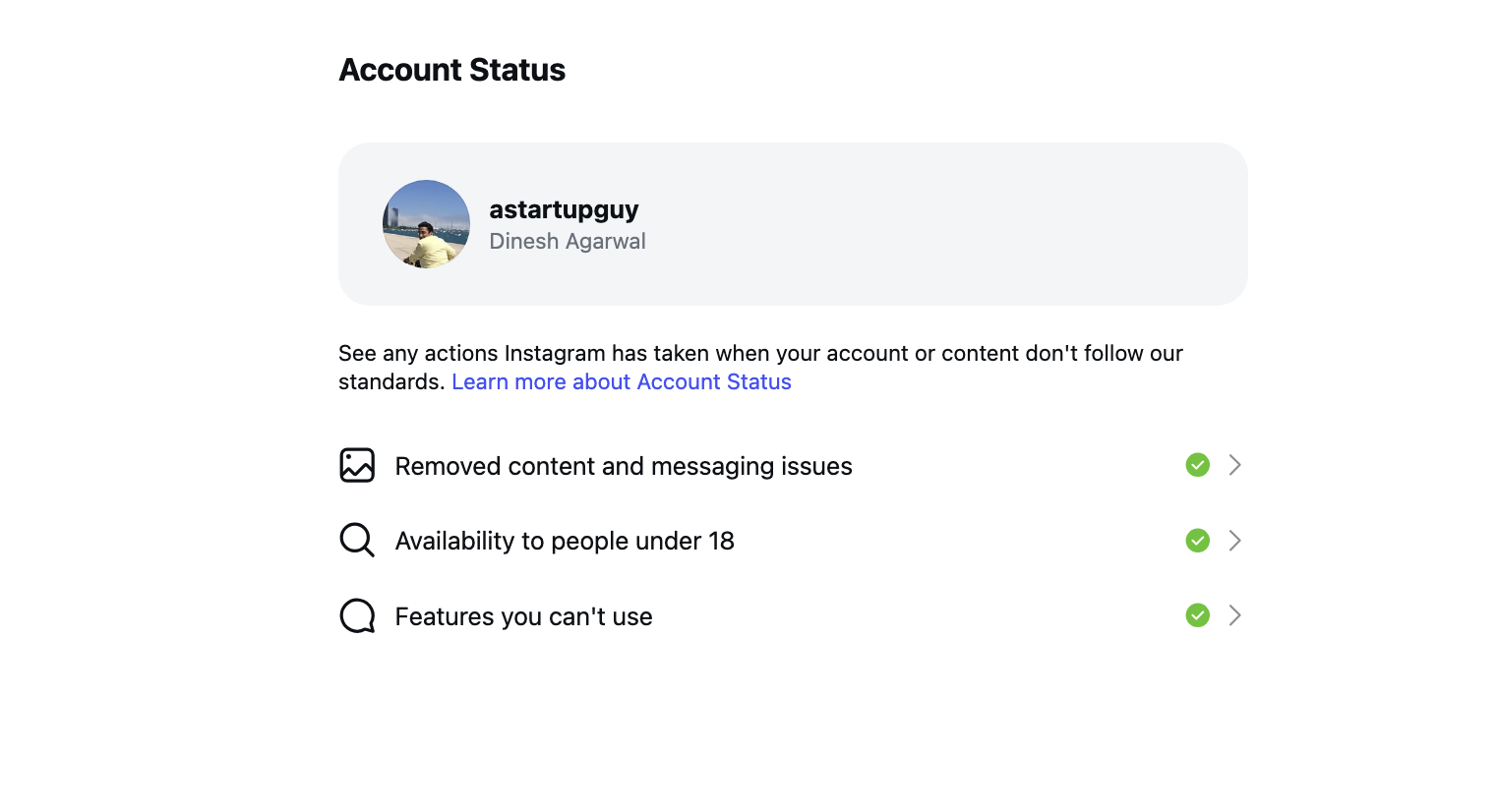
Two things about that screen are worth stating plainly. It is a summary, so an all-clear at this level is not the same as an all-clear everywhere. And the recommendation-eligibility reporting Instagram announced on December 7, 2022 does not appear as its own row at this level. Whether that is because it sits inside one of the three rows, or because it is scoped to professional accounts, is not something this screen answers.
Applies to a practitioner who can open the account and read its status. Does not apply to third-party shadowban checker tools, which this page does not test or endorse.
The beliefs with no published source
Nine beliefs were audited against the primary record. Each one below states the belief the way practitioners state it, then the finding.
Reading order matters here. A finding of “no published source” is a statement about the record, not a statement about Instagram’s behavior. Instagram may do any of these things and simply not document it.
- Editing a caption after posting suppresses reach. No Instagram or Meta document read for this page mentions caption edits in a ranking or reach context, including Instagram’s own reach guidance (Tips for Improving Your Reach, 2023-05-31).
- Deleting a post harms the account. No document read for this page attaches a ranking or reach consequence to deletion. Instagram’s own guidance points the other way in one narrow case: it tells creators to edit or delete content that goes against the guidelines in order to become recommendable again (Tips for Improving Your Reach, 2023-05-31).
- Engagement in the first hour determines total reach. No document read for this page names a first-hour window or any time-boxed engagement threshold.
- A fixed posting cadence is required for reach. No document read for this page states a required or recommended posting frequency as a ranking input.
- Switching to a business or creator account reduces reach. No document read for this page states a reach consequence for account type. The nearest published statement runs the other way: Instagram says it only recommends content from public accounts, and that Creator and Business accounts are public by default (What Creators Need To Know About Instagram Recommendations, 2022-08-30).
- Replying to your own comments changes ranking. No document read for this page names author replies as a ranking input. Meta’s Instagram Feed card lists comment-related predictions from the viewer’s side, not the author’s (Instagram Feed, updated 2026-06-29).
- Hashtag count changes reach. No document read for this page ties a number of hashtags to ranking or reach. What Instagram does state is narrower: keywords and hashtags in the caption help a post be found in Search (Tips for Improving Your Reach, 2023-05-31).
- Sends per reach is the single most important Instagram ranking signal. Meta lists DM sharing among the significant Feed predictions and ranks nothing (Instagram Feed, updated 2026-06-29). The ranked version of the claim is attributed to a Mosseri video statement that no Instagram-owned or Meta-owned page read for this page carries in text.
- Links in captions suppress reach. No document read for this page states that a caption link affects ranking or reach. This one has tested evidence available in principle, and testing is a different exercise from reading the record. This page does not test it.
The search trail behind these findings is in the method note below.
A freelancer who inherited a 40-page best-practices document from a client’s previous agency can run each rule in it through the same two questions: which primary source states this, and on what date. Rules that survive both questions stay. Rules that do not are somebody’s inference wearing a rule’s clothes.
Applies to deciding which received rules to stop enforcing. Does not apply to concluding a belief is false.
What changed in the last 18 months
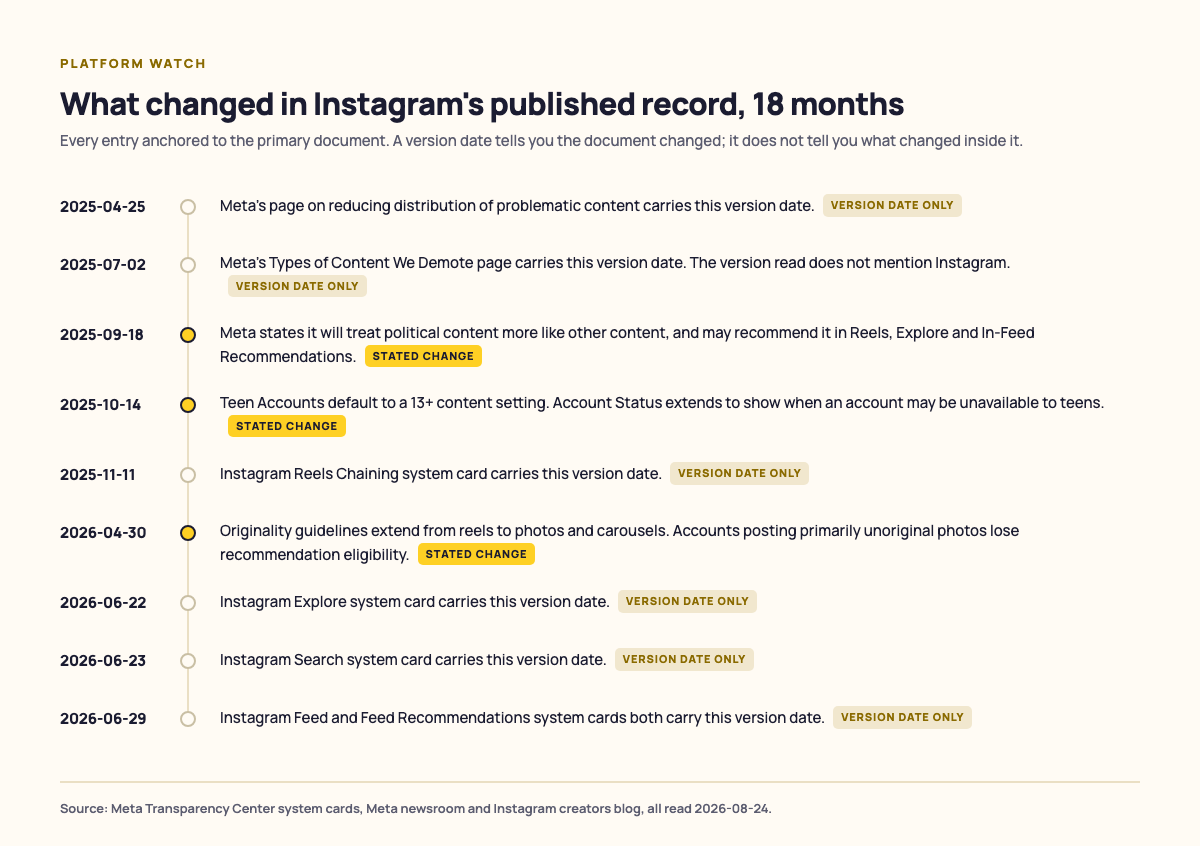
Nine dated entries sit in the window from February 2025 to August 2026. Each one is anchored to the primary document, not to coverage of it.
- 2025-04-25. Meta’s page on reducing the distribution of problematic content carries this version date. It names Facebook and Instagram together and lists clickbait, engagement bait, ad-covered or broken link destinations, repeatedly copied comments, limited-originality content and misinformation (Reducing the distribution of problematic content).
- 2025-07-02. Meta’s Types of Content We Demote page carries this version date. The version read on 2026-08-24 does not mention Instagram (Types of Content We Demote).
- 2025-09-18. Meta states it will treat political content more like other content and may recommend it in Instagram Reels, Explore and In-Feed Recommendations (Our Approach to Political Content). This supersedes the position in Instagram’s 2024-04-30 originality post, which listed political content among the categories that may not be eligible for recommendations. Both dates belong on the record.
- 2025-10-14. Instagram places Teen Accounts into a 13+ content setting by default, and extends Account Status to show when an account may be unavailable to teens under 18 and when its reach is limited (Helping You Understand What’s Going On with Your Account). This adds an age-audience dimension to reach that no earlier Account Status update covered.
- 2025-11-11. Meta’s Instagram Reels Chaining system card carries this version date (Instagram Reels Chaining).
- 2026-04-30. Instagram extends its originality guidelines from reels to photos and carousels. Accounts that primarily post unoriginal photos or carousels are no longer shown where Instagram recommends content, and Instagram states that “75% of recommendations in the US now coming from original posts” (Rewarding original creators on Instagram). This supersedes the reels-only scope set on 2024-04-30, and it replaces that post’s numeric aggregator threshold of 10 or more copied posts in 30 days with a majority-original test over a rolling 30-day period.
- 2026-06-22. Meta’s Instagram Explore system card carries this version date (Instagram Explore).
- 2026-06-23. Meta’s Instagram Search system card carries this version date (Instagram Search).
- 2026-06-29. Meta’s Instagram Feed and Instagram Feed Recommendations system cards both carry this version date (Instagram Feed, Instagram Feed Recommendations).
Entries 1, 2, 5, 7, 8 and 9 are version dates. A version date tells you the document changed. It does not tell you what changed inside it.
Applies to updating an existing playbook. Does not apply to anticipating the next change, which this page does not speculate about.
What the documented signals do and do not mean for posting
Five things the published record supports, each traced to a stated signal or rule.
- Read Account Status before diagnosing anything else. Instagram built it to report content-level and account-level recommendation eligibility, feature restrictions, and teen-audience availability, with an appeal path (Helping You Understand What’s Going On with Your Account, updates through 2025-10-14).
- Check content and profile against the three Recommendations Guidelines categories and the six account conditions. Both lists are published and both are specific (Instagram Recommendations Guidelines, read 2026-08-24).
- Treat follower reach and non-follower reach as two different systems. Meta documents them on two separate cards with two separate prediction sets (Instagram Feed and Instagram Feed Recommendations, both updated 2026-06-29).
- Put keywords and hashtags in the caption if Search discovery is the goal. Instagram states this, and states that the caption is the place for them (Tips for Improving Your Reach, 2023-05-31).
- Add material edits when third-party content is involved. When sourcing visual assets for new content, an AI-powered image search can also help creative teams find relevant visuals more efficiently before adapting them into original posts. Instagram publishes what counts as a material edit and what does not, and ties the distinction directly to recommendation eligibility (Original Content Guidelines, read 2026-08-24; Rewarding original creators on Instagram, 2026-04-30).
Four things the record does not support, stated plainly because the omission is the finding.
- It cannot explain one post’s performance. Every document in the source ledger describes categories, criteria and prediction types. None describes an individual post’s outcome.
- It cannot be turned into a reach promise. No Instagram or Meta document read for this page attaches a reach figure to any behavior.
- It cannot produce a ranked list of signal importance for 2026. The only ranked ordering in the record is Mosseri’s from 2023-05-31, and Meta’s current system cards present predictions and signals as unordered lists.
- It cannot replace testing on your own account. The record describes systems in general terms. Your account’s behavior is a measurement question, and measurement happens on the account.
Recency appears in the current record once, and narrowly: Meta lists “How recently the post was created (within 90 days)” as an input signal to a single Feed prediction about DM sharing (Instagram Feed, updated 2026-06-29). That is a documented signal. It is not a schedule, and nothing in the sources read for this page supports turning it into one. The separate question of when to post is a measurement question rather than a documentation question, and it is not this page’s subject; RecurPost keeps a best times to post on Instagram page for that.
Applies to teams who can act on documented criteria. Does not apply to teams looking for a reach formula.
Method: which sources were read and when
Every source in this page was fetched on 2026-08-24. Five lanes were read: Instagram’s own blog posts on about.instagram.com, Instagram’s creator documentation on creators.instagram.com, Meta’s Transparency Center system cards and ranking guidance on transparency.meta.com, the Recommendations Guidelines on the Instagram Help Center, and Meta’s explaining-ranking index, which was used to find the surface cards rather than cited for a claim.
A “no source found” verdict required two steps. First, a read of the Instagram-owned and Meta-owned pages that would carry the claim if it were documented: Instagram Ranking Explained, Tips for Improving Your Reach, the two recommendations and originality posts, the Original Content Guidelines, the Recommendations Guidelines, and the five Instagram system cards. Second, a web search scoped to Instagram-owned and Meta-owned domains for the claim’s own wording. Four searches were run in this session, covering caption editing and post deletion, posting frequency and first-hour engagement, account-type switching, and hashtags, comment replies and caption links. Each search returned secondary coverage and no primary Instagram or Meta page stating the claim.
Two limits are worth naming. Four of the nine Instagram system cards were not read, so nothing here covers Stories, Comments, Notifications or Suggested Accounts. And statements Adam Mosseri makes in Instagram videos or Threads posts could not be captured as dated, quotable documents, which is why the sends-per-reach claim sits in the evidence gaps rather than in the table as stated.
To check your own account, open Settings, then Account, then Account Status, and read what each row reports rather than what a diagnosis says it should report.
Where the record is still silent
Instagram publishes no per-post explanation of reach, no ranked list of current signal weights, and no version history that shows what changed inside each system card. Meta publishes the surfaces and the categories. The gap between those two facts is where most Instagram ranking advice lives, and it is why a sourced record dates faster than it feels like it should.
This page carries a six-month review date because the documents behind it carry version dates that move. The next update replaces version dates with diffs where snapshots allow it, and moves any belief that acquires a primary source out of the unsourced list and into the table.
More dated, sourced platform reading sits in Platform Watch.
Questions practitioners ask about Instagram ranking
Does Instagram shadowban accounts?
“Shadowban” is a practitioner term, not Instagram’s. Adam Mosseri addressed it on May 31, 2023 and said there is no single shared definition of the word (Instagram Ranking Explained). Instagram does document a state in which content reaches followers and stops reaching non-followers, and it calls that recommendation ineligibility (Instagram Recommendations Guidelines, read 2026-08-24). No source read for this page describes a separate, unreported, account-wide reach suppression.
Does Instagram reduce the reach of posts with links?
No Instagram or Meta document read for this page states that a link in a caption affects ranking or reach. That is a finding about the published record, not a measurement. Testing whether a link changes reach on a real account is a separate exercise, and this page does not run it.
Do hashtags affect what Instagram ranks?
Instagram states that hashtags in the caption help a post be found in Search, and Meta’s Search card names hashtags as both a result type and a prediction target (Tips for Improving Your Reach, 2023-05-31; Instagram Search, updated 2026-06-23). Nothing in the sources read for this page ties the number of hashtags to ranking or reach on any surface.
Does editing a caption after posting affect reach?
No primary Instagram or Meta source read for this page mentions caption edits in a ranking or reach context. You are working from an undocumented rule if you avoid editing captions for reach reasons. The record is silent, which is different from Instagram confirming that edits are harmless.
Is recency a stated ranking signal on Instagram?
Recency is stated, once and narrowly. Meta lists “How recently the post was created (within 90 days)” as an input signal to one Instagram Feed prediction about DM sharing (Instagram Feed, updated 2026-06-29). Adam Mosseri also listed when a post was shared among Feed signals on May 31, 2023 (Instagram Ranking Explained). Neither source states a schedule.
Does Instagram treat Reels and Feed posts by the same criteria?
Meta documents them separately. The Instagram Feed card covers content from accounts a person follows and lists its own predictions (Instagram Feed, updated 2026-06-29). Instagram Reels Chaining is a separate card with a separate pipeline and separate predictions, including audio reuse and sub-three-second watch likelihood (Instagram Reels Chaining, updated 2025-11-11). Adam Mosseri made the same point in prose on May 31, 2023.
How can I check whether my own account is restricted?
You can open Settings, then Account, then Account Status. Instagram built that screen to report whether your content is eligible for recommendation to non-followers, whether your account is eligible in Search and Suggested Accounts, whether features are restricted, and whether your account is unavailable to teens under 18, with an appeal option on each (Helping You Understand What’s Going On with Your Account, updates through 2025-10-14).
Source ledger
Every URL below was fetched in this session on 2026-08-24. Publication or version dates are the dates shown on the page itself.
| # | URL | Publisher | Date shown on the page |
|---|---|---|---|
| 1 | https://about.instagram.com/blog/announcements/instagram-ranking-explained | Instagram (Adam Mosseri) | 2023-05-31 |
| 2 | https://about.instagram.com/blog/announcements/instagram-outages-and-account-status | original 2021-10-11; updates 2022-12-07, 2023-04-25, 2023-06-23, 2025-10-14 | |
| 3 | https://about.instagram.com/blog/announcements | index, no date (used to locate posts) | |
| 4 | https://creators.instagram.com/blog/rewarding-original-creators-on-instagram | Instagram for Creators | 2026-04-30 |
| 5 | https://creators.instagram.com/blog/recommendations-and-originality | Instagram for Creators | 2024-04-30 |
| 6 | https://creators.instagram.com/blog/instagram-recommendations-eligibility-tips-creators | Instagram for Creators | 2022-08-30, updated 2023-04-25 |
| 7 | https://creators.instagram.com/blog/tips-for-improving-your-reach | Instagram for Creators | 2023-05-31 |
| 8 | https://creators.instagram.com/original-content-guidelines | Instagram for Creators | no date shown; read 2026-08-24 |
| 9 | https://creators.instagram.com/blog | Instagram for Creators | index, no date (used to locate posts) |
| 10 | https://creators.instagram.com/lab/bust-algorithm-myths | Instagram for Creators | fetched, no readable text returned (video hub); not cited for any claim |
| 11 | https://creators.instagram.com/grow/algorithms-and-ranking | Instagram for Creators | fetched, no substantive text returned; not cited for any claim |
| 12 | https://help.instagram.com/313829416281232 | Instagram Help Center (Recommendations Guidelines) | no version date shown; read 2026-08-24 |
| 13 | https://transparency.meta.com/features/explaining-ranking/ | Meta Transparency Center | index, no date; read 2026-08-24 |
| 14 | https://transparency.meta.com/features/explaining-ranking/ig-feed/ | Meta Transparency Center | updated 2026-06-29 |
| 15 | https://transparency.meta.com/features/explaining-ranking/ig-feed-recommendations/ | Meta Transparency Center | updated 2026-06-29 |
| 16 | https://transparency.meta.com/features/explaining-ranking/ig-explore/ | Meta Transparency Center | updated 2026-06-22 |
| 17 | https://transparency.meta.com/features/explaining-ranking/ig-search/ | Meta Transparency Center | updated 2026-06-23 |
| 18 | https://transparency.meta.com/features/explaining-ranking/ig-reels-chaining/ | Meta Transparency Center | updated 2025-11-11 |
| 19 | https://transparency.meta.com/features/approach-to-ranking/types-of-content-we-demote/ | Meta Transparency Center | updated 2025-07-02 |
| 20 | https://transparency.meta.com/enforcement/taking-action/lowering-distribution-of-problematic-content/ | Meta Transparency Center | updated 2025-04-25 |
| 21 | https://transparency.meta.com/features/approach-to-political-content/ | Meta Transparency Center | updated 2025-09-18 |
| 22 | https://transparency.fb.com/features/explaining-ranking/ig-feed-recommendations/ | Meta Transparency Center (legacy host) | updated 2026-06-29; same document as row 15, fetched first on this host |
| 23 | https://www.threads.com/@mosseri | Threads (Adam Mosseri profile) | fetched; no ranking statements retrievable and no dates exposed; not cited for any claim |
Search trail, four web searches run on 2026-08-24, used only to test for the absence of a primary source and not cited for any claim:
- Meta Transparency Center recommendation guidelines and demoted content (located rows 12, 14 to 21).
- Instagram official statements on caption editing and post deletion affecting reach: secondary coverage only.
- Instagram or Meta statements on posting frequency and first-hour engagement: secondary coverage only.
- Instagram official statements on account-type switching, hashtags, comment replies and caption links: secondary coverage only, plus row 7.