Picture a social media manager with two captions that went out on the same account. One shows a higher number in the analytics screen, and a client report is due. The sentence they want to write is “version B won.” The question is whether the evidence behind it can carry that word. This is a described situation, not a case, and it has no figures on purpose.
One boundary first. Meta’s A/B testing tool, in the two pages cited here, is described entirely in terms of ads: ad images, ad text, audience, placement, campaigns, ad sets, Ads Manager and an Experiments tool. Neither page says it can be applied to organic posts, so this post does not say so either. What follows is a reading of two Meta Business Help Center pages, accessed 2026-10-18, set beside what a manual two-caption comparison contains. It is not a test run by this publication.
The moment before you write ‘version B won’
The word “won” is a claim about cause. It says the caption made the difference. A number being higher is an observation. The gap between the two is what a test design exists to close, and Meta’s documentation is unusually plain about what closing it takes. That makes it a useful yardstick for the reader, even though the tool itself is built for paid campaigns.
What Meta says a test is
The About A/B Testing page opens with a definition: “A/B testing lets you compare two versions of an ad strategy by changing variables such as ad images, ad text, audience or placement. We show each version to a segment of your audience and ensure nobody sees both, then determine which version performs best.”
The next instruction is about order. “Before you select a variable to test, choose a hypothesis for your test.” Meta’s own example is that you might hypothesize a custom audience strategy will outperform an interest-based audience strategy. The page also names the measurement basis: the tool measures each strategy on a cost per result basis or a cost per conversion lift basis.
Look at what that definition assumes. A stated hypothesis, one changed variable and segments that never see both versions are all set before any result exists. The test is a plan first and a number second. A manual comparison usually runs in the opposite order.
Four things the documentation asks for, and the two posts you have
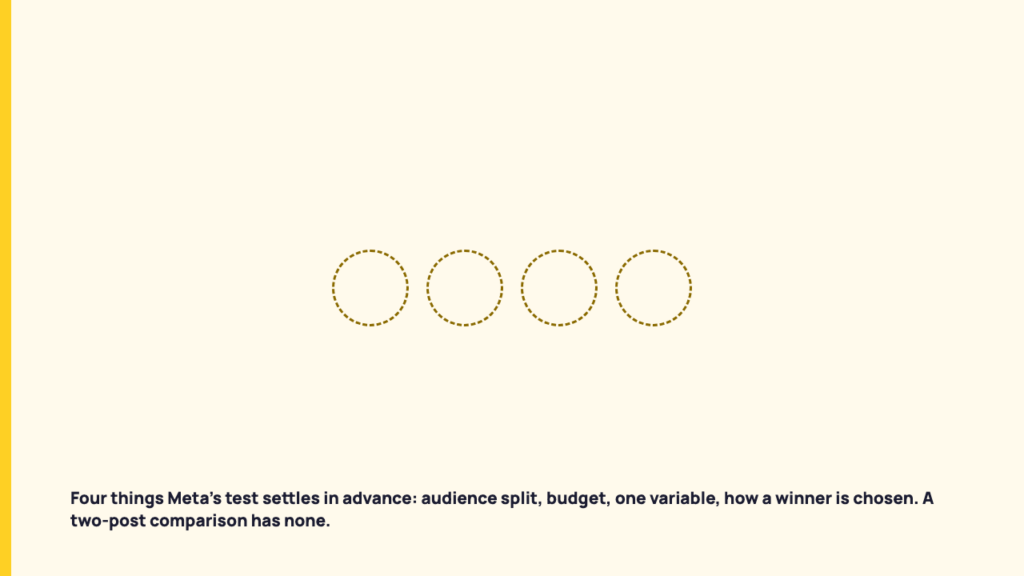
The table sets documented requirements from the two Meta pages against what a two-post comparison typically contains. It compares requirements, not results of any test. The right-hand column describes how a manual comparison works in general. It is not a measurement of any particular account.
| Requirement | What Meta’s pages say | Two posts |
|---|---|---|
| Audience | Each version is shown to a segment of the audience and nobody sees both. Audiences are described as evenly split and statistically comparable. | Both posts go to one overlapping following, at different moments, to whoever the feed surfaced them to. Nothing splits that audience. |
| Budget | Meta recommends the same budget for both versions “to ensure a fair comparison.” | An organic post has no equivalent control. The contrast is stated here without guessing at a mechanism. |
| Hypothesis and one variable | Choose a hypothesis, then a variable to test. | Two captions can differ in length, hook, attached image and more. More than the caption differs, so the cause is open. |
| How a winner is decided | On the Experiments page, the user chooses how to determine a winner as a setup step, before the test is submitted. | The metric is often picked after the numbers are visible, which lets the result choose the yardstick. |
None of the four rows is exotic. Each is a decision made in advance, and each is absent when someone looks back at two posts and asks which did better.
Informal testing, in Meta’s own warning
The page is blunt about the alternative to a structured test. In its section on when to use one, Meta writes: “We do not recommend testing informally, such as by turning ad sets or campaigns on and off manually. This can lead to inefficient ad delivery and unreliable test results.”
It then draws the contrast directly: “A/B testing helps ensure your audiences will be evenly split and statistically comparable, while informal testing can lead to overlapping audiences.”
Meta is speaking about ads there, and the warning should not be read as a ruling on organic posts. What it offers is the platform’s own account of why an informal comparison is weaker than a designed one: overlapping audiences and unreliable results. A manager comparing two posts is doing something informal in exactly that sense, and can reasonably borrow the caution without borrowing the tool.
What the pages do not say
It is as useful to know where the documentation stops, so no one fills the gap with a number from memory. On the two pages fetched on 2026-10-18:
- No minimum run length, minimum budget, minimum audience or result count, or confidence percentage is stated. The extracted text was searched for days, week, minimum, confidence, percent, significance and sample before this was written.
- The Experiments page tells the user to schedule the test’s start and end dates to cover the campaign duration, “or enough time to yield reliable results.” It gives no number for that. It also says that when using existing campaigns, you can choose up to 5 to compare.
- How Meta computes a winner is not detailed on these pages, so this post does not describe it.
Any threshold you have seen quoted elsewhere is not supported by these two pages.
What you can honestly tell the client
The report wording should claim only what the comparison supports. Here are contrasts between an overclaim and a defensible description, with no figures invented.
- Overclaim: “Caption B won.” Defensible: “Caption B had a higher number on this metric. The two posts were not split across audiences, so this is an observation, not a test result.”
- Overclaim: “Shorter captions perform better for this account.” Defensible: “The shorter caption had the higher number once. The posts also differed in other ways, so we cannot attribute it to length.”
- Overclaim: “The data proves the new hook works.” Defensible: “The new hook is worth trying again, and we will state what we expect before the next pair goes out.”
The last line points at a habit worth borrowing from Meta’s hypothesis step. Before posting a pair next time, write down three things: the hypothesis, the single thing that differs between the two, and the metric you will judge by. That is reporting discipline, and it costs a few lines in a document. It does not turn two posts into a controlled test, but it stops the metric from being chosen after the numbers are in. If you are unsure which number should count as the result, five ways to say engagement rate lays out how many answers that question has.
If the client’s real question is about paid creative, the route is Meta’s own tool, described on the pages cited below.
Where this sits next to other measurement reads
For a different platform and a different question, see how YouTube’s title and thumbnail test picks its winner. For the rest of this strand, there are more measurement reads.
FAQ
Can Meta’s A/B testing tool be used on organic posts?
The pages cited describe testing ad strategies, campaigns, ad sets and ads, and they do not say it applies to organic posts. The documentation does not offer it, and this post will not speculate beyond that.
How long does a Meta A/B test have to run?
The two pages fetched give no number. The Experiments page says to set the schedule to cover the campaign duration, “or enough time to yield reliable results,” and stops there.
Sources
- About A/B Testing, Meta Business Help Center, read 2026-10-18.
- Create an A/B Test in Experiments Tool, Meta Business Help Center, read 2026-10-18.