You run a client’s accounts on a 1099, you work most of the week for that one client, and somewhere between the logins and the approval emails you have started to wonder whether “contractor” is the right word for what you are. The IRS has a published way of looking at that question: the IRS common-law test.
Read this first: what this piece is and is not
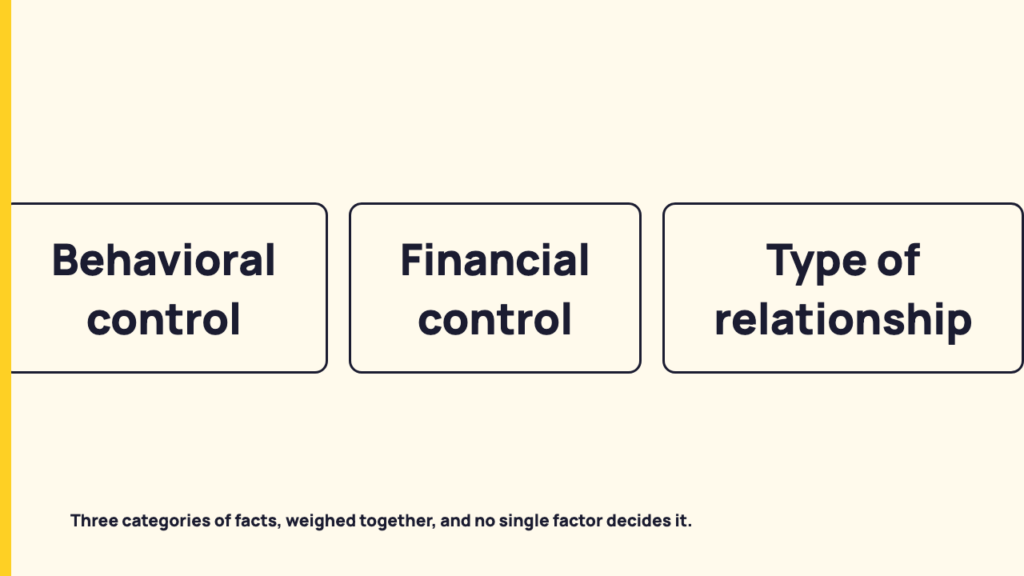
The IRS common-law test asks whether a business controls, or has the right to control, what a worker does and how the worker does the job. The IRS groups the evidence into three categories: behavioral control, financial control and the type of relationship. No single factor decides the result.
This is a reading of published IRS guidance. It is not legal or tax advice, and nothing here concludes anything about your own arrangement. The situations below are generic illustrations written from the worker’s side. They are not real cases, and they are not a survey of job postings or of how social media work is actually structured.
The IRS common-law test is one test, used for federal employment tax purposes. Other tests exist, and state law exists, and they can reach a different result from the IRS test on the same set of facts. This piece names that difference and goes no further into it.
Why this question lands on social media jobs
Picture an arrangement, offered as an illustration and not as data, that is hard to classify by feel. The client grants you access to its accounts. Every caption goes through an approval step before it posts. The client provides the scheduling and analytics tools. You are expected to cover set hours. One client takes most of your working week.
The label on the paperwork does not settle it. On its page about the type of relationship, the IRS says a contract stating a worker’s status “is not sufficient to determine the worker’s status” and that how the parties work together is what determines it. A job title or the word on an invoice is not the test. Official statistics label the role in their own way, set out in how official occupation data classifies the job, and that label does not settle tax status either. The relationship is.
The IRS common-law test in its own words
The IRS pages cited here were fetched on 2026-11-01. The table gives the date each showed as last reviewed.
| Category | The IRS’s question or description | Page and last reviewed |
|---|---|---|
| Behavioral | Does the company control or have the right to control what the worker does and how the worker does the job? | IRS main page, 19-May-2026 |
| Financial | Are the business aspects of the worker’s job controlled by the payer, such as how the worker is paid, whether expenses are reimbursed, and who provides tools and supplies? | IRS main page, 19-May-2026 |
| Type of relationship | Are there written contracts or employee-type benefits? Will the relationship continue, and is the work a key aspect of the business? | IRS main page, 19-May-2026 |
Topic no. 762 (last reviewed 13-Oct-2026) uses the same three groupings but calls the third one “relationship of the parties” instead of “type of relationship.” The behavioral control page (last reviewed 15-Jan-2026), the financial control page (30-Jan-2026) and the type of relationship page (27-Feb-2026) each expand one category.
The main page is direct about how the categories work together: “There is no ‘magic’ or set number of factors that ‘makes’ the worker an employee or an independent contractor and no one factor stands alone in making this determination.” It adds that factors relevant in one situation may not be relevant in another. On behavioral control, the IRS says the business “does not have to actually direct or control the way the work is done” as long as it has the right to.
Behavioral control, held against a social media arrangement
The IRS behavioral control page sorts its factors into four groups: type of instructions given, degree of instruction, evaluation systems, and training. Its examples of instructions include when and where to do the work, what tools or equipment to use, and what order or sequence to follow. Here are three hypothetical situations, with the direction the IRS says that kind of fact generally points. None of them is a result.
- Situation A. A client specifies posting hours and requires an approval step for every caption. Instructions about when to work and detailed instructions are the kind of fact the IRS associates with an employee. The page says more detailed instructions indicate more control.
- Situation B. A client gives only a brief and a monthly goal. The IRS says less detailed instruction reflects less control, which it says points toward an independent contractor. On evaluation, it says a system that measures just the end result “can point to either” side.
- Situation C. A client requires use of its own scheduling and analytics logins. Instructions about what tools or equipment to use appear in the IRS’s list of examples, and the financial side of the same fact comes up in the next section.
Two cautions from the same page. First, absence of instruction does not close the question: “Even if no instructions are given, sufficient behavioral control may exist if the employer has the right to control how the work results are achieved.” Second, the page notes that a business may lack the knowledge to instruct some highly specialised professionals, and that in other cases a task may need little or no instruction. The key consideration, in the IRS’s words, is whether the business has retained the right to control the details of the worker’s performance or has given up that right. On training, the IRS says it indicates the business wants the job done a particular way, while independent contractors ordinarily use their own methods.
Financial control: tools, expenses, and who carries the risk
The financial control page names five groups: significant investment, unreimbursed expenses, opportunity for profit or loss, services available to the market, and method of payment.
On investment, the IRS says there are “no precise dollar limits” that must be met to have a significant investment, and that a significant investment is not necessary for independent contractor status because some types of work simply do not require large expenditures. It also points out that in some occupations workers spend thousands of dollars on tools and are still considered employees.
Ask, without any data about what people spend, who pays for design software, stock footage and paid tools, and whether those costs continue when no client work is happening. A subscription you pay for yourself, such as a tool for social media management for freelancers, belongs on that list of costs. The IRS calls fixed ongoing costs incurred regardless of whether work is being performed “especially important.” Ask whether you are free to take other clients, since the page describes an independent contractor as generally free to seek out business opportunities. And ask how you are paid. The IRS says an employee is generally guaranteed a regular wage for a period of time, and an independent contractor is usually paid a flat fee for the job, but it also says hourly payment is common for contractors in some professions, with law as its example. Payment by project, by retainer or by hour is therefore a fact to record, and none of them settles the matter alone. What employers publish as pay for in-house social roles is a different dataset, read in why postings with more duties pay less.
The relationship: contracts, permanence, and the key-activity question
The IRS states that a contract describing a worker as a contractor is not sufficient, and that the IRS “is not required to follow a contract stating that the worker is an independent contractor.” The same page says that the lack of employee benefits “does not necessarily mean the worker is an independent contractor.”
Two factors remain. Permanency asks whether the relationship was expected to continue indefinitely or was set up for a specific project or period. The IRS says an indefinite expectation is generally considered evidence of an employer-employee relationship. For an open-ended, single-client social media role, that fact could point toward employee, while a role scoped to a defined campaign would read differently.
The key-activity factor asks whether the worker’s services are a key aspect of the business. The IRS says that if so, the business is more likely to have the right to direct and control the work, and its example is a law firm presenting an attorney’s work as its own. How that cuts for a social media role depends on what the client’s business is. The IRS page does not say, and neither does this piece.
What the test does not decide
- The factors are weighed together. The same fact can matter in one situation and not in another, in the IRS’s own wording.
- This is not the only test. The federal overtime tests are a separate question and can give a different answer.
- Form SS-8 is how the IRS lets a business or a worker request a determination. The IRS main page says it “may be filed by either the business or the worker,” that the IRS reviews the facts and circumstances, and that it “may take at least six months to receive a determination.” This is a description of the form, not a suggestion to file it.
- State agencies and other federal tests may differ from the IRS test. This piece names no state and gives no specifics.
A short worksheet for reading your own situation
The IRS’s own advice on this is to “document each of the factors used” in reaching a determination. The table below uses only the IRS sub-categories as prompts.
| IRS category | Facts about my arrangement to write down |
|---|---|
| Behavioral control | Type of instructions (when, where, which tools, what order). Degree of instruction. How my work is evaluated. Any training I receive. |
| Financial control | My investment in tools. Expenses I am not reimbursed for. My opportunity for profit or loss. Whether I make my services available to other clients. How I am paid. |
| Type of relationship | What any written contract or oral agreement says. Whether I receive benefits. Whether the work was expected to be indefinite or time-limited. Whether my work is a key part of the client’s regular business. |
Filling it in produces a record of facts, not a classification.
Where to take a real question
For a conclusion about a real arrangement, the routes are a tax professional or the IRS itself.
FAQ
Does working for only one client make someone an employee?
The IRS lists whether a worker makes services available to the market, and the permanency of the relationship, as factors, but it also says no one factor stands alone, so one client is a fact to record, not a verdict.
What is Form SS-8 and who can file it?
Per the IRS, it is the form used to request a determination of worker status for federal employment tax purposes; either the business or the worker may file it, the IRS reviews the facts and circumstances, and the IRS says a determination may take at least six months.
Is this the IRS 20-factor test?
The current IRS pages read for this piece do not use that name. The IRS main page on contractors, Topic no. 762 and Publication 15-A (2026), re-read on 2026-11-03, group the evidence into three categories, behavioral control, financial control and the type of relationship, and none of them lists twenty factors. The main page says there is no “magic” or set number of factors. This piece does not describe how earlier IRS guidance was organised.
Is a 1099 social media manager an independent contractor?
Not because of the paperwork. The IRS type of relationship page says a contract stating a worker’s status “is not sufficient to determine the worker’s status”, and that the IRS “is not required to follow a contract stating that the worker is an independent contractor.” This piece reads a 1099 arrangement the same way as any other label: as one fact to record, while the relationship itself, read through the three categories above, is what the IRS looks at.
Sources
- IRS, Independent contractor (self-employed) or employee?, last reviewed 19-May-2026, fetched 2026-11-01
- IRS, Topic no. 762, Independent contractor vs. employee, last reviewed 13-Oct-2026, fetched 2026-11-01
- IRS, Behavioral control, last reviewed 15-Jan-2026, fetched 2026-11-01
- IRS, Financial control, last reviewed 30-Jan-2026, fetched 2026-11-01
- IRS, Type of relationship, last reviewed 27-Feb-2026, fetched 2026-11-01
- IRS, About Form SS-8, last reviewed 30-Mar-2026, fetched 2026-11-01
- IRS, Publication 15-A (2026), Employer’s Supplemental Tax Guide, fetched 2026-11-03