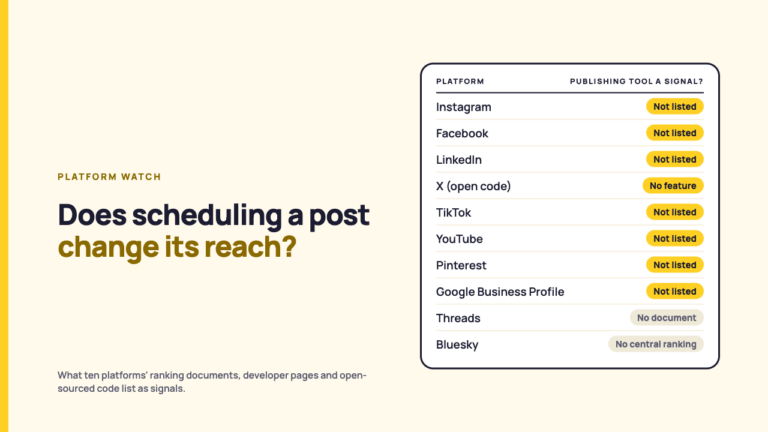
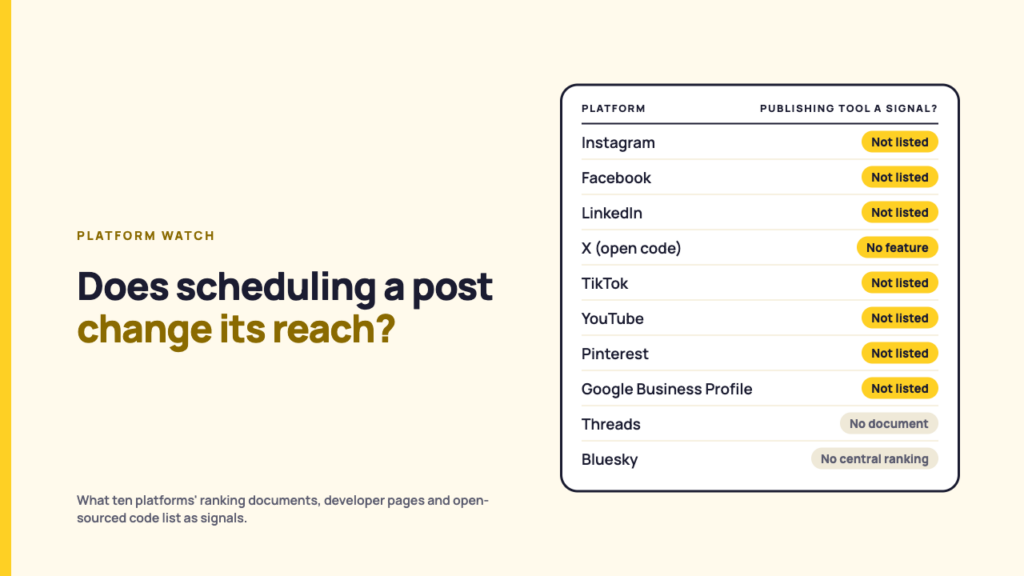
Scheduling a post does not change how any major platform says it ranks that post. None of the ranking documents published by Instagram, Facebook, LinkedIn, TikTok, YouTube, Pinterest or Google Business Profile lists the publishing tool as a signal. X’s open-sourced ranking code contains no ranking feature for the app a post was sent from. Adam Mosseri, the head of Instagram, answered the question himself on March 17, 2026: asked whether scheduling a reel hurts reach, he said “the answer is categorically no” (Mosseri, Instagram reel).
What scheduling can change is the post itself. The route a post takes to the platform decides which features it carries, whether it goes out public, and when it lands. Those differences are documented too. They explain most of the reach drops that get blamed on a scheduler.
This page is a reading of help pages, developer documentation, open-sourced code and on-record statements from ten platforms, all read on 2026-09-30. No test was run for it.
The one platform statement on record
Adam Mosseri’s March 17, 2026 reel is the only first-party statement found that answers the scheduling question directly. The caption reads: “One of the most common questions I get is does scheduling a reel hurt your reach? and the answer is categorically no.” The reel is on Mosseri’s own account and carries its posting date (Mosseri, 2026-03-17).
A different Mosseri line circulates more widely: “if you use something like scheduled posts, it will not affect your reach in one way or another.” That sentence appears on scheduling vendors’ blogs. No Instagram-owned page or dated Mosseri video read for this page carries it. The March 2026 caption says the same thing and can be checked, so it is the one quoted here.
LinkedIn’s position exists only secondhand. Jack Appleby’s Future Social newsletter reported on March 13, 2026 that “LinkedIn confirmed the algorithm doesn’t care what tools you use to schedule your content” (Future Social, 2026-03-13). The newsletter does not attribute that line to a named LinkedIn executive, and no LinkedIn help page or engineering post read for this page says it. It is a report of what LinkedIn said, not LinkedIn’s statement.
No other platform has published a sentence on the question either way. Facebook, TikTok, YouTube, Pinterest, Threads, Bluesky, X and Google Business Profile are silent. For those eight, the evidence is what their ranking documents list, which is the subject of the section after next.
Applies to anyone who needs a quotable source for a client or a manager. Does not apply to platforms other than Instagram, where no equivalent statement exists.
Where the belief started: Facebook in 2011
The belief that scheduling hurts reach has a real origin. In 2011 an analytics vendor measured lower engagement on Facebook Page posts sent through third-party apps, and Facebook reported a fix two months later. Four dated entries make up the record.
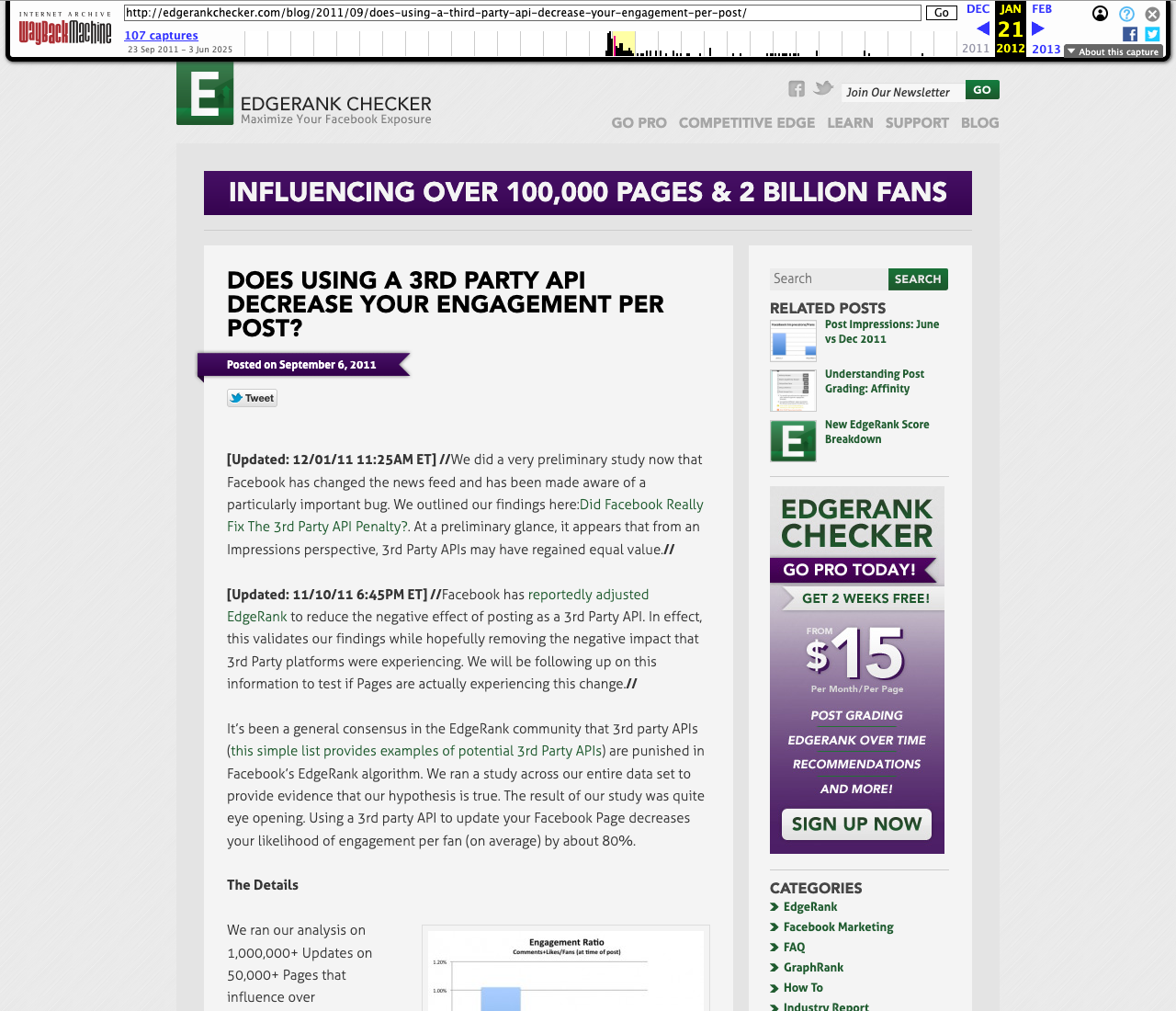
- 2011-09-06. EdgeRank Checker, a Facebook analytics product from Applum, published an analysis of “1,000,000+ Updates on 50,000+ Pages.” It reported that posting through a third-party API “decreases your likelihood of engagement per fan (on average) by about 80%.” The same post conceded that “Any negative impacts of scheduled posts are most likely correlations with poorly developed content” (EdgeRank Checker, archived). Trade press ran the finding as 70 to 80 percent fewer interactions.
- 2011-11-06. Facebook reported a change. Buffer quoted a Facebook developer consultant saying “we recently made a fix that added more signals to detect good quality posting behavior. This should improve the distribution of posts from third-party apps in the News Feed” (Buffer, 2011-11-09). The original Facebook notice was not found, so the quote is attributed here to Buffer’s report.
- 2011-12-01. EdgeRank Checker published a follow-up on more than 4,000 Pages, segmented down to 391. After the fix, third-party posts showed an “average change of -1% and median change of -7%.” The vendor concluded that “the penalty we discovered was both real and now fixed” (EdgeRank Checker, archived).
- 2012-05-31. Facebook added its own scheduling for Page posts, set by clicking a clock icon in the composer (TechCrunch, 2012-05-31).
A 2014 Facebook statement is often cited as a second penalty. It is not about schedulers. Facebook said it would “continue to prioritize explicitly shared stories from apps in News Feed over implicitly shared stories” (Meta Newsroom, 2014-05-27). The announcement covers automatic app activity stories, such as a game posting a score. A Page post sent by a scheduler is an explicit post.
An agency lead who inherited a client’s rule of “always post natively” is usually carrying the September 2011 finding without the December 2011 follow-up. The penalty was measured, and then it was measured again as gone. Both dates belong in the answer.
Applies to explaining where the belief comes from. Does not apply to any platform’s behavior today, which the 2011 studies do not describe.
What each platform’s ranking documentation lists
None of the ranking documents read for this page lists the publishing tool as a signal. The table sets each platform’s document beside what it says about timing, since timing is the part of a scheduled post that the platforms do discuss.
| Platform | Ranking document read | Publishing tool named as a signal? | Timing-related wording in the document |
|---|---|---|---|
| Instagram Feed system card, Meta Transparency Center, updated 2026-06-29 | No | “How recently the post was created (within 90 days),” as an input to one Feed prediction | |
| Facebook Feed system card, updated 2026-06-24 | No | None named on the card | |
| LinkedIn Help on feed ranking and LinkedIn Engineering, 2026-03-12 | No. The help page says the systems “consider hundreds of signals” | “balancing freshness with relevance” and “recency signals” | |
| X | Open-sourced code: twitter/the-algorithm (2023) and xai-org/x-algorithm (README updated 2026-09-18) | No ranking feature uses the author’s posting app. The app is stored and searchable, and a client app ID appears only in abuse-detection code | The home feed filters out “Posts older than 48 hours” |
| TikTok | How TikTok recommends videos #ForYou, 2020-06-18 | No. Device and account settings “receive lower weight” than interactions and video information | Videos “that have just been uploaded or are under review” may be “ineligible for recommendation” |
| YouTube | YouTube Help 141805 | No | “Publish time is not known to impact a video’s long-term performance,” except for Live and Premiere |
| Pin performance and distribution | No | “There’s no set engagement window for Pins” | |
| Google Business Profile | Google Business Profile Help 7091 | No. Local results are “mainly based on relevance, distance, and popularity” | None |
| Threads | No separate ranking document found | Not published | Not published |
| Bluesky | No central ranking. Feeds are built by third parties | Not applicable | A documented sort rule on post timestamps, covered below |
An absence in a document is a finding about the document, not proof of how production systems behave. X is the only platform whose ranking code can be read line by line. The code read for this page stores the posting client on each post and indexes it for search, and no ranking feature uses it. The one place a client app ID appears is in bot and abuse detection. X’s open-sourced ranking code has its own page on this blog.
The Instagram and LinkedIn rows have longer readings too: what Instagram has published about ranking and how LinkedIn’s engineers describe the feed.
Applies to checking a claimed scheduling penalty against the platform’s own document. Does not apply to proving that no penalty exists anywhere, which no document can do.
What a scheduled post can actually lose
Scheduling does not change how a post is ranked. The route a post takes can change what gets published, and the platforms document four kinds of difference.
Features the publishing APIs do not carry
Third-party schedulers publish through each platform’s developer API, and each API supports less than the app. Four platforms document the gaps in their developer pages:
- Instagram. For Stories, “Publishing stickers (i.e., link, poll, location) is not supported.” Reels can carry music and original sounds through Meta’s (Instagram Audio API), but the API “returns audio that has been authorized for third party use,” and “the available selection may vary from what appears in the native app.” It works only on connections made through Facebook Login, and a Reel can’t be previewed with its audio attached. The publishing guide adds that “Filters are not supported,” that JPEG is the only image format, and that accounts are “limited to 100 API-published posts within a 24-hour moving period” (Contentpublishing).
- LinkedIn. The Posts API states that “Organic carousel is currently not supported.” It also “does not support URL scraping for article post creation,” so the tool has to supply the link preview’s thumbnail, title and description itself (Posts API).
- TikTok. The Content Sharing Guidelines require the person posting to pick a privacy setting with “no default value,” set comments, Duet and Stitch off by default, and confirm music usage. Direct Post is capped at “typically around 15 posts per day” per creator account across all API clients (Content Sharing Guidelines).
- Google Business Profile. “Product Posts cannot be created using the Google My Business API at this time” (Google My Business API, posts).
Instagram’s own pages disagree on two points. The publishing guide says “Shopping tags are not supported,” while the media reference lists product_tags field. The media reference also still says, “Music tagging is only available for original audio,” while the Audio API page, updated 2026-06-16, documents attaching licensed music to Reels. The Audio API page is the more specific and more recent of the two, so this page follows it. All three were read between 2026-09-30 and 2026-10-01.
A Story that loses its poll sticker, or a Reel whose planned track isn’t in the API’s licensed catalog, is a different post from the one planned.
If it reaches fewer people, the format change is a documented cause and the scheduler is not. API documentation also changes without much notice, which is why reading a platform’s developer changelog pays off.
API uploads that go out private
Three platforms publish API uploads as private until the app sending them has been reviewed:
- TikTok. “All content posted by unaudited clients will be restricted to private viewing mode” (Content Posting API, last updated 2026-08-04).
- YouTube. “All videos uploaded via the videos.insert endpoint from unverified API projects created after 28 July 2020 will be restricted to private viewing mode” (YouTube Data API, last updated 2026-09-14).
- Pinterest. “All Pins and Boards created with Trial access are only visible to their creator as Sandbox entities” (Pinterest access tiers).
This is the one documented case in which a scheduled post truly reaches nobody. It is a visibility setting, not a ranking penalty, and it applies to unaudited or trial apps rather than to reviewed ones. A TikTok with zero views after a scheduled upload should be checked for its privacy status before anything else.
Native schedulers have limits too
Scheduling inside the platform’s own app does not remove the gaps. The native schedulers carry their own windows and exclusions:
| Platform | Native scheduler rule, as documented | Source |
|---|---|---|
| Up to 25 posts a day, up to 30 days ahead. “Features such as product tagging, collaborative posts, sponsored posts and fundraisers aren’t compatible with scheduled content at this time.” | Instagram Help | |
| Posts can be scheduled “between 20 minutes and 29 days away” in Meta Business Suite. | Facebook Help | |
| “within 10 minutes to 3 months” ahead. Scheduling “is not supported” for Events, Jobs and Services posts. | LinkedIn Help | |
| YouTube | Schedules “a private video to go public at a specific time.” Scheduled videos do not publish while a Community Guidelines strike penalty is active. | YouTube Help |
| One help page says “up to 30 days in advance” with up to 10 scheduled Pins. Another says “up to two weeks in advance.” | Schedule Pins; Pin performance | |
| Google Business Profile | Posts can be scheduled and set to repeat from a “Repeats” menu. | Google Business Profile Help |
| X | A post scheduled in the business tools “won’t be discoverable on X until the date and time you scheduled.” | X Help |
| Bluesky | No native scheduler. Bluesky announced a partnership with Buffer for scheduling on 2024-07-30. | Bluesky blog |
Instagram’s own scheduler drops collaborative posts and product tags. Those are the same kind of gap people blame third-party tools for. The native-versus-third-party question matters less than whether the route chosen carries the format the post needs.
Timestamps
Bluesky documents a timestamp rule that a scheduler can trip. Each post’s createdAt value is set by the app that sends it. Bluesky’s guidance for sorting is “Use the createdAt timestamp unless it is in the future. If it’s in the future, use the indexedAt timestamp” (Bluesky timestamps). The reasoning from that rule, not an observation: a tool that stamps the time a post was queued, rather than the time it was sent, would make the post sort as older than it is.
Applies to diagnosing a scheduled post that went out different from the plan. Does not apply to a post that published exactly as intended, where these four differences are ruled out.
The tests people cite, and how much they can carry
No large controlled comparison of scheduled and native posts has been published. The tests cited on both sides are small or observational:
| Test | Sample | Result | What limits it |
|---|---|---|---|
| EdgeRank Checker, 2011-09-06 | 1,000,000+ updates on 50,000+ Pages | About 80% lower engagement per fan through third-party APIs | Observational, with no control for content. The vendor itself pointed to content quality. Reported fixed two months later |
| EdgeRank Checker, 2011-12-01 | 391 Pages, from 4,000+ | -1% average and -7% median after the fix | Described by the vendor as preliminary |
| Buffer, 2015-11-23 | One Facebook account, two weeks | Average reach 1,357 native and 1,595 through Buffer | The authors call it anecdotal |
| Hootsuite, 2025-04-30 | One Instagram account. Five feed posts and five Stories per method, native week first and scheduled week second | Engagement rate 6.44% native and 8.19% scheduled. Reach 7,189 and 10,122 | Two different weeks, so week-to-week variation is not separated from the method. The authors flag the small sample |
| Metricool and Resuelta Estudio, 2026 | 202 TikToks posted through Metricool | 43% passed 50,000 views | No native comparison group |
| John Shehata, LinkedIn post | Not stated | “Scheduled posts \= lower reach + weaker engagement” | No data given. A reply on the post from a LinkedIn staff member says scheduling does not affect engagement and that timing does |
The tests that favor scheduling are about as thin as the claims against it. Every one compares a handful of posts or skips the comparison entirely. The platform documentation is stronger evidence than any of them, which is why this page rests on it.
The same limit applies to a single account. One scheduled post that underperformed is not a test. Comparing posts inside one account across dozens of posts is the minimum that separates a pattern from a bad week.
Applies to weighing a statistic someone sends you. Does not apply to settling the question for your own account, which none of these samples can do.
What changes when nobody is there at publish time
Timing is a documented input on some platforms, and scheduling affects it in one way only: through the time chosen. Five platforms say something about it.
- Instagram lists how recently a post was created as an input to one Feed prediction (Instagram Feed, updated 2026-06-29).
- LinkedIn engineers describe the feed as “balancing freshness with relevance” (LinkedIn Engineering, 2026-03-12).
- YouTube says “Publish time is not known to impact a video’s long-term performance,” and names Live and Premiere as the exceptions (YouTube Help). Its “When your viewers are on YouTube” report exists to help “understand when to schedule a Premiere, or to plan your next live stream” (YouTube Help).
- Pinterest says “There’s no set engagement window for Pins,” and that a Pin can gain traction “hours, days, months, or even years after it’s first published” (Pinterest Help).
- Meta Business Suite offers “Active times to see recommended publication times” inside its scheduler (Facebook Help).
A scheduled post sent at a good time and the same post sent at a bad time are two different experiments. The scheduler is the same in both. Only the time moved.
Take an agency manager who queues a client’s week on Friday afternoon. The posts go out at 7am while nobody reads comments until 10am. Any gap in early replies is a staffing decision, and it would be the same if someone pressed publish by hand at 7am and walked away. Brand accounts publish outside office hours more often than the job descriptions admit, as how many brand posts go out outside office hours shows.
No platform document read for this page names a first-hour window, a minutes-before-your-audience rule, or a share of impressions earned in the first 48 hours. Those figures circulate widely and have no published source.
Applies to choosing when to schedule and who covers replies. Does not apply to finding the best hour for a given account, which is a measurement question on that account.
Checking a scheduled post that underperformed
Six questions rule out the documented causes before the scheduler gets the blame. They run in order, from the causes that stop a post reaching anyone to the ones that only change how many it reaches.
- Is the post public? TikTok, YouTube and Pinterest keep uploads from unaudited or trial apps private. Check the privacy status on the platform itself.
- Did it publish in the planned format? Check for dropped Story stickers, Reel audio that wasn’t in the API’s licensed catalog or was sent over an Instagram Login connection, product tags, collaborators or a LinkedIn carousel that arrived as something else.
- Did the link preview render? LinkedIn’s API does not scrape links, so a missing thumbnail or title means the tool sent an empty preview.
- What local time did it go out? Compare it with the audience-activity report the platform provides, such as Meta’s active times or YouTube’s viewer report.
- Was anyone replying in the first hours? Check the timestamps of the first replies against the publish time.
- Is it low against the account’s own median? Compare the post with the account’s median across 20 or more recent posts, not with the post before it. Platforms also count reach differently across their own screens, which why platform numbers disagree with themselves covers.
If all six check out, the drop sits with the content or with that day’s audience. Switching to manual posting will not change it. That sentence is the answer to send a client who asks whether the scheduler is to blame.
Applies to one post or one week that underperformed. Does not apply to a long decline across months, which needs the account-level reading this checklist does not cover.
Method: which sources were read and when
Every source in this page was read on 2026-09-30, except the Instagram Audio API page, read on 2026-10-01. Five kinds of source were used:
- Platform help centers for Instagram, Facebook, LinkedIn, X, YouTube, Pinterest and Google Business Profile.
- Developer documentation for the Instagram Graph API, Facebook Pages API, LinkedIn Posts API, X API, TikTok Content Posting API, YouTube Data API, Pinterest API, Threads API and Google My Business API.
- Ranking explanations published by Meta, LinkedIn Engineering and TikTok’s newsroom.
- X’s open-sourced ranking code, searched for any feature that reads the posting client.
- The 2011 EdgeRank Checker posts, read through web.archive.org because the original site is gone.
TikTok’s developer and newsroom pages refused direct connections in this session and were read through web.archive.org snapshots. The Instagram help center renders empty to scripts, so its scheduling page was read on the facebook.com help host. Vendor tests are cited for what they report, and their limits are stated from their own pages.
Where the record is still silent
Seven things could not be confirmed from a primary source:
- A dated primary source for the Mosseri line “it will not affect your reach in one way or another.”
- A statement on the record from a named LinkedIn executive about scheduling tools.
- The original Facebook notice of the November 2011 fix.
- TikTok Studio’s scheduling window, because the help page could not be retrieved.
- Threads’ native scheduling window, which appears only in press coverage.
- A first-party X help page for scheduling from the regular web composer.
- The age at which Bluesky’s app marks a post as backdated.
None of these gaps changes the answer. Each one is a place where the record could be firmer. The next update of this page moves any item that gains a primary source into the body.
More dated, sourced platform reading sits in Platform Watch.
Questions practitioners ask about scheduling and reach
Does Instagram penalize scheduled posts?
No, according to Adam Mosseri, who said on March 17, 2026 that the answer to whether scheduling hurts reach is “categorically no.” Instagram’s own scheduler does have limits: it cannot schedule collaborative posts or posts with product tags (Instagram Help).
Is a native scheduler better for reach than a third-party tool?
No platform documents a ranking difference between the two. Both routes have documented feature gaps. Instagram’s scheduler excludes collaborative posts, and Instagram’s API excludes Story stickers. The better route for a given post is the one that carries its format.
Do scheduled TikToks or YouTube videos get fewer views?
Scheduled TikToks and YouTube videos get zero public views only when an unaudited or unverified app uploads them, because both platforms make those uploads private. YouTube also states that publish time “is not known to impact a video’s long-term performance” outside Live and Premiere.
Why do people believe scheduling hurts reach?
People believe it because it was measured on Facebook in September 2011. EdgeRank Checker reported about 80% lower engagement per fan for third-party posts. Facebook reported a fix in November 2011, and the same vendor measured the gap at -1% on average that December.
Source ledger
Every URL below was read on 2026-09-30. Dates are the dates shown on the page itself.